

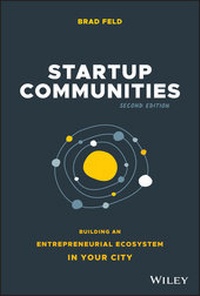
Startup Communities
Building an Entrepreneurial Ecosystem in Your City
2nd Edition
Published on 25. June 2020
256 pages
978-1-119-61782-2 (ISBN)
Description

First published in 2012, Startup Communities became a blueprint for what it takes to build a supportive entrepreneurial community. Now regarded as a classic, the "Boulder Thesis" created and popularized by Feld within the book generated enormous media attention nearly a decade ago.
At that time, Boulder was an emerging startup laboratory--a hub of innovation building new tech businesses. It quickly accelerated into a world class ecosystem for entrepreneurs. Boulder's entrepreneurial density, combined with the geographic concentration of entrepreneurial activity around the Boulder downtown core, made it a hotbed of startup activity. Feld was and is still there, as a keen observer and one of its leaders. As he notes simply in the new edition, humans are wired to start things.
In a sense, that short Feld-ism accurately describes the startup revolution still taking hold throughout the world. Boulder is proof that innovation can happen anywhere, in any city. Thanks in part to the book, what happens in Boulder now leaves Boulder. Rapidly growing startup communities in Atlanta, Detroit, Denver, Kansas City, Nashville, and Indianapolis are just a few examples. Over the last decade, Feld has dispelled the myth that startups can only thrive in Silicon Valley.
Startup communities continue to pop up across the U.S. and around the world, prompting fresh new revelations and stories from Feld about what's happened over the last decade. Startup Communities 2e describes what makes a startup community ecosystem first click, then hum, and in time, excel. From Boulder to Beijing and beyond, entrepreneurial ecosystems are driving innovation. Startup Communities 2e discusses and the necessary dynamics and pre-conditions of building communities of entrepreneurs who can feed off each other's talent, creativity, and support.
In Startup Communities 2e, Feld will help you understand:
* The core principles of a vibrant startup community, re-examining his Boulder Thesis and exploring other historical frameworks.
* The attributes of leadership in a startup community that can help it thrive along with the classical problems any community will face during development.
* The importance of a university in a startup community, and how large companies can engage effectively with entrepreneurs.
* The importance of continuous improvement so growth does not stagnate.
* The common myths about startup communities.
* The opportunities to build startup communities in non-urban, or rural, places that are much less populated.
At that time, Boulder was an emerging startup laboratory--a hub of innovation building new tech businesses. It quickly accelerated into a world class ecosystem for entrepreneurs. Boulder's entrepreneurial density, combined with the geographic concentration of entrepreneurial activity around the Boulder downtown core, made it a hotbed of startup activity. Feld was and is still there, as a keen observer and one of its leaders. As he notes simply in the new edition, humans are wired to start things.
In a sense, that short Feld-ism accurately describes the startup revolution still taking hold throughout the world. Boulder is proof that innovation can happen anywhere, in any city. Thanks in part to the book, what happens in Boulder now leaves Boulder. Rapidly growing startup communities in Atlanta, Detroit, Denver, Kansas City, Nashville, and Indianapolis are just a few examples. Over the last decade, Feld has dispelled the myth that startups can only thrive in Silicon Valley.
Startup communities continue to pop up across the U.S. and around the world, prompting fresh new revelations and stories from Feld about what's happened over the last decade. Startup Communities 2e describes what makes a startup community ecosystem first click, then hum, and in time, excel. From Boulder to Beijing and beyond, entrepreneurial ecosystems are driving innovation. Startup Communities 2e discusses and the necessary dynamics and pre-conditions of building communities of entrepreneurs who can feed off each other's talent, creativity, and support.
In Startup Communities 2e, Feld will help you understand:
* The core principles of a vibrant startup community, re-examining his Boulder Thesis and exploring other historical frameworks.
* The attributes of leadership in a startup community that can help it thrive along with the classical problems any community will face during development.
* The importance of a university in a startup community, and how large companies can engage effectively with entrepreneurs.
* The importance of continuous improvement so growth does not stagnate.
* The common myths about startup communities.
* The opportunities to build startup communities in non-urban, or rural, places that are much less populated.
More details
Other editions
Additional editions
Brad Feld
Startup Communities: Building an Entrepreneurial Ecosystem in Your City
Building an Entrepreneurial Ecosystem in Your City
Book
07/2020
2nd Edition
Wiley
€27.50
Shipment within 15-20 days
Person
BRAD FELD has been an early-stage investor and entrepreneur for over 30 years. He is currently a partner at Foundry Group and is a co-founder of Techstars. In addition to his investing efforts, Brad runs the Anchor Point Foundation with his wife Amy Batchelor. Brad is a nationally recognized speaker on the topics of venture capital investing and entrepreneurship.
Content
Foreword
Introduction to Second Edition
Preface
Chapter One: Introduction
Chapter Two: The Boulder Startup Community
Chapter Three: Principles of a Vibrant Startup Community
Chapter Four: Participants in a Startup Community
Chapter Five: Attributes of Leadership in a Startup Community
Chapter Six: Classical Problems
Chapter Seven: Activities and Events
Chapter Eight: The Power of Accelerators
Chapter Nine: University Involvement
Chapter Ten: Contrasts between Entrepreneurs and Government
Chapter Eleven: How Large Corporations Can Help
Chapter Twelve: The Power of the Community
Chapter Thirteen: Broadening a Successful Startup Community
Chapter Fourteen: Rural Startup Communities
Chapter Fifteen: Myths about Startup Communities
Chapter Sixteen: Getting Started
About the Author
Acknowledgments
Foreword 1st edition
Introduction to Second Edition
Preface
Chapter One: Introduction
Chapter Two: The Boulder Startup Community
Chapter Three: Principles of a Vibrant Startup Community
Chapter Four: Participants in a Startup Community
Chapter Five: Attributes of Leadership in a Startup Community
Chapter Six: Classical Problems
Chapter Seven: Activities and Events
Chapter Eight: The Power of Accelerators
Chapter Nine: University Involvement
Chapter Ten: Contrasts between Entrepreneurs and Government
Chapter Eleven: How Large Corporations Can Help
Chapter Twelve: The Power of the Community
Chapter Thirteen: Broadening a Successful Startup Community
Chapter Fourteen: Rural Startup Communities
Chapter Fifteen: Myths about Startup Communities
Chapter Sixteen: Getting Started
About the Author
Acknowledgments
Foreword 1st edition
