

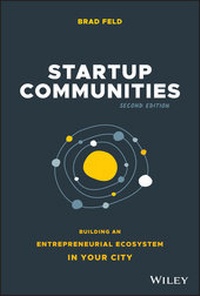
Startup Communities
Description

At that time, Boulder was an emerging startup laboratory--a hub of innovation building new tech businesses. It quickly accelerated into a world class ecosystem for entrepreneurs. Boulder's entrepreneurial density, combined with the geographic concentration of entrepreneurial activity around the Boulder downtown core, made it a hotbed of startup activity. Feld was and is still there, as a keen observer and one of its leaders. As he notes simply in the new edition, humans are wired to start things.
In a sense, that short Feld-ism accurately describes the startup revolution still taking hold throughout the world. Boulder is proof that innovation can happen anywhere, in any city. Thanks in part to the book, what happens in Boulder now leaves Boulder. Rapidly growing startup communities in Atlanta, Detroit, Denver, Kansas City, Nashville, and Indianapolis are just a few examples. Over the last decade, Feld has dispelled the myth that startups can only thrive in Silicon Valley.
Startup communities continue to pop up across the U.S. and around the world, prompting fresh new revelations and stories from Feld about what's happened over the last decade. Startup Communities 2e describes what makes a startup community ecosystem first click, then hum, and in time, excel. From Boulder to Beijing and beyond, entrepreneurial ecosystems are driving innovation. Startup Communities 2e discusses and the necessary dynamics and pre-conditions of building communities of entrepreneurs who can feed off each other's talent, creativity, and support.
In Startup Communities 2e, Feld will help you understand:
* The core principles of a vibrant startup community, re-examining his Boulder Thesis and exploring other historical frameworks.
* The attributes of leadership in a startup community that can help it thrive along with the classical problems any community will face during development.
* The importance of a university in a startup community, and how large companies can engage effectively with entrepreneurs.
* The importance of continuous improvement so growth does not stagnate.
* The common myths about startup communities.
* The opportunities to build startup communities in non-urban, or rural, places that are much less populated.
More details
Other editions
Additional editions
Person
Content
Introduction to Second Edition
Preface
Chapter One: Introduction
Chapter Two: The Boulder Startup Community
Chapter Three: Principles of a Vibrant Startup Community
Chapter Four: Participants in a Startup Community
Chapter Five: Attributes of Leadership in a Startup Community
Chapter Six: Classical Problems
Chapter Seven: Activities and Events
Chapter Eight: The Power of Accelerators
Chapter Nine: University Involvement
Chapter Ten: Contrasts between Entrepreneurs and Government
Chapter Eleven: How Large Corporations Can Help
Chapter Twelve: The Power of the Community
Chapter Thirteen: Broadening a Successful Startup Community
Chapter Fourteen: Rural Startup Communities
Chapter Fifteen: Myths about Startup Communities
Chapter Sixteen: Getting Started
About the Author
Acknowledgments
Foreword 1st edition
CHAPTER TWO
THE BOULDER STARTUP COMMUNITY
In November 1995, I left Boston and moved to Boulder. I'd gone to college at MIT and had lived in Boston for 12 years. However, Boston wasn't my home; I'd grown up in Dallas, and my wife, Amy Batchelor, had grown up in Alaska. When I sold my first company at age 28, I promised Amy that we'd leave Boston by the time I was 30. Two months before I turned 30, Amy told me she was moving to Boulder, and I was welcome to join her if I wanted to.
We'd both been to Boulder and loved Colorado. Neither of us wanted to live in the Bay Area, which was a logical choice given the work I do, but we wanted either ocean or mountains wherever we lived. Because we were both attracted to the western United States and the Rocky Mountains, we figured we'd give Boulder a try, and if it didn't work out, we'd just keep heading west.
After six months, we loved Boulder and never looked back. When we moved here, we knew only one person, and he and his wife moved away a few months later. However, within a year we had already found a community of friends and entrepreneurs and were quickly learning our way around town. Twenty-four years later, I can't imagine a better place to live.
BOULDER AS A LABORATORY
Boulder is a small city. In 2012, there were less than 100,000 actual residents, and by 2020, this number had only grown to 107,000. The extended metro area, which includes the neighboring towns of Superior, Broomfield, Lafayette, Longmont, and Lyons, was only 250,000 people in 2012 and is now only slightly over 300,000 people. Boulder is small enough that you can get your mind around the whole place but big enough to be interesting. As a result, I've come to think of Boulder as my laboratory for thinking about startup communities.
Boulder is a smart city. The University of Colorado Boulder is located right in the middle of town, and students, faculty, and staff comprise about 30 percent of the population of Boulder. The presence of several national research labs, including the National Oceanic and Atmospheric Administration (NOAA), the National Center for Atmospheric Research (NCAR), and the National Institute of Standards and Technology (NIST) add nicely to the number of PhDs around. Other alternative educational institutions, such as Naropa, call Boulder home.
Boulder has one of the highest entrepreneurial densities in the world. I define entrepreneurial density as follows:
Boulder's entrepreneurial density, combined with the geographic concentration of entrepreneurial activity around the Boulder downtown core, makes downtown Boulder a hotbed of startup activity.
Finally, Boulder is an incredibly inclusive community. Although there is some competition between companies, especially over talent, the community is defined by a strong sense of collaboration and philosophy of "giving before you get." If you contribute, you are rewarded, often in unexpected ways. At the same time, especially since it's a small community, it's particularly intolerant of bad actors. If you aren't sincere, constructive, and collaborative, the community behaves accordingly.
Before we dig into the principles of a sustainable startup community, let's spend a little time on the history of Boulder, so we can understand how the community evolved.
BEFORE THE INTERNET (1970-1994)
I moved to Boulder in 1995. This, however, was not the beginning of the rise of the startup community in Boulder; the seeds were planted a long time ago, and there was a significant amount of entrepreneurial success in and around Boulder between 1970 and 1994. I've asked Kyle Lefkoff, a Boulder resident and venture capitalist since the mid-1970s, to describe what he saw happen during this time frame.
It was not by accident that a university town nestled at the base of the Flatirons would emerge as the densest cluster of technology startups in the world-it was the result of a generation of entrepreneurs drawn to the region first by business necessity, who stayed by choice. Were it not for the foundational success stories in data storage, pharmaceuticals, and natural-foods brands, Boulder's thriving ecosystem would not exist. But the success of these anchor tenants presaged the growth and success of today's Boulder startup community.
The data-storage landscape was shaped first by IBM's decision to locate its tape-drive division in Boulder in the 1960s, and then, by the success of its first spin-off, StorageTek, in 1975. Led by its visionary founders, Jesse Aweida and Juan Rodriguez, StorageTek was Boulder's first big VC-backed high-tech success story, and it spawned a storage and networking industry that grew to dozens of companies by the early 1990s, including billion-dollar success stories such as McData, Exabyte, and Connor Peripherals.
The pharmaceutical industry had its roots in the science laboratories of the University of Colorado's Boulder campus, where a biotech cluster was born from the labs of Marv Caruthers, who founded Amgen and Applied Biosciences, and Larry Gold, who founded Synergen. Together, these successful companies spawned an industry of home-grown biotech companies to compete with Syntex, which based its manufacturing in Boulder, and Ciba-Geigy, which had acquired Geneva Generics, a local generic pill manufacturer. Based on the work of these entrepreneurs, additional pharma successes in this period included Hauser Chemical Research, Somatagen, and Nexstar Pharmaceuticals.
The natural-foods industry began in Boulder with Celestial Seasonings, an herbal tea brand that sprang to national prominence under the leadership of Mo Siegel and Barney Feinblum, who would each go on to play an important role in nearly every other major brand success in the 1980s and early 1990s with Boulder roots, including Alfalfa's, Wild Oats, Whole Foods, Earth's Best Baby Food, Horizon Organic Dairy, and Silk.
A small but devoted group of venture capitalists stood behind these early entrepreneurs and helped put Boulder on the national map of startups. John Hill, a former StorageTek investor, and Carl Carman, a longtime IBM executive, teamed up in the 1980s to form Hill Carman ventures, which backed many of the technology successes in the region. Merc Mercure, the founder of Ball Aerospace, and Bill Coleman, who ran the Syntex facility in Boulder, together formed Colorado Venture Management, the city's first seed fund. Finally, Jim Roser, a renowned East Coast investment banker, moved to Boulder in the 1970s and provided a critical link to capital for a number of local companies. Together, these five individuals pioneered the venture capital industry in Boulder.
Kyle Lefkoff, Boulder Ventures (2012)
PRE-INTERNET BUBBLE (1995-2000)
When I first arrived in Boulder, I had no work expectations. At the time I was investing my own money, which I made from the sale of my first company, in startups around the country, and I was spending my time in Boston, New York, San Francisco, and Seattle. Because I was already crisscrossing the country, I figured that having a home base in the middle of the country would make my life easier. Amy and I found Boulder to be beautiful, and, within six months of moving there from Boston, we bought a house just outside of Boulder behind Eldorado Springs State Park. We lived there until the fall of 2013, when we moved to Longmont, a city bordering the other end of Boulder.
As I got to know Boulder better, I realized it was perfectly configured for the entrepreneurial revolution that took place around the first wave of the commercial internet. It was a college town, full of smart, independently minded, and intellectually curious people. As I sat in a bar talking to the one person I knew in town, waiting for Amy to join us for dinner, the guy sitting next to me overheard our conversation and said, "I have a friend who is starting an internet company. Would you like to meet him?" I did! That person ended up being Andrew Currie, a local entrepreneur who was starting a business with Brian Makare that became Email Publishing, my first Boulder investment. Andrew introduced me to a few of his entrepreneurial friends, and before long I was getting to know the local scene.
I discovered that there was a big divide in Boulder between the entrepreneurs and the investors. Many of the entrepreneurs I met didn't have a lot of respect for the local investors, and as a result, there was a large number of bootstrapped companies. The local investor options for these entrepreneurs were thin as there were only a few small VC firms and these investors tended to be highly selective about who they worked with, often preferring to work with entrepreneurs they'd worked with previously. The newest generation of entrepreneurs who emerged in the mid-1990s had a fierce bias to just do things themselves.
In 1996, I co-founded the Young Entrepreneurs Organization's (YEO) Boulder chapter. I got introductions to a local lawyer, Mike Platt (Cooley), who I still work with today, and a local accountant. I asked each to send out a letter with me to Boulder entrepreneurs they knew to invite them to an inaugural meeting of YEO Boulder. About a dozen people showed up, including Terry Gold (Gold Systems), Paul Berberian (LinkVTC), and Tim Enwall (Solista). Suddenly I was part of a group of a dozen entrepreneurs who were meeting monthly.
In 1997, I co-founded the...
