

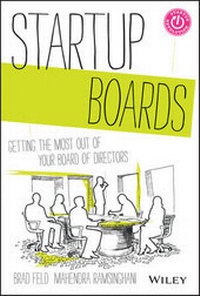
Startup Boards
Description

Let's face it, as founders and entrepreneurs, you have a lot onyour plate--getting to your minimum viable product, developingcustomer interaction, hiring team members, and managing theaccounts/books. Sooner or later, you have a board of directors,three to five (or even seven) Type A personalities who seek yourattention and at times will tell you what to do. While you might behesitant to form a board, establishing an objective outside groupis essential for startups, especially to keep you on track, callyou out when you flail, and in some cases, save you fromyourself.
In Startup Boards, Brad Feld--a Boulder,Colorado-based entrepreneur turned-venture capitalist--shareshis experience in this area by talking about the importance ofhaving the right board members on your team and how to manage themwell. Along the way, he shares valuable insights on various aspectsof the board, including how they can support you, help youunderstand your startup's milestones and get to them faster, andhold you accountable.
* Details the process of choosing board members, includinginterviewing many people, checking references, and remembering thatthere should be no fear in rejecting a wrong fit
* Explores the importance of running great meetings, mixingsocial time with business time, and much more
* Recommends being a board member yourself at some otherorganization so you see the other side of the equation
Engaging and informative, Startup Boards is a practicalguide to one of the most important pieces of the startuppuzzle.
All prices
More details
Other editions
Additional editions
Persons
Mahendra Ramsinghani has over fifteen years of investmentand entrepreneurial experience and has led investments in overfifty seed stage companies. He helped draft the underlyinglegislation for a fund-of-funds for the state of Michigan. For hiscontributions, Ramsinghani's immigration to the United States wasapproved under "national interest." He is the author of TheBusiness of Venture Capital (Wiley). His articles and blogshave been published in Forbes, MIT Technology Review,Thomson Reuters, and the Huffington Post. His educationalbackground includes a BE in electronics and MBA in finance andmarketing from the University of Pune, India.
Content
ACKNOWLEDGMENTS xiii
PART ONE: OVERVIEW 1
CHAPTER ONE
Introduction 3
CHAPTER TWO
What Is a Board? 11
PART TWO: BUILDING YOUR BOARD 23
CHAPTER THREE
Creating Your Board 25
CHAPTER FOUR
Recruiting Board Members 49
CHAPTER FIVE
The Formal Structure of the Board 63
CHAPTER SIX
Aligning Your Board 71
CHAPTER SEVEN
Is an Advisory Board Useful? 77
PART THREE: THE BUSINESS OF THE BOARD MEETING 85
CHAPTER EIGHT
The Actual Board Meeting 87
CHAPTER NINE
Motions and Votes 101
CHAPTER TEN
Legal Challenges 111
PART FOUR: COMMUNICATIONS 115
CHAPTER ELEVEN
Managing Ongoing Expectations 117
CHAPTER TWELVE
Trying New Things 131
CHAPTER THIRTEEN
Communication Confl icts 135
CHAPTER FOURTEEN
CEO Transitions 143
PART FIVE: TRANSACTIONS 151
CHAPTER FIFTEEN
Financings 153
CHAPTER SIXTEEN
Selling a Company 157
CHAPTER SEVENTEEN
Going Public 167
CHAPTER EIGHTEEN
Going Out of Business 173
CHAPTER NINTEEN
Conclusion 179
APPENDIX
Checklist 1: Preparing Your Board Package 183
Checklist 2: Conducting Your Board's Annual Assessment185
Checklist 3: Question for Your Legal Counsel 187
Checklist 4: Should You Get Directors and Offi cers Insurance?189
Checklist 5: Stock Option Grants and 409A Valuation 191
NOTES 195
INTERVIEWS 199
BIBLIOGRAPHY 201
ABOUT THE AUTHORS 203
INDEX 205
Excerpt from Startup CEO 211
Chapter One
Introduction
The word boardroom conjures up images of important people puffing on cigars or sipping Scotch while sitting in leather chairs in wood-paneled rooms. These important people are talking about complex things that determine the future of companies. Formality and seriousness fill the air. Big decisions are being made.
While first-time chief executive officers (CEOs) and founders often have an elevated view of the boardroom, great startup boards aren’t fancy, complex, or pretentious. Instead, a startup board is usually a small group of people trying to help build your company.
Over the years, we’ve served on hundreds of boards. A few were great, many were good, and some were terrible. When things in a company were going smoothly, the board was congratulatory and supportive. When there were challenges, some boards helped and some boards hurt. The tempo and interactions of these boards varied dramatically. In some cases reality prevailed, and in others it was denied.
In 2010, after a particularly tedious board meeting, Brad realized that the default structure of a startup board was an artifact of the past 40 years, dating back to the way early venture-backed company boards operated. Things had changed and evolved some, but the dramatic shift in communication patterns and technology over the past decade hadn’t been incorporated into the way most boards worked. As a result, Brad ran a two-year experiment where he tried different things; some successful, some not. As with every experiment, he did more of what worked, modified and killed what didn’t, tried new things, and measured a lot of stuff.
The idea for this book emerged during this experiment. We decided that in addition to describing the new startup board approach that resulted from Brad’s experiment, it was important to lay the groundwork and explain clearly how startup boards worked, how they could be most effective, and what the challenges were. Brad’s new board approach built on the traditional board of directors, so rather than throw it out, we use a highly functioning one as the basis for a new, evolved, and much more effective approach to a board of directors.
While the topic may feel dry, we’ve tried, as Brad and Jason Mendelson (Foundry Group, Managing Director) did in Venture Deals: Be Smarter Than Your Lawyer and Venture Capitalist, to take a serious topic, cover it rigorously, but do it in plain English with our own brand of humor. Our goal is to demystify how a board of directors works, discuss historical best and worst practices, and give you a clear set of tools for creating and managing an awesome board.
Why Does a Startup Need a Board?
Entrepreneurs, the creators and architects of creative construction (with apologies to Schumpeter1), enjoy creating new products and companies from just an idea. These forceful personalities break new ground and explore uncharted territory while their unstoppable drive changes the world we live in. As a society, we should be grateful to the entrepreneurial force that creates new things, but often this new-new thing causes fear and uncertainty in the old and the established, followed by resistance and denial. Whether it is building a new product, landing the first customer, raising the initial round of capital, or recruiting early team members, an entrepreneur’s journey can be lonely, stressful, and extremely challenging. While entrepreneurship currently is popular—even trendy—this is not always the case, and the journey to create a successful company can be a long and difficult one.
One of the early challenges encountered is raising money. While many startups are bootstrapped, with the founders choosing to focus on generating revenue to fund their business, other entrepreneurs choose to raise money from friends and family, angel investors, or venture capitalists (VCs). The challenges of raising the first round of capital are well documented, and only a small percentage of startups get funded, either through sheer persistence or a stroke of luck.
Once this first round of capital is raised, a new set of challenges arises. Investors, driven by the desire for a substantial financial return, seek milestones, demonstrable progress, new rounds of financing at higher prices, or even quick exits. While some investors may be patient, taking a decade or longer view to helping build the company, others are more anxious to see quick progress. In many cases, these investors view the company as partly their own, which it in fact is, now that they’ve invested in it. Some of these investors are happy to support the entrepreneur in any way the entrepreneur needs them to. Other investors have their own view of what they, and the entrepreneur, should be doing—providing oversight, and “adding value” to the startup through their role on the board.
A long-standing cliché in the venture capital world is that VCs provide “adult supervision” to the entrepreneurs. We find this language to be pejorative and insulting to the entrepreneur and the company, so we try to avoid it. Instead of talking in abstractions, we’ll describe clearly what VCs and board members can do to be helpful to the companies whose boards they serve on. We’ll be equally direct about describing what entrepreneurs and management can do to engage these directors.
A board of directors can be created at the inception of the company and is almost always formed in conjunction with the first outside financing. Many early-stage companies never convene a board on a regular basis. In bootstrapped companies, the entrepreneurs have no outside investors so they often feel no need to create a board since they feel responsible only to themselves.
In all cases we think this is a mistake and believe you should form your board early in the life of your company, regardless of how you are financed. If you do it correctly, choose the right directors, and engage them actively, they can help you dramatically accelerate your business. Then when you run into trouble, they can help guide you through the tough spots.
Clint Korver (Ulu Ventures, Partner) teaches a course on startup boards at Stanford University called “Startup Boards: Advanced Entrepreneurship.” Clint says, “The most common mistake startups make is not having a board at all.” He points out that research shows a majority of startups fail due to self-inflicted wounds—internal decisions about founding team, roles, equity, and other important issues. “Founders who are overconfident or choose to avoid conflict often miss an opportunity to bring in fresh perspective and structure these decisions from appropriate individuals,” says Clint. “The other common mistake founders make is to populate the board with friends and family—you need to think carefully if they can address challenges or make decisions in the interest of the startup. Finally, often only founders populate the startups board—this often leads to confusion with respect to decision making and authority.”
The Board Is an Extension of Your Team
The search for capital can be agonizing. When a term sheet is on the horizon, most founders are ecstatic that the long process of raising the venture round is almost over. During this process, many founders ignore the type of board members that come with the money. Smart founders understand that building a great company is all about the people and the members of the board are just as important as the early employees. “If I was prepping my younger brother on a startup journey, I would tell him to raise money only from those investors who can strategically add value and emotionally connect with you to help you be better,” says Foundry Group managing director Jason Mendelson.
Once you’ve taken investment from VCs, they will ensure their investment has some protection as a result of control provisions in the financing document. They’ll also have a governance role as a result of their board seat. But more importantly they become part of the company as a result of their role on the board. While founders and investors often fret over control issues, Union Square Ventures partner Fred Wilson points out, “Boards should not be controlled by the founder, the CEO, or the largest shareholder. For a board to do its job, it must represent all stakeholders’ interests, not just one stakeholder’s interest.”2
The best entrepreneurs construct a board of directors the same way they build their core management team, recruiting the best people they can find for the roles that are needed. A great board member can be a superb coach and mentor—pushing you to grow, encouraging you to take on bigger challenges, and ultimately reaching your highest potential. Like any great coach, he will be careful never to undermine you or jump in the driver’s seat.
Not all board members understand this. Some feel the need to manage the CEO and the entrepreneurs. Others can’t help but get involved in minutiae stir up conflict, and try to solve problems that they see emerging. This type of board member behavior gets in the way of the functioning of the company, confuses the management team, and, in the worst cases, damages the startup.
Constructing a good board starts with identifying investors and board members who understand the world of startups, know the dynamics of your market, and bring unique positive attributes that are often much more important than money. Founders, especially early in the life of a company, often feel like they have to make...
