

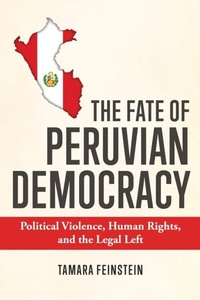
The Fate of Peruvian Democracy
Political Violence, Human Rights, and the Legal Left
1st Edition
Published on 15. September 2023
277 pages
978-0-268-20624-6 (ISBN)
Description

Tamara Feinstein investigates the bloody Shining Path conflict's effect on the legal Left in late-twentieth-century Peru, illustrating the catastrophic impact state and insurgent violence can have on the growth and resilience of democratic political actors during times of war.
In this engaging historical study, Tamara Feinstein chronicles the late-twentieth-century Shining Path conflict and argues that it significantly contributed to the rupture and disintegration of the noninsurgent legal Left in Peru by deepening preexisting divisions and eradicating an entire generation of leaders. Using a combination of oral histories, archival documents, contemporary media accounts, and participant observation of commemorations, Feinstein maps the trajectory of the Peruvian Left's rise and fall by analyzing two emblematic human rights cases that occurred at the Left's zenith and nadir: the state-based violence of the 1986 Lima prison massacres and the 1992 Shining Path assassination of leftist shantytown leader Maria Elena Moyano. The lessons found in The Fate of Peruvian Democracy reach beyond Peru to connect with other Latin American countries. Peru's story illustrates the difficulties of accumulating political force during times of violence, underscores how struggles for self-defense can complicate ideological stances on violence, and helps explain the unevenness of the resurgence of the Left (the so-called "pink tide") in Latin America in the twenty-first century. The book contributes to debates on memory and human rights in Peru and Latin America where divisions over how to remember the war retraced the fault lines of earlier debates over democracy and violence.
In this engaging historical study, Tamara Feinstein chronicles the late-twentieth-century Shining Path conflict and argues that it significantly contributed to the rupture and disintegration of the noninsurgent legal Left in Peru by deepening preexisting divisions and eradicating an entire generation of leaders. Using a combination of oral histories, archival documents, contemporary media accounts, and participant observation of commemorations, Feinstein maps the trajectory of the Peruvian Left's rise and fall by analyzing two emblematic human rights cases that occurred at the Left's zenith and nadir: the state-based violence of the 1986 Lima prison massacres and the 1992 Shining Path assassination of leftist shantytown leader Maria Elena Moyano. The lessons found in The Fate of Peruvian Democracy reach beyond Peru to connect with other Latin American countries. Peru's story illustrates the difficulties of accumulating political force during times of violence, underscores how struggles for self-defense can complicate ideological stances on violence, and helps explain the unevenness of the resurgence of the Left (the so-called "pink tide") in Latin America in the twenty-first century. The book contributes to debates on memory and human rights in Peru and Latin America where divisions over how to remember the war retraced the fault lines of earlier debates over democracy and violence.
Reviews / Votes
"This is a riveting analysis of the rise and fall of Peru's left during the 1970s-1990s. Drawing on scores of personal interviews, Feinstein puts us in the room where the leaders of Peru's leftist political parties struggled to cope with the challenge posed by the savage Shining Path insurgency." -Cynthia McClintock, author of Electoral Rules and Democracy in Latin AmericaMore details
Language
English
Place of publication
Notre Dame IN
United States
Target group
Professional and scholarly
Illustrations
4 b&w illustrations, 3 tables, 2 maps - 4 Halftones, black and white - 3 Tables, black and white - 2 Maps
ISBN-13
978-0-268-20624-6 (9780268206246)
Copyright in bibliographic data and cover images is held by Nielsen Book Services Limited or by the publishers or by their respective licensors: all rights reserved.
Schweitzer Classification
Other editions
Additional editions
Book
09/2023
University of Notre Dame Press
€78.40
Shipment within 10-20 days
Person
Tamara Feinstein is an assistant professor of Latin American history at Murray State University. She is editor of the online archive Peru: Human Rights, Drugs, and Democracy, 1980-2000.
Content
Acknowledgements
List of Maps and Images
Spanish Language Terms
Acronyms List and Glossary
Regional Maps
Introduction
1. Revolution from Above or Below? (1960s-1970s)
2. Entering the Democratic Game - The Birth of Izquierda Unida (1980-1983)
3. To Support or Oppose the Populist Center? (1983-1986)
4. Days of Barbarity - The 1986 Lima Prison Massacres
5. The Center Cannot Hold -The First and Last Congress of Izquierda Unida at Huampani (1989)
6. Fighting Against the Tide: Maria Elena's Last Stand (1992)
7. The Afterlife of War: Post-Conflict Memory in Peru (2000-2019)
Conclusion
Bibliography
List of Maps and Images
Spanish Language Terms
Acronyms List and Glossary
Regional Maps
Introduction
1. Revolution from Above or Below? (1960s-1970s)
2. Entering the Democratic Game - The Birth of Izquierda Unida (1980-1983)
3. To Support or Oppose the Populist Center? (1983-1986)
4. Days of Barbarity - The 1986 Lima Prison Massacres
5. The Center Cannot Hold -The First and Last Congress of Izquierda Unida at Huampani (1989)
6. Fighting Against the Tide: Maria Elena's Last Stand (1992)
7. The Afterlife of War: Post-Conflict Memory in Peru (2000-2019)
Conclusion
Bibliography
