

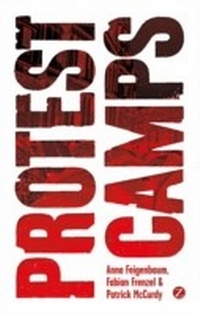
Protest Camps
1st Edition
Published on 10. October 2013
272 pages
978-1-78032-358-9 (ISBN)
Description

From Tahrir Square to Occupy, from the Red Shirts in Thailand to the Teachers in Oaxaca, protest camps are a highly visible feature of social movements' activism across the world. They are spaces where people come together to imagine alternative worlds and articulate contentious politics, often in confrontation with the state. Drawing on over fifty different protest camps from around the world over the past fifty years, this book offers a ground-breaking and detailed investigation into protest camps from a global perspective - a story that, until now, has remained untold.
Taking the reader on a journey across different cultural, political and geographical landscapes of protest, and drawing on a wealth of original interview material, the authors demonstrate that protest camps are unique spaces in which activists can enact radical and often experiential forms of democratic politics.
Taking the reader on a journey across different cultural, political and geographical landscapes of protest, and drawing on a wealth of original interview material, the authors demonstrate that protest camps are unique spaces in which activists can enact radical and often experiential forms of democratic politics.
Reviews / Votes
Analysing the global history and radical infrastructures of protest camps this book provides a captivating cartography that helps heal the chasm between how we live our everyday life and what our political ideas are, how we protest against the old world whilst proposing new ones. Best read (and discussed) around a (protest) camp fire. * John Jordan, artist, activist and co-founder of the direct action protest movement 'Reclaim the Streets'. * The phenomenon of protest camps is finally given the attention it deserves. With an international remit and a huge range of historical and contemporary examples, Feigenbaum, Frenzel and McCurdy provide a theoretically robust yet also highly readable and inspiring investigation of what protest camps are, do, achieve and challenge. What is more it is packed full of great photographs, cartoons and diagrams. * Dr Jenny Pickerill, Reader in Environmental Geography, University of Leicester * Much has been written about recent protests as digital networks, but too little about the physical process of continuously occupying significant space. Feigenbaum, Frenzel and McCurdy's wonderful book brings a fresh perspective to our understanding of contemporary political action, connecting to the history of occupations from Greenham onwards and offering smart conceptual tools for analysing both recent and historical events in all their richness, messiness and hidden order. A fine achievement. * Nick Couldry, London School of Economics and Political Science * An exciting, engaging and energizing book, Protest Camps is required reading for activists and academics interested in the history, politics and practice of the occupation of public space as a creative form of extra-parliamentary action. * Sasha Roseneil, author of Disarming Patriarchy: feminism and political action at Greenham, Professor of Sociology and Social Theory, Birkbeck University of London. *More details
Edition
1. Auflage
Language
English
Place of publication
United Kingdom
Publishing group
Bloomsbury Publishing PLC
Target group
College/higher education
ISBN-13
978-1-78032-358-9 (9781780323589)
Copyright in bibliographic data and cover images is held by Nielsen Book Services Limited or by the publishers or by their respective licensors: all rights reserved.
Schweitzer Classification
Other editions
Additional editions
Anna Feigenbaum | Fabian Frenzel | Patrick McCurdy
Protest Camps
Book
10/2013
Zed Books Ltd
€126.28
Shipment within 3-4 weeks
Anna Feigenbaum | Fabian Frenzel | Patrick McCurdy
Protest Camps
Book
10/2013
Zed Books Ltd
€47.22
Shipment within 3-4 weeks
Persons
Anna Feigenbaum is a lecturer in media and politics at Bournemouth University and has held fellow positions at the Rutgers Center for Historical Analysis and the London School of Economics and Political Science. She completed her PhD at McGill University, Montreal, in 2008, where her project was funded by a Mellon Pre-dissertation Fellowship, the Institute of Historical Research, University of London, and the Social Sciences and Humanities Research Council of Canada. She has published in a range of outlets, including South Atlantic Quarterly, ephemera, Feminist Media Studies, Fuse magazine and Corpwatch.org. She is an associate of the Higher Education Academy and is a trained facilitator and community educator, running group development workshops for academics, nongovernmental organisations and local initiatives. She can be found on Twitter at @drfigtree.
Fabian Frenzel is lecturer in organisation at the School of Management, University of Leicester, and Marie Curie post-doctoral fellow at the Department of Geography, University of Potsdam, Germany. He has worked on democratic politics in Europe, Africa and Brazil, looking at issues such as alternative media, international development and climate change. His PhD thesis is from the Centre of Tourism and Cultural Change, Leeds Metropolitan University. He is currently working on a two-year research project funded by the EU to investigate the valorisation of areas of deprivation and poverty in tourism. His work has been published in journals such as Environment and Planning A, Tourism Geographies and Parallax. He has edited (with Ko Koens and Malte Steinbrink) Slum Tourism: Poverty, Power, Ethics, published in 2012.
Patrick McCurdy is assistant professor in the Department of Communication at the University of Ottawa, Canada and holds a PhD from the London School of Economics and Political Science. His thesis on how radical social movement actors interact with media at the site of protest was selected as part of the LSE History of Thought theses. His work has been published in several journals, including the International Journal of Communication and Critical Discourse Studies. He has published two co-edited books: Mediation and Social Movements (with Bart Cammaerts and Alice Mattoni), 2013; and Beyond WikiLeaks: Implications for the Future of Communications, Journalism and Society (with Benedetta Brevini and Arne Hintz), 2013. He can be found on Twitter at @pmmcc.
Fabian Frenzel is lecturer in organisation at the School of Management, University of Leicester, and Marie Curie post-doctoral fellow at the Department of Geography, University of Potsdam, Germany. He has worked on democratic politics in Europe, Africa and Brazil, looking at issues such as alternative media, international development and climate change. His PhD thesis is from the Centre of Tourism and Cultural Change, Leeds Metropolitan University. He is currently working on a two-year research project funded by the EU to investigate the valorisation of areas of deprivation and poverty in tourism. His work has been published in journals such as Environment and Planning A, Tourism Geographies and Parallax. He has edited (with Ko Koens and Malte Steinbrink) Slum Tourism: Poverty, Power, Ethics, published in 2012.
Patrick McCurdy is assistant professor in the Department of Communication at the University of Ottawa, Canada and holds a PhD from the London School of Economics and Political Science. His thesis on how radical social movement actors interact with media at the site of protest was selected as part of the LSE History of Thought theses. His work has been published in several journals, including the International Journal of Communication and Critical Discourse Studies. He has published two co-edited books: Mediation and Social Movements (with Bart Cammaerts and Alice Mattoni), 2013; and Beyond WikiLeaks: Implications for the Future of Communications, Journalism and Society (with Benedetta Brevini and Arne Hintz), 2013. He can be found on Twitter at @pmmcc.
Content
Introduction
1. Infrastructures and practices of protest camping
2. Media and communication infrastructures
3. Protest action infrastructures
4. Governance infrastructures
5. Re-creation Infrastructures
6. Alternative worlds
1. Infrastructures and practices of protest camping
2. Media and communication infrastructures
3. Protest action infrastructures
4. Governance infrastructures
5. Re-creation Infrastructures
6. Alternative worlds
