
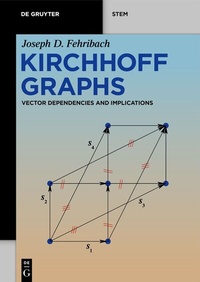
Kirchhoff Graphs
Description
Alles über E-Books | Antworten auf Fragen rund um E-Books, Kopierschutz und Dateiformate finden Sie in unserem Info- & Hilfebereich.
Kirchhoff graphs are a new type of graph, one whose edges are vectors. They depict the dependencies in sets of vectors, and in this regard, they are akin to matroids. Indeed every binary matroid is Kirchhoff graphic. If the vectors in the set represent the stoichiometry of a reaction network (chemical, electrochemical or otherwise), a Kirchhoff graph is a circuit diagram for that reaction network. This book discusses the basic definitions for Kirchhoff graphs, their connections to matroids and finite fields, their connections to reaction networks and use as circuit diagrams, Kirchhoff graph uniformity, prime, composite and fundamental Kirchhoff graphs, and the structure of families of Kirchhoff graphs. They been studied by the author and his collaborators since 2005, and this book presents what we have learned in the past twenty years.
More details
Other editions
Additional editions

Person
System requirements
File format: ePUB
Copy protection: Watermark-DRM (Digital Rights Management)
System requirements:
- Computer (Windows; MacOS X; Linux): Use a reading software that can process the file format ePUB: e.g., Adobe Digital Editions or FBReader – both free (see eBook Help).
- Tablet/Smartphone (Android; iOS): Before downloading, install the free app Adobe Digital Editions (see eBook Help).
- E-reader: Bookeen, Kobo, Pocketbook, Sony, Tolino and many more (not Kindle).
The file format ePUB works well for novels and non-fiction books – i.e., „flowing” text without complex layout. On an e-reader or smartphone, line and page breaks automatically adjust to fit the small displays.
This eBook uses Watermark-DRM, a „soft” copy protection. This means that there are no technical restrictions to prevent illegal distribution. However, there is a personalised watermark embedded in the eBook that can be used to identify the purchaser of the eBook in the event of misuse and to provide evidence for legal purposes.
For more information, see our eBook Help page.