

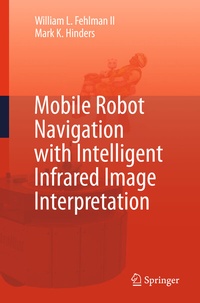
Mobile Robot Navigation with Intelligent Infrared Image Interpretation
Description

Mobile robots require the ability to make decisions such as "go through the hedges" or "go around the brick wall." Mobile Robot Navigation with Intelligent Infrared Image Interpretation describes in detail an alternative to GPS navigation: a physics-based adaptive Bayesian pattern classification model that uses a passive thermal infrared imaging system to automatically characterize non-heat generating objects in unstructured outdoor environments for mobile robots. The resulting classification model complements an autonomous robot's situational awareness by providing the ability to classify smaller structures commonly found in the immediate operational environment.
More details
Other editions
Additional editions
Persons
William L. Fehlman II is a lieutenant colonel in the United States Army. He received a BS in Mathematics from SUNY Fredonia in 1990 and MS in Applied Mathematics from Rensselaer Polytechnic Institute in 2000. He earned a PhD in Applied Science from The College of William and Mary in 2008, and is currently assigned as an Assistant Professor of Mathematics at the United States Military Academy, West Point, New York. His research interests include pattern classification, multi-sensor data fusion, and autonomous robotic systems.
Mark K. Hinders holds a BS, MS and PhD in Aerospace and Mechanical Engineering from Boston University, and is currently Professor of Applied Science at the College of William and Mary in Virginia. Before coming to Williamsburg in 1993, Professor Hinders was Senior Scientist at Massachusetts Technological Laboratory, Inc., and also Research Assistant Professor at Boston University. Before that Dr Hinders was an Electromagnetics Research Engineer at the USAF Rome Laboratory located at Hanscom AFB, MA. Professor Hinders conducts research in wave propagation and scattering phenomena, applied to medical imaging, intelligent robotics, security screening, remote sensing and nondestructive evaluation. He and his students study the interaction of acoustic, ultrasonic, elastic, thermal, electromagnetic and optical waves with materials, tissues and structures.
