

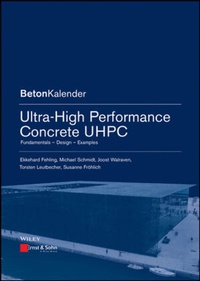
Ultra-High Performance Concrete UHPC
Fundamentals, Design, Examples
1st Edition
Published on 19. August 2014
198 pages
978-3-433-60406-9 (ISBN)
Description

Selected chapters from the German concrete yearbook are now being published in the new English "Beton-Kalender Series" for the benefit of an international audience.
Since it was founded in 1906, the Ernst & Sohn "Beton-Kalender" has been supporting developments in reinforced and prestressed concrete. The aim was to publish a yearbook to reflect progress in "ferro-concrete" structures until - as the book's first editor, Fritz von Emperger (1862-1942), expressed it - the "tempestuous development" in this form of construction came to an end. However, the "Beton-Kalender" quickly became the chosen work of reference for civil and structural engineers, and apart from the years 1945-1950 has been published annually ever since.
Ultra high performance concrete (UHPC) is a milestone in concrete technology and application. It permits the construction of both more slender and more durable concrete structures with a prolonged service life and thus improved sustainability.
This book is a comprehensive overview of UHPC - from the principles behind its production and its mechanical properties to design and detailing aspects. The focus is on the material behaviour of steel fibre-reinforced UHPC. Numerical modelling and detailing of the connections with reinforced concrete elements are featured as well. Numerous examples worldwide - bridges, columns, façades and roofs - are the basis for additional explanations about the benefits of UHPC and how it helps to realise several architectural requirements.
The authors are extensively involved in the testing, design, construction and monitoring of UHPC structures. What they provide here is therefore a unique synopsis of the state of the art with a view to practical applications.
Since it was founded in 1906, the Ernst & Sohn "Beton-Kalender" has been supporting developments in reinforced and prestressed concrete. The aim was to publish a yearbook to reflect progress in "ferro-concrete" structures until - as the book's first editor, Fritz von Emperger (1862-1942), expressed it - the "tempestuous development" in this form of construction came to an end. However, the "Beton-Kalender" quickly became the chosen work of reference for civil and structural engineers, and apart from the years 1945-1950 has been published annually ever since.
Ultra high performance concrete (UHPC) is a milestone in concrete technology and application. It permits the construction of both more slender and more durable concrete structures with a prolonged service life and thus improved sustainability.
This book is a comprehensive overview of UHPC - from the principles behind its production and its mechanical properties to design and detailing aspects. The focus is on the material behaviour of steel fibre-reinforced UHPC. Numerical modelling and detailing of the connections with reinforced concrete elements are featured as well. Numerous examples worldwide - bridges, columns, façades and roofs - are the basis for additional explanations about the benefits of UHPC and how it helps to realise several architectural requirements.
The authors are extensively involved in the testing, design, construction and monitoring of UHPC structures. What they provide here is therefore a unique synopsis of the state of the art with a view to practical applications.
More details
Other editions
Additional editions
Ekkehard Fehling | Michael Schmidt | Joost C. Walraven
Ultra-High Performance Concrete UHPC
Fundamentals, Design, Examples
Book
09/2014
1st Edition
Ernst & Sohn
€59.00
Shipment within 5-7 days
Software
08/2014
Ernst & Sohn
€82.61
No shipping information available
Persons
Univ.-Prof. Dr.-Ing. Ekkehard Fehling studied civil engineering and gained his doctoral degree at TU Darmstadt in 1990. In 1993 he was awarded the IABSE Prize (International Association for Bridge & Structural Design). Since 1997 he has been a licensed checking engineer for structural design in concrete and steel. In that same year he was appointed professor of concrete construction at the University of Kassel, Institute of Structural Engineering.
Univ.-Prof. Dr.-Ing. habil. Michael Schmidt studied civil engineering and gained his doctoral degree at TU Hannover in 1977. After 20 years of R&D in the German cement industry he served as professor of construction materials at the University of Kassel, Institute of Structural Engineering from 1999 to 2012.
Prof. Dr. ir. Dr.-Ing. h. c. Joost Walraven studied civil engineering and gained his doctoral degree at Delft University of Technology in 1980. For five years he was professor of concrete technology at TU Darmstadt, and since 1989 he has been professor of structural and building engineering at TU Delft. He is honorary president of the International Federation for Structural Concrete, fib.
Univ.-Prof. Dr.-Ing. Torsten Leutbecher studied civil engineering and gained his doctoral degree at the University of Kassel in 2007. For six years he was a research associate at the University of Kassel, Institute of Structural Engineering. In 2014 he was appointed professor of structural concrete at the University of Siegen.
Dipl.-Ing. Susanne Fröhlich is a research assistant at the University of Kassel, Institute of Structural Engineering.
Univ.-Prof. Dr.-Ing. habil. Michael Schmidt studied civil engineering and gained his doctoral degree at TU Hannover in 1977. After 20 years of R&D in the German cement industry he served as professor of construction materials at the University of Kassel, Institute of Structural Engineering from 1999 to 2012.
Prof. Dr. ir. Dr.-Ing. h. c. Joost Walraven studied civil engineering and gained his doctoral degree at Delft University of Technology in 1980. For five years he was professor of concrete technology at TU Darmstadt, and since 1989 he has been professor of structural and building engineering at TU Delft. He is honorary president of the International Federation for Structural Concrete, fib.
Univ.-Prof. Dr.-Ing. Torsten Leutbecher studied civil engineering and gained his doctoral degree at the University of Kassel in 2007. For six years he was a research associate at the University of Kassel, Institute of Structural Engineering. In 2014 he was appointed professor of structural concrete at the University of Siegen.
Dipl.-Ing. Susanne Fröhlich is a research assistant at the University of Kassel, Institute of Structural Engineering.
Content
1. Introduction
2. Principles for the production of UHPC
2.1 Development
2.2 Basic material concepts
2.3 Raw materials
2.4 Mix composition
2.5 Mixing
2.6 Curing and heat treatment
2.7 Testing
3. Mechanical properties of the hardened concrete
3.1 General
3.2 Behaviour in compression
3.3 Behaviour in tension
3.4 Shrinkage
3.5 Creep
3.6 Multi-axial stresses
3.7 Fatigue behaviour
3.8 Dynamic actions
3.9 Fire resistance
3.10 UHPC with combinations of fibres (fibre cocktails)
4. Durability
4.1 Microstructure
4.2 Resistance to aggressive media
4.3 Classification in exposure classes
5. Design principles
5.1 Influence of fibre distribution and fibre orientation
5.2 Analyses for the ultimate limit state
5.3 Analyses for the serviceability limit state
6. Connections
6.1 General
6.2 Dry joints
6.3 Glued joints
6.4 Wet joints
6.5 Grouted joints
6.6 Adding UHPC layers to existing components to upgrade structures
7. Projects completed
7.1 Bridges
7.2 Applications in buildings
7.3 Other applications
8. Acknowledgements
9. References
2. Principles for the production of UHPC
2.1 Development
2.2 Basic material concepts
2.3 Raw materials
2.4 Mix composition
2.5 Mixing
2.6 Curing and heat treatment
2.7 Testing
3. Mechanical properties of the hardened concrete
3.1 General
3.2 Behaviour in compression
3.3 Behaviour in tension
3.4 Shrinkage
3.5 Creep
3.6 Multi-axial stresses
3.7 Fatigue behaviour
3.8 Dynamic actions
3.9 Fire resistance
3.10 UHPC with combinations of fibres (fibre cocktails)
4. Durability
4.1 Microstructure
4.2 Resistance to aggressive media
4.3 Classification in exposure classes
5. Design principles
5.1 Influence of fibre distribution and fibre orientation
5.2 Analyses for the ultimate limit state
5.3 Analyses for the serviceability limit state
6. Connections
6.1 General
6.2 Dry joints
6.3 Glued joints
6.4 Wet joints
6.5 Grouted joints
6.6 Adding UHPC layers to existing components to upgrade structures
7. Projects completed
7.1 Bridges
7.2 Applications in buildings
7.3 Other applications
8. Acknowledgements
9. References
