

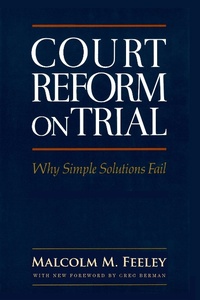
Court Reform on Trial: Why Simple Solutions Fail
Description

COURT REFORM ON TRIAL is a recognized study of innovation in the process of criminal justice, and why it so often fails?despite the best intentions of judges, administrators, and reformers. The arc of innovation to disappointment is analyzed for such ideas as bail reform, pretrial diversion, speedy trials, and determinate sentencing. A much-maligned system of plea bargaining shifts power to prosecutors away from judges, as formal trials recede in importance?but is that really the problem? Perhaps it lies in unrealistic expectations, splintered systems and decisionmaking, waning political will, unempowered constituencies, and reformers' hubris. Feeley analyzes the persistent failure and proposes insightful pathways out of the cycle.
First commissioned as a study in the influential Twentieth Century Fund series, the book is accessible for today's readers as part of the Classics of Law & Society series. It adds a reflective new preface by the author and a foreword by Greg Berman, Executive Director of the Center for Court Innovation. The new edition embeds page numbers from the original printings, for continuity of referencing and classroom assignment and to provide meaningful, matching page numbers in the ebook formats.
Calling it an "intellectual touchstone ... brimming with energy not resignation," Greg Berman writes that the book "has all of the hallmarks of Feeley's best work. Lucid prose. Idiosyncratic analysis. A willingness to speak truth to vested interests. And a commitment to describing the way the world actually works from a ground-level perspective?as opposed to the official versions of how systems theoretically should function." ... "The world has changed a lot and not at all" since the book was first published, Berman adds. "What is striking reading COURT REFORM ON TRIAL again in 2013 is just how relevant it still is."
More details
Person
Malcolm Feeley is a senior professor of law and jurisprudence & social policy at Boalt Hall School of Law at the University of California at Berkeley.
