

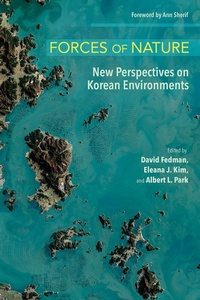
Forces of Nature
Description

Bringing together a multidisciplinary conversation about the entanglement of nature and society in the Korean peninsula, Forces of Nature aims to define and develop the field of the Korean environmental humanities. At its core, the volume works to foreground non-human agents that have long been marginalized in Korean studies, placing flora, fauna, mineral deposits, and climatic conditions that have hitherto been confined to footnotes front and center. In the process, the authors blaze new trails through Korea's social and physical landscapes.
What emerges is a deeper appreciation of the environmental conflicts that have animated life in Korea. The authors show how natural processes have continually shaped the course of events on the peninsula-how floods, droughts, famines, fires, and pests have inexorably impinged on human affairs-and how different forces have been mobilized by the state to variously, control, extract, modernize, and showcase the Korean landscape. Forces of Nature suggestively reveals Korea's physical landscape to be not so much a passive context to Korea's history, but an active agent in its transformation and reinvention across centuries.
With support from the Henry Luce Foundation, our goal is to produce all titles in this series both in Open Access, for reasons of global accessibility and equity, as well as in print editions.
More details
Other editions
Additional editions
Persons
David Fedman is Associate Professor of History at the University of California, Irvine. He is the author of Seeds of Control.
Eleana Kim is Associate Professor of Anthropology, University of California, Irvine. She is the author of Adopted Territory and Making Peace with Nature.
Albert L. Park is the Bank of America Associate Professor of Pacific Basin Studies at Claremont McKenna College of The Claremont Colleges. He is the author of Building a Heaven on Earth.
Content
General Introduction: Whose Nature? Centering the Environment in Korean Studies
Geographical Introduction: Biography of the Korean Peninsula in Maps
Imperial Interventions: Introduction To Part I
1. A State of Ranches and Forests: The Environmental Legacy of the Mongol Empire in Korea
2. Dammed Fish: Piscatorial Developmentalism and the Remaking of the Yalu River
Crisis and Repsonse: Introduction to Part II
3. The Politics of Frugality: Environmental Crisis and Artistic Production in Eighteenth-Century Korea
4. Between Memory and Amnesia: Seoul's Nanjido Landfill, 1978-1993
5. North Korea Caught between Developmentalism and Humanitarianism
Processes of Disposession: Introduction to Part III
6. Rice Fields, Mountains, and the Invisible Meatification of Korean Agriculture
7. The Eco-zombies of South Korean Cinema: Consumerism, Carnivores, and Eco-criticism
Reclaiming Life: Introduction to Part IV
8. Communal Environmentalism in the History of the Organic Farming Movement in South Korea
9. Gotjawal: The Promise of Becoming Wild
10. South Korea's Nuclear-Energy Entanglements and the Timescales of Ecological Democracy
Epilogue: On Everyday Ecologies and Systems of Mediation
