

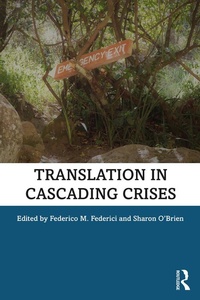
Translation in Cascading Crises
1st Edition
Published on 17. September 2019
260 pages
978-1-000-65707-4 (ISBN)
Description

This volume addresses the imperative need for recognizing, exploring, and developing the role of multilingual communication in crisis settings. It is recognized that 'communication is aid' and that access to communication is an undeniable human right in crises. Even where effective and accurate information is available to be distributed, circulated, and broadcast in different ways through an ever-growing array of technologies, too often the language barrier remains in place.
From the Philippines to Lebanon via Spain, Italy, Columbia, and the UK, crisis situations occur worldwide, with different cultural reactions and needs everywhere. The contributors of this volume represent a geographical mixture of regions, language combinations, and disciplines, because crisis situations need to be studied in their locale with different methods. Drawing on disaster studies research, this book aims to stimulate a broad, multidisciplinary debate on how complex communication is in cascading crises and on the role translation can play to facilitate communication.
Translation in Cascading Crises is a key resource for students and researchers of Translation and Interpreting Studies, Humanitarian Studies, and Disaster Studies.
From the Philippines to Lebanon via Spain, Italy, Columbia, and the UK, crisis situations occur worldwide, with different cultural reactions and needs everywhere. The contributors of this volume represent a geographical mixture of regions, language combinations, and disciplines, because crisis situations need to be studied in their locale with different methods. Drawing on disaster studies research, this book aims to stimulate a broad, multidisciplinary debate on how complex communication is in cascading crises and on the role translation can play to facilitate communication.
Translation in Cascading Crises is a key resource for students and researchers of Translation and Interpreting Studies, Humanitarian Studies, and Disaster Studies.
Reviews / Votes
"This comprehensive and much-needed volume brings together a variety of experts to discuss the relation between translation and crises from diverse approaches and perspectives. A must read for anyone with an interest in the role language, communication, interpreting and translation studies can play in situation of crisis, in disaster management, in risk mitigation and reduction and, ultimately, in saving lives."Marc Orlando, Monash University, Australia
More details
Edition
1. Auflage
Language
English
Place of publication
London
United Kingdom
Publishing group
Taylor & Francis Ltd
Target group
College/higher education
Professional and scholarly
Illustrations
9 Tables, black and white; 12 Line drawings, black and white; 6 Halftones, black and white; 18 Illustrations, black and white
ISBN-13
978-1-000-65707-4 (9781000657074)
Copyright in bibliographic data and cover images is held by Nielsen Book Services Limited or by the publishers or by their respective licensors: all rights reserved.
Schweitzer Classification
Other editions
Additional editions
Federico Federici | Sharon O'Brien
Translation in Cascading Crises
Book
10/2019
1st Edition
Routledge
€65.10
Shipment within 10-20 days
Federico Federici | Sharon O'Brien
Translation in Cascading Crises
Book
10/2019
1st Edition
Routledge
€206.50
Shipment within 10-20 days
Persons
Federico M. Federici is an associate professor in Translation Studies at the Centre for Translation Studies (CenTraS) at University College London, UK.
Sharon O'Brien is a professor at the School of Applied Language and Intercultural Studies at Dublin City University, Ireland.
Sharon O'Brien is a professor at the School of Applied Language and Intercultural Studies at Dublin City University, Ireland.
Content
Contents
List of Figures
List of Tables
List of Contributors
Acknowledgements
Chapter 1 Cascading Crises: Translation as Risk Reduction Federico M. Federici and Sharon O'Brien
Part 1: Sample Crisis Settings
Chapter 2 Crisis Translation in Yemen: Needs and Challenges of Volunteer Translators and Interpreters Khaled Al-Shehari
Chapter 3 Police Communication across Languages in Crisis Situations: Human Trafficking Investigations in the UK Joanna Drugan
Chapter 4 Cascading Effects: Mediating the Unutterable Sufferance of Gender-based Violence in Migratory Flows Denise Filmer
Part 2: Instruments and Support
Chapter 5 Accessibility of Multilingual Information in Cascading Crises Silvia Rodriguez Vazquez and Jesus Torres-del-Rey
Chapter 6 Mapping Translation Technology and the Multilingual Needs of NGOs along the Aid Chain Celia Rico Perez
Chapter 7 Ethical Considerations on the Use of Machine Translation and Crowdsourcing in Cascading Crises Carla Parra Escartin and Helena Moniz
Chapter 8 Management and Training of Linguistic Volunteers: A Case Study of Translation at Cochrane Germany Patrick Cadwell, Claudia Bollig, and Juliane Ried
Part 3: Methods and Data
Chapter 9 Integrating Language Needs in Disaster Research and Disaster Risk Reduction and Management through Participatory Methods Jake Rom D. Cadag
Chapter 10 Human Factors in Risk Communication: Exploring Pilot-Controller 'Communication Awareness' Bettina Bajaj
Chapter 11 Intralingual Translation and Cascading Crises: Evaluating the Impact of Semi-Automation on the Readability and Comprehensibility of Health Content Alessandra Rossetti
Index
List of Figures
List of Tables
List of Contributors
Acknowledgements
Chapter 1 Cascading Crises: Translation as Risk Reduction Federico M. Federici and Sharon O'Brien
Part 1: Sample Crisis Settings
Chapter 2 Crisis Translation in Yemen: Needs and Challenges of Volunteer Translators and Interpreters Khaled Al-Shehari
Chapter 3 Police Communication across Languages in Crisis Situations: Human Trafficking Investigations in the UK Joanna Drugan
Chapter 4 Cascading Effects: Mediating the Unutterable Sufferance of Gender-based Violence in Migratory Flows Denise Filmer
Part 2: Instruments and Support
Chapter 5 Accessibility of Multilingual Information in Cascading Crises Silvia Rodriguez Vazquez and Jesus Torres-del-Rey
Chapter 6 Mapping Translation Technology and the Multilingual Needs of NGOs along the Aid Chain Celia Rico Perez
Chapter 7 Ethical Considerations on the Use of Machine Translation and Crowdsourcing in Cascading Crises Carla Parra Escartin and Helena Moniz
Chapter 8 Management and Training of Linguistic Volunteers: A Case Study of Translation at Cochrane Germany Patrick Cadwell, Claudia Bollig, and Juliane Ried
Part 3: Methods and Data
Chapter 9 Integrating Language Needs in Disaster Research and Disaster Risk Reduction and Management through Participatory Methods Jake Rom D. Cadag
Chapter 10 Human Factors in Risk Communication: Exploring Pilot-Controller 'Communication Awareness' Bettina Bajaj
Chapter 11 Intralingual Translation and Cascading Crises: Evaluating the Impact of Semi-Automation on the Readability and Comprehensibility of Health Content Alessandra Rossetti
Index
