

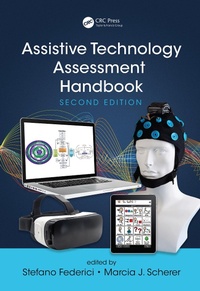
Assistive Technology Assessment Handbook
2nd Edition
Published on 23. November 2017
512 pages
978-1-4987-7412-3 (ISBN)
Description

Assistive Technology Assessment Handbook, Second Edition, proposes an international ideal model for the assistive technology assessment process, outlining how this model can be applied in practice to re-conceptualize the phases of an assistive technology delivery system according to the biopsychosocial model of disability. The model provides reference guidelines for evidence-based practice, guiding both public and private centers that wish to compare, evaluate, and improve their ability to match a person with the correct technology model. This second edition also offers a contribution to the Global Cooperation on Assistive Technology (GATE) initiative, whose activities are strongly focused on the assistive products service delivery model. Organized into three parts, the handbook: gives readers a toolkit for performing assessments; describes the roles of the assessment team members, among them the new profession of psychotechnologist; and reviews technologies for rehabilitation and independent living, including brain-computer interfaces, exoskeletons, and technologies for music therapy. Edited by Stefano Federici and Marcia J. Scherer, this cross-cultural handbook includes contributions from leading experts across five continents, offering a framework for future practice and research.
Reviews / Votes
"The book provides a policy-driven, theory-guided and evidence-based approach to the assessment of assistive technology. It is contemporary and engages with the global discourse in this field."-Johan Borg, Lund University, Sweden
"This new edition covers all aspects related to Assistive Technology service delivery, taking a global perspective. It may represent a useful resource for professionals with different cultural backgrounds as well as students or academics that want to advance their understanding of the main principles that drive the provision of any assistive device."
-Lorenzo Desideri, Center for Assistive Technology - AIAS Bologna, Italy
"In the 2nd edition of the Assistive Technology Assessment Handbook, Federici and Scherer have assembled some of the best minds in assistive technology who provide an extraordinary breadth of integration of theory, models of the assessment process, assessments for individuals with diverse abilities, and assistive technology devices. This book is sure to become the key resource for those interested in researching, assessing, implementing, and evaluating the use of assistive technology devices across diverse areas. It presents new and exciting ways of thinking about the use of assistive technology for enhancing the wellbeing of people with a variety of disabilities."
-Nirbhay N. Singh, Medical College of Georgia, Augusta University, Augusta, GA, USA
"...a valuable source of information and a compelling reading. Determining the best possible match between individual and technology is a complex and relatively obscure task, and this book provides the reader with detailed guidelines to carry out such a task successfully."
-Giulio Lancioni, University of Bari, Italy
"...an important and timely update of the definitive handbook of research and practice in the use of assistive technology for the rehabilitation of people with disabilities. This handbook is an invaluable resource for researchers, clinicians, and students in the disability and rehabilitation fields that should be on every desk of every researcher and clinician working with assistive technology."
-Jeff Sigafoos, Victoria University of Wellington, New Zealand
"A great book to let readers know about the numerous fields of application of assistive technology."
-Carlo Ricci, University Pontificia Salesiana and Walden Technology of Rome, Italy
"The authors have taken a measured approach that focuses on the individual with respect for the various experiences of people who would benefit from a well-conceptualized and implemented AT assessment. This person-centered approach takes into consideration many different areas of expertise, and braids them together in a way that will allow people who would benefit from assistive technology, teachers, parents, therapists, medical professions, and rehabilitation specialists, among others, to develop and implement assistive technologies that will remove environmental barriers and allow people to live their fullest lives."
-Helen Malone, The Ohio State University, Columbus, Ohio, USA
More details
Series
Edition
2nd edition
Language
English
Place of publication
London
United Kingdom
Publishing group
Taylor & Francis Ltd
Target group
College/higher education
Illustrations
79 s/w Abbildungen
30 Illustrations, color; 79 Illustrations, black and white
File size
6,54 MB
ISBN-13
978-1-4987-7412-3 (9781498774123)
Copyright in bibliographic data and cover images is held by Nielsen Book Services Limited or by the publishers or by their respective licensors: all rights reserved.
Schweitzer Classification
Other editions
Additional editions
Stefano Federici | Marcia Scherer
Assistive Technology Assessment Handbook
Book
12/2017
2nd Edition
CRC Press
€288.80
Shipment within 15-20 days
Persons
Stefano Federici is a professor in general psychology and psychology of disability at the University of Perugia, Italy. He has been a very active researcher in assistive technology for the disabled over the past 15 years and has published extensively in this area. In addition to the first edition, he has also published several additional reference works in the field.
Marcia Scherer is a rehabilitation psychologist and founding President of the Institute for Matching Person & Technology She is also Professor of Physical Medicine and Rehabilitation, University of Rochester Medical Center where she received both her Ph.D. and MPH degrees. She is a past member of the National Advisory Board on Medical Rehabilitation Research, National Institutes of Health, and is Editor of the journal Disability and Rehabilitation: Assistive Technology. Dr. Scherer is Fellow of the American Psychological Association, American Congress of Rehabilitation Medicine, and the Rehabilitation Engineering and Assistive Technology Society of North America (RESNA). Dr. Scherer has authored, edited, or co-edited nine books and has published over seventy-five articles in peer-reviewed journals as well as thirty book chapters on disability and technology. Her research has been cited more than 4500 times by others.
Marcia Scherer is a rehabilitation psychologist and founding President of the Institute for Matching Person & Technology She is also Professor of Physical Medicine and Rehabilitation, University of Rochester Medical Center where she received both her Ph.D. and MPH degrees. She is a past member of the National Advisory Board on Medical Rehabilitation Research, National Institutes of Health, and is Editor of the journal Disability and Rehabilitation: Assistive Technology. Dr. Scherer is Fellow of the American Psychological Association, American Congress of Rehabilitation Medicine, and the Rehabilitation Engineering and Assistive Technology Society of North America (RESNA). Dr. Scherer has authored, edited, or co-edited nine books and has published over seventy-five articles in peer-reviewed journals as well as thirty book chapters on disability and technology. Her research has been cited more than 4500 times by others.
Content
Foreward; Preface to First Edition; Preface to Second Edition; Acknowledgements; Editors; Contributors; Section I The Assistive Technology Assessment Process Model and Basic Definitions; Chapter One: Assessing Individual Functioning and Disability; Chapter Two: Measuring Individual Functioning; Chapter Three: Measuring the Assistive Technology MATCH; Chapter Four: Assessment of the Environments of AT Use: Accessibility, Universal Design, and Sustainability; Chapter Five: Measuring the Impact of Assistive Technology on Family Caregivers; Section II Assessment Professionals: Working on the Multidisciplinary Team; Chapter Six: Assessment of Assistive Technology for Individuals with Cognitive Impairments; Chapter Seven: The Special Educator; Chapter Eight: The Psychologist; Chapter Nine: The Psychotechnologist: A New Profession in the Assistive Technology Assessment; Chapter Ten: The Occupational Therapist: Enabling Activities and Participation Using Assistive Technology; Chapter Eleven: Pediatric Specialists in Assistive Solutions; Chapter Twelve: The Geriatrician; Chapter Thirteen: Role of Speech-Language Pathologists in Assistive Technology Assessments; Section III Assistive Technology Devices; Chapter Fourteen: The Systemic User Experience Assessment; Chapter Fifteen: Gesture, Signing, and Tracking; Chapter Sixteen: Using Brain-Computer Interfaces for Motor Rehabilitation; Chapter Seventeen: Graphic User Interfaces for Communication; Chapter Eighteen: Exoskeleton: The New Horizon of Robotic Assistance for Human Gait; Chapter Nineteen: Assistive Technologies for Children with Autism Spectrum Disorder; Chapter Twenty: Technology Developments in Music Therapy; Index
