

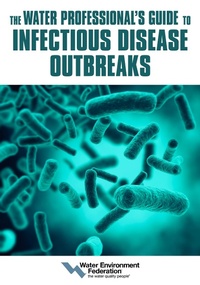
Water Professional's Guide to Infectious Disease Outbreaks
Published on 7. September 2023
325 pages
978-1-57278-447-5 (ISBN)
Description

In recent years, the importance of planning for and responding to infectious disease outbreaks has become increasingly evident. It is imperative to make the protection of water professionals, public health, and the environment a priority during the uncertainty of an outbreak. The Water Professional' s Guide to Infectious Disease Outbreaks will help you understand and evaluate the vast amounts of information produced during outbreaks and make evidence-based decisions to protect both water professionals and the wider community. The publication covers pathogens, treatment practices, risk assessment, health and safety evaluation approaches, adaptations in facility management, communications, and wastewater surveillance.
More details
Other editions
Additional editions
Water Environment Federation
The Water Professional's Guide to Infectious Disease Outbreaks
Book
06/2023
Water Environment Federation,US
€243.64
Shipment within 3-4 weeks
Content
- Intro
- Title Page
- Copyright
- Contents
- List of Figures
- List of Tables
- Preface
- Chapter 1 What Are Infectious Disease Outbreaks?: Rasha Maal-Bared, PhD
- Kari Brisolara
- Keerthi Palanisamy
- Leilani Perriatt
- & Albert Rubin
- 1.0 Infectious Diseases and Zoonoses
- 1.1 History of Infectious Agents and Disease Outbreaks
- 1.2 What Are Zoonoses?
- 2.0 Definitions You Should Know
- 2.1 Public Health Definitions
- 2.2 Microbiology Definitions
- 2.3 Water and Wastewater Treatment Definitions
- 2.4 Molecular Biology Definitions
- 3.0 Impacts on Economies, Communities, and Water Resource Recovery Facilities
- 3.1 Impacts on the Economy, Health Care, and Other Areas
- 3.2 Impacts on Water Resource Recovery Facilities-The COVID-19 Case Study
- 3.2.1 Lockdowns and Changes in Consumption Patterns
- 3.2.2 Increased Use of Wipes
- 3.2.3 Increased Consumption of Antibiotics, Disinfectants, and Cleaning Products
- 4.0 Resources
- 4.1 Publicly Available
- 4.2 Require Access
- Chapter 2 Pathogens in Wastewater: Chuck Gerba
- Tiong Gim Aw, PhD
- Bo Li
- Prakit Saingam
- Samendra Sherchan
- & Mark Sobsey
- 1.0 Classifications and Characteristics Relevant to Removal, Inactivation, or Control Microorganisms
- 1.1 Classes and Their Properties
- 1.2 The Chain of Infection
- 2.0 Epidemiology of Infectious Diseases in Water Resource Recovery Facility Workers
- 2.1 Major Routes of Exposure in Wastewater Systems
- 2.1.1 Untreated Wastewater
- 2.1.2 Bioaerosols
- 2.1.3 Sludge and Biosolids
- 2.2 Epidemiology of Infectious Diseases Among Wastewater Workers
- 3.0 Relevant Pathogens
- 3.1 Water, Sanitation, and Hygiene-Related Pathogens
- 3.1.1 Bacterial
- 3.1.1.1 Campylobacter
- 3.1.1.2 Escherichia coli and Its Pathogenic Strains
- 3.1.1.3 Salmonella
- 3.1.1.4 Vibrio cholerae
- 3.1.1.5 Shigella
- 3.1.1.6 Yersiniae enterocolitica
- 3.1.2 Viral
- 3.1.2.1 Aichi Viruses
- 3.1.2.2 Adenoviruses
- 3.1.2.3 Astroviruses
- 3.1.2.4 Enteroviruses
- 3.1.2.5 Hepatitis A
- 3.1.2.6 Norovirus
- 3.1.2.7 Rotavirus
- 3.1.2.8 Sapovirus
- 3.1.2.9 Reoviruses
- 3.1.2.10 Parechovirus
- 3.1.3 Protozoa
- 3.1.3.1 Cryptosporidium
- 3.1.3.2 Cyclospora
- 3.1.3.3 Entamoebah histolytica
- 3.1.3.4 Giardia
- 3.1.3.5 Toxoplasma gondii
- 3.1.3.6 Balantidium coli-Less Relevant
- 3.1.3.7 Blastocystis hominis
- 3.1.3.8 Cystoisospora belli (Formerly Isospora)
- 3.1.4 Fungi-Microsporidia
- 3.1.5 Helminths
- 3.2 Other Pathogens of Interest
- 3.2.1 Enteric
- 3.2.1.1 Leptospira-Common in Mice, Rodent Vector Control Issues
- 3.2.1.2 Aeromonas hydrophila and Other Pathogenic Species
- 3.2.1.3 Klebsiella Spp., Especially Klebsiella pneumoniae
- 3.2.1.4 Clostridium difficile
- 3.2.1.5 Clostridium perfringens (Primarily Foodborne and Detected as a Fecal Indicator)
- 3.2.1.6 Clostridium tetani (Cause of Tetanus From Wound and Related Exposures)
- 3.2.1.7 Helicobacter Pylori
- 3.2.1.8 MRSA and Other Antibiotic Resistant Bacteria
- 3.2.1.9 Hepatitis E
- 3.2.2 Non-enteric
- 3.2.2.1 Staphylococcus aureus
- 3.2.2.2 Hepatitis B
- 3.2.2.3 Free-Living Amoeba-Acanthamoeba culbertsoni and A. keratitis
- 3.2.2.4 Free-Living Amoeba-Naegleria fowleri
- 3.2.2.5 Legionella pneumophila
- 3.2.2.6 Pseudomonas aeruginosa
- 3.2.2.7 Mycobacterium Avium Complex
- 3.2.3 Viruses That Receive Public Attention but That Have Limited Relevance in Wastewater
- 4.0 Resources for Additional Information on Specific Pathogens
- 4.1 Publicly Available
- 4.2 Additional Resources
- Chapter 3 Current State of the Knowledge on Treatment Efficacy: Kari Brisolara
- Philip Block, PhD
- Chuck Gerba
- Bob Reimers
- Jenny Reina
- Stan Shmia
- Jay Swift
- & Yue Xu, PhD
- 1.0 Introduction-overall Pathogens Removals
- 2.0 Wastewater Treatment to Protect Public Health
- 2.1 Effluent-UV
- 2.1.1 Chemistry
- 2.1.2 Mode of Action
- 2.1.3 Inactivation/Log Removals
- 2.1.4 Pros and Cons
- 2.1.4.1 Pros
- 2.1.4.2 Cons
- 2.2 Effluent-Chlorine, Chloramine, and Chlorine Dioxide
- 2.2.1 Chemistry
- 2.2.1.1 Chlorine Demand
- 2.2.1.2 Breakpoint Chlorination
- 2.2.2 Mode of Action
- 2.2.2.1 Chlorine Gas
- 2.2.2.2 Sodium Hypochlorite
- 2.2.2.3 Chloramine
- 2.2.3 Inactivation/Log Removals
- 2.2.4 Pros and Cons
- 2.2.4.1 Pros
- 2.2.4.2 Cons
- 2.3 Effluent-Peracetic Acid and Performic Acid
- 2.3.1 Inactivation/Removal
- 2.3.2 Pros and Cons
- 2.3.2.1 Pros
- 2.3.2.2 Cons
- 2.4 Effluent-Ozone
- 2.4.1 Mode of Action
- 2.4.2 Inactivation/Log Removal
- 2.4.3 Pros and Cons
- 2.5 Biosolids
- 2.5.1 Class A and Class B
- 2.5.2 Overview of Treatment Types With Pros/Cons
- 2.5.2.1 Anaerobic Digestion
- 2.5.2.2 Aerobic Digestion
- 2.5.2.3 Alkaline Stabilization
- 2.5.2.4 Composting
- 2.5.2.5 Thermal Drying
- 2.5.2.6 Pasteurization
- 2.6 Hospital Effluent
- 2.6.1 Hazards Associated With Medical Waste
- 2.6.2 Approved Methods to Disinfect Infectious Wastes
- 2.6.2.1 Incineration (Thermal Destruction)
- 2.6.2.2 Steam Sterilization (Autoclave)
- 2.6.2.3 Dry Heat Sterilization/Thermal Inactivation
- 2.6.2.4 Chemical Disinfection
- 2.6.2.5 Irradiation Technologies (Gamma, Microwave, and E-beam)
- 2.6.2.6 Emerging Technologies: Shredding Medical Waste Followed by Disinfectant
- 2.6.3 Summary of Pros and Cons of Treatment and Disposal Options
- 3.0 Monitoring Water for Pathogens
- 3.1 Molecular Versus Culture-Based Methods
- 3.1.1 Culture-Based Methods
- 3.1.2 Molecular-Based Methods
- 3.1.3 Limitations of Each Approach (Pros and Cons) in Relation With Public Health Decision-Making
- 3.1.3.1 Culture-Based Approaches
- 3.1.3.2 Molecular Approaches
- 3.2 Types of Indicators
- 3.2.1 Bacterial Indicators and Their Standard Methods
- 3.2.2 Protozoan Indicators and Their Standard Methods
- 3.2.3 Viral Indicators and Their Standard Methods
- 3.2.3.1 Bacteriophages
- 3.2.3.2 Other (PMMoV, Adenovirus)
- 4.0 Low- and High-resource Settings
- 4.1 Defining the Issue
- 4.2 Technologies and Solutions
- 5.0 Resources
- 5.1 Publicly Available
- 5.2 Require Access
- Chapter 4 Understanding Risk and Knowledge Gaps: Mark Sobsey, Lee Gary, Bo Li, Prakit Saingam, & Samendra Sherchan
- 1.0 Assessing Risk
- 1.1 Qualitative Comparisons
- 1.2 Quantitative Assessments Using Quantitative Microbial Risk Assessment and Disability Adjusted Life Year
- 1.2.1 How the World Health Organization Uses DALYs to Quantify Risks
- 1.2.2 What Is QMRA, and How Is It Conducted?
- 1.2.3 Approaches and Metrics Used to Evaluate and Quantify Risk
- 2.0 Examples of Risk Analyses and Associated Metrics
- 2.1 Health Risk-Based Guidance for the Safe Use of Human Fecal Wastes for Agriculture
- 2.2 Health Risk-Based Microbial Standards for Treatment of Human Wastes Using Commercial Nonsewered Sanitation Systems On-Site
- 2.3 Health Risk Analysis for the Microbial Quality of Drinking Water
- 2.4 Epidemiological Health Risk-Based Approach to Address Pathogen Risks in Recreational Waters
- 2.5 Categorical Health Risk Analysis in Relation to Bacteriological Quality of Bathing Waters Based on Field Epidemiological Studies
- 2.6 Assessing and Managing Health Risks from Legionella in Water
- 3.0 Managing Risk and Promoting Preparedness
- 3.1 Identifying, Isolating, and Treating Infections to Prevent and Control Them
- 3.2 Vaccinations and Vaccines Against Known Pathogens
- 3.3 Disinfecting Hospital Waste and Similar Wastes Present in Communities
- 3.4 Disinfecting Surfaces and Tools
- 3.5 Hygiene Practices, Such as Handwashing at Critical Times
- 3.5.1 Handwashing at Critical Times
- 3.5.2 Other Hygiene Measures
- 3.6 Preventing or Reducing Exposure to Pathogens
- 3.6.1 Personal Protective Equipment
- 3.6.2 Engineering Controls of Pathogens
- 3.7 Awareness, Education, and Communication
- 4.0 Case Study: Using Qmra to Assess the Risk of Ebola Transmission to Wastewater Workers
- 5.0 Resources
- 5.1 Publicly Available
- 5.2 Require Access and/or Cited in Text
- Chapter 5 Utility Management and Operation: Learning From Others: Aditya Ramamurthy, Nija Ali, Adam Baron, Stephanie Corso, Shea Dunifon, Maureen Holman, Alexandra Lampson, Dusti Lowndes, Scott Perry, & Nelson Sims
- 1.0 Understanding the Macroeconomy
- 2.0 The Circular Economy
- 3.0 Operational Excellence and Performance
- 4.0 Business Continuity: The Dc Water Case
- 4.1 Financial Measures
- 4.1.1 Affordability, Access, and Customer Assistance
- 4.1.2 Revenue Streams (e.g., Reduced Usage, Extended Periods of Nonpayment)
- 4.1.3 Customer-Focused Assistance Programs
- 4.1.3.1 DC Water Cares
- 4.1.3.2 Emergency Residential Relief
- 4.1.3.3 Multifamily Assistance Program for Tenants and Renters
- 4.1.4 Utility Financing Strategies
- 4.1.5 Funding and Grants
- 4.2 Cybersecurity
- 4.3 Utility Workforce
- 4.3.1 Recruitment, Retention, and Staff Engagement
- 4.3.2 Motivation and Morale (Internal and Customer Facing)
- 4.3.3 Union Engagement and Policy Flexibility
- 5.0 Risk Management
- 5.1 Customer Risks
- 5.2 Risk Identification and Response Strategies
- 6.0 Utility Operations Leveraging the Incident Management Team
- 6.1 Incident Management for Common Operation Picture and Span of Control
- 6.1.1 Incident Management and Incident Command
- 6.1.2 Incident Management Team
- 6.1.3 Continuous Evaluation and Action Plans
- 6.1.4 Planning Meetings
- 6.1.5 Operations Briefs
- 6.1.6 Information Gathering and Documentation
- 6.1.7 Communications
- 6.1.8 Transition to Long-Term Recovery and Demobilizing of IMT
- 6.1.9 After-Action Activities and Review
- 6.2 Utility Operations and Supply Chain Management
- 6.2.1 Initial Awareness and Response
- 6.2.2 Chemical Supply Security
- 6.2.3 Centralize the Procurement of PPE and Cleaning Supplies
- 6.2.4 Creation of an Authority-Wide COVID-19 Work Order
- 6.2.5 Sourcing Team for COVID-19
- 6.2.6 Authority Manning and Policy Decisions
- 6.2.7 Leveraging the Incident Command System Reporting Structure
- 6.2.8 Teamwork and Thinking Out of the Box
- 6.3 Facility Readiness
- 6.4 DC Water's Return-to-Workplace Readiness
- 6.4.1 Ongoing Communication With Employees
- 6.4.2 Facilities Readiness, Space Planning, and Capacity Limitations
- 6.4.3 Collaborating With Government Agency's Reopen Teams
- 7.0 Changes in Laboratory Testing
- 7.1 Drinking Water Testing
- 7.2 Wastewater Testing
- 8.0 Health and Safety
- 9.0 Strategic Communications
- 9.1 Introduction
- 9.2 Identifying the Problem and the Audience
- 9.2.1 The Problem
- 9.2.2 Mapping Stakeholders
- 9.2.3 Audience Profiles
- 9.2.3.1 Regulators
- 9.2.3.2 Customers
- 9.2.3.3 Internal Communications
- 9.3 Develop Campaign Strategies and Content
- 9.3.1 Assessment
- 9.3.2 Branding
- 9.3.3 Content
- 9.3.4 Strategy
- 9.3.4.1 Be Omnichannel
- 9.3.4.2 Be Collaborative
- 9.3.4.3 Be Fluid
- 9.4 Digital Communications: Social Media Engagement and Participation
- 9.5 Communicating With the Media
- 9.5.1 Before the Crisis
- 9.5.2 During the Crisis
- 9.5.3 After the Crisis
- 9.6 Deploy and Debrief
- 10.0 References
- Chapter 6 Occupational Health Protection: Tom Burgess, MS, CSP, CIH
- David Gill
- Albert Rubin
- & Mark Wilson
- 1.0 Introduction
- 2.0 Exposure Assessment
- 2.1 Strategy
- 2.2 Basic Characterization
- 2.2.1 Criteria for Acceptable Exposure (Infection Risk)
- 2.2.2 Workplace Characterization (Exposure Risk)
- 2.3 Exposure Assessment
- 2.3.1 Exposure Groups
- 2.3.2 Qualitative Assessment
- 2.3.2.1 Aerosols
- 2.3.2.2 Qualitative Assessment Example
- 2.3.3 Quantitative Assessment
- 2.3.4 Exposure Risk
- 3.0 Controls
- 3.1 Hierarchy of Controls
- 3.2 Elimination/Engineering
- 3.3 Administrative
- 3.4 Personal Protective Equipment
- 3.5 Controlled Risk
- 4.0 Implementation and Management
- 4.1 Leadership and Employee Participation
- 4.2 Resources and Communication
- 4.3 Operational Planning and Control
- 4.4 Emergency Preparedness and Response
- 4.5 Performance Evaluation
- 5.0 Resources
- Chapter 7 Wastewater-Based Surveillance: Anna Mehrotra
- Tiong Gim Aw, PhD
- & Krystin Kadonsky
- 1.0 Background
- 1.1 Definitions
- 1.2 Origins
- 1.3 Historical Uses by Public Health Agencies
- 1.3.1 Poliovirus and the Global Polio Eradication Initiative
- 1.3.2 Illicit Drugs and the European Monitoring Centre for Drugs and Drug Addiction
- 1.3.3 COVID-19 and the U.S. Centers for Disease Control and Prevention
- 2.0 Methodology
- 2.1 Sample Collection
- 2.1.1 Sampling Locations
- 2.1.2 Sample Matrices
- 2.1.3 Sampling Approaches
- 2.1.4 Sample Preservation
- 2.2 Sample Processing
- 2.2.1 For Chemicals
- 2.2.2 For Pathogens
- 2.2.2.1 Pretreatment
- 2.2.2.2 Concentration
- 2.2.2.3 Nucleic Acid Extraction
- 2.3 Analysis
- 2.3.1 Mass Spectrometry
- 2.3.2 Nucleic Acid Amplification-Based Methods
- 2.3.3 Next Generation Sequencing
- 2.3.4 Quality Assurance/Quality Control
- 2.4 Data Interpretation and Sharing
- 2.4.1 Normalization
- 2.4.2 Complementary Data Sources
- 2.4.3 Data Representation and Display Practices
- 2.5 Data Application and Use
- 3.0 Limitations
- 4.0 Ethical Considerations
- 5.0 Resources
- Chapter 8 Looking Forward: Opportunities for the Water Sector and Its Workforce: Shea Dunifon
- Kari Brisolara
- Jen Loudon
- Bina Nayak, PhD
- Leilani Perriatt
- & Aditya Ramamurthy
- 1.0 Introduction: A Workforce with Diverse Perspectives
- 2.0 Water Sector Challenges during Covid-19
- 2.1 Emergency Response Planning
- 2.2 Knowledge Management and Communications
- 2.3 Pathogen Awareness and Training
- 2.4 Remote Work
- 2.5 Reduced Workforce
- 2.6 Morale and Tension
- 3.0 The Influence of Water Sector Experience and Role in Perceptions of Challenges and Opportunities in the Water Sector
- 3.1 Recent College Graduates and Job Seekers (Less Than 1 Year of Experience)
- 3.2 Young Professionals (1-10 Years)
- 3.3 Mid-Level Employees (10-15 Years)
- 3.4 Senior Employees (15+ Years)
- 4.0 Skills and Competencies for Water Professionals
- 4.1 Skills-Specific Learned Abilities Needed to Perform a Job Well
- 4.2 Competencies-Behaviors That Lead to Job Success
- 4.3 Job Descriptions, Competencies, and Checklists for Each Group
- 4.3.1 Field Crews (Water, Wastewater, and Collection Systems)
- 4.3.2 Public Health Professionals
- 4.3.3 Laboratory Technicians
- 4.3.4 Health and Safety Professionals
- 4.3.5 Public Affairs Professionals
- 5.0 Opportunities for the Water Sector
- 5.1 Shape Public Perception in a Positive Manner
- 5.2 Promote Clear and Transparent Communications
- 5.3 Utility Participation in Research
- 5.4 Create a Diverse, Equitable, and Inclusive Workforce
- 5.5 Promote Trade Careers Within Schools-Universities Are Not the Only Path
- 5.6 Identify and Highlight Advocates for the Industry
- 6.0 Resources
- 6.1 Publicly Available
- 6.2 Require Access
