

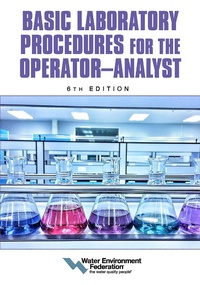
Basic Laboratory Procedures for the Operator-Analyst, 6th Edition
Published on 19. January 2023
404 pages
978-1-57278-444-4 (ISBN)
Description

This manual includes laboratory procedures most often performed in wastewater laboratories and includes general wet chemistry procedures, activated sludge process control tests, bacteriological testing, and special sections about basic laboratory techniques and proper use of spectrophotometers and colorimetry. Each method (procedure) is broken down into easy-to-follow, step-by-step directions that adhere to recommendations found in Standard Methods for the Examination of Water and Wastewater and approved U.S. Environmental Protection Agency guidelines. Each method (procedure) includes a sample benchsheet. The intention of this publication is to help the operator? analyst produce analytical data that are defensible, precise, and accurate for process control and permit reporting. Special emphasis is placed on quality assurance and quality control. The introduction to each method includes a brief discussion of why the test is performed and how it can be used for process control. Most methods include typical ranges for the parameter associated with different types of treatment processes. This will help the operator? analyst determine the appropriateness of the collected samples.
More details
Other editions
Additional editions
Water Environment Federation
Basic Laboratory Procedures for the Operator-Analyst
Book
12/2022
6th Edition
Water Environment Federation,US
€218.38
Shipment within 3-4 weeks
Content
- Intro
- Title Page
- Copyright
- Contents
- List of Figures
- List of Tables
- Preface
- Chapter 1 Introduction to the Laboratory
- 1.0 Background
- 2.0 Wastewater Constituents
- 2.1 Components
- 2.2 Relationships between Different Wastewater Components
- 2.2.1 Per Capita Generation Rates
- 2.2.2 Ratios Between Wastewater Constituents in Domestic Wastewater
- 2.3 Mass Balance
- 3.0 Sampling
- 3.1 Representative Sampling
- 3.2 Purposes of Sampling
- 3.2.1 Regulatory Requirements
- 3.2.2 Process Control
- 3.2.3 Determine Process and Facility Efficiency
- 3.2.4 Support or Refute Future Capital Expenditures
- 3.2.5 Historical Records
- 3.3 Sample and Measurement Collection
- 3.3.1 Continuous Measurements
- 3.3.2 Grab Samples
- 3.3.3 Composite Samples
- 3.3.3.1 Fixed-Volume Composite Samples
- 3.3.3.2 Flow-Proportional Composite Samples
- 3.3.3.2.1 Variable-Volume Technique
- 3.3.3.2.2 Variable-Frequency Technique
- 3.4 Use of Automatic Samplers
- 3.4.1 Programming
- 3.4.2 Cleanliness
- 3.4.3 Materials of Construction
- 3.5 Sample Hold Time
- 3.6 Sample Containers
- 3.7 Preservatives
- 3.8 Samples Requiring Special Consideration
- 3.9 Recommended Sampling Locations for Process Control
- 4.0 References
- Chapter 2 Laboratory Basics
- 1.0 Laboratory Safety
- 1.1 Personal Protective Equipment
- 1.2 Chemical Storage
- 1.3 Chemical Handling
- 1.4 Chemical Spills
- 1.5 Fire
- 1.6 Ingestion Hazards
- 2.0 Laboratory Analysis
- 2.1 Volumetric Analyses (Titrations)
- 2.2 Gravimetric Analysis
- 2.3 Colorimetric Analysis
- 2.4 Electrometric Analysis
- 3.0 Laboratory Equipment
- 3.1 Glassware
- 3.1.1 Volumetric Glassware
- 3.1.2 Using Volumetric Glassware
- 3.1.3 Other Glassware
- 3.2 Miscellaneous Laboratory Equipment
- 4.0 Housekeeping
- 4.1 Laboratory Environment
- 4.1.1 Climate
- 4.1.2 General Cleanliness
- 4.2 Washing Dishes
- 4.2.1 Acid Washes
- 4.2.2 Oxidizers
- 5.0 Basic Chemistry
- 5.1 Using the Periodic Table of the Elements
- 5.2 Atoms
- 5.3 Elements
- 5.4 Atomic Numbers
- 5.5 Molecules and Compounds
- 5.6 Moles
- 5.7 Atomic Weight
- 5.8 Formula Weight
- 5.9 Ions
- 5.10 Molar Solutions
- 5.11 Normal Solutions
- 5.12 Milligrams per Liter Solutions
- 5.13 Determining Percent Weight of Atoms in Molecules
- 6.0 Weighing
- 6.1 Analytical Balances and Weighing Conditions
- 6.2 Weighing Containers and Accessories
- 6.3 Drying Dishes and Reagents
- 6.4 Weighing Procedures for Reagents
- 7.0 Reagents
- 7.1 Laboratory-Grade Water
- 7.2 Reagent Grades
- 7.3 Mixing Reagents
- 8.0 Making Acids and Bases
- 9.0 Stock, Standards, and Standard Dilutions
- 9.1 Stock Solutions
- 9.2 Standard Solutions
- 9.3 Standard Dilutions
- 10.0 Accuracy, Precision, and Error
- 10.1 Accuracy and Precision
- 10.2 Error and Uncertainty
- 10.2.1 Determinate Errors
- 10.2.2 Indeterminate Errors
- 10.3 Significant Figures
- 11.0 Quality Assurance and Quality Control
- 11.1 Quality Assurance System
- 11.2 Measures of Precision
- 11.2.1 Mean
- 11.2.2 Relative Percent Difference
- 11.2.3 Standard Deviation
- 11.2.4 Relative Standard Deviation
- 11.3 Measures of Accuracy
- 12.0 Elements of Quality Control
- 12.1 Method Blank
- 12.2 Laboratory-Fortified Blank
- 12.3 Laboratory-Fortified Matrix and Laboratory-Fortified Matrix Duplicate
- 12.4 Duplicates
- 12.5 Calibration
- 12.6 Continuing Calibration Verification
- 12.7 Initial Demonstration of Capability
- 12.8 Quality Control Sample
- 12.9 Control Charts
- 12.10 Limits and Levels
- 12.10.1 Instrument Detection Limit
- 12.10.2 Method Detection Level
- 12.10.3 Quantitation Limits
- 12.10.4 Reporting Limits
- 13.0 References
- Chapter 3 Physical and Chemical Examination
- 1.0 pH
- 1.1 General Description
- 1.2 Application
- 1.3 Interferences
- 1.4 Apparatus and Materials
- 1.5 Stock and Standards
- 1.6 Quality Assurance and Quality Control
- 1.7 Sample Collection, Preservation, and Holding Times
- 1.8 Procedure
- 1.9 Reporting
- 1.10 Troubleshooting and Tips
- 1.11 Benchsheet
- 2.0 Total Alkalinity of Wastewater and Sludge
- 2.1 General Description
- 2.2 Application
- 2.3 Interferences
- 2.4 Apparatus and Materials
- 2.5 Reagents
- 2.6 Quality Assurance and Quality Control
- 2.7 Sample Collection, Preservation, and Holding Times
- 2.8 Procedure
- 2.9 Calculations
- 2.10 Reporting
- 2.11 Troubleshooting and Tips
- 2.12 Benchsheet
- 3.0 Volatile Organic Acids in Wastewater Sludge
- 3.1 General Description
- 3.2 Application
- 3.3 Interferences
- 3.4 Apparatus and Materials
- 3.5 Reagents
- 3.6 Sample Collection, Preservation, and Handling
- 3.7 Quality Assurance and Quality Control
- 3.8 Procedure
- 3.9 Calculations
- 3.10 Reporting
- 3.11 Benchsheet
- 4.0 Solids Procedures
- 5.0 Settleable Solids
- 5.1 General Description
- 5.2 Application
- 5.3 Apparatus and Materials
- 5.4 Sample Collection, Preservation, and Holding Times
- 5.5 Quality Assurance and Quality Control
- 5.6 Procedure
- 5.7 Calculations
- 5.8 Reporting
- 5.9 Troubleshooting and Tips
- 5.10 Benchsheet
- 6.0 Total Fixed and Volatile Solids in Solid and Semisolid Samples
- 6.1 General Description
- 6.2 Application
- 6.3 Interferences
- 6.4 Apparatus and Materials
- 6.5 Stock and Standards
- 6.6 Quality Assurance and Quality Control
- 6.7 Sample Collection, Preservation, and Holding Times
- 6.8 Procedure
- 6.9 Calculations
- 6.10 Reporting
- 6.11 Troubleshooting and Tips
- 7.0 Total Solids Dried at 103 to 105 °C
- 7.1 General Description
- 7.2 Application
- 7.3 Interferences
- 7.4 Apparatus and Materials
- 7.5 Reagents
- 7.6 Stock and Standards
- 7.7 Quality Assurance and Quality Control
- 7.8 Sample Collection, Preservation, and Holding Times
- 7.9 Procedure
- 7.10 Calculations
- 7.11 Reporting
- 7.12 Troubleshooting and Tips
- 7.13 Benchsheet
- 8.0 Total Suspended Solids (Total Nonfilterable Residue)
- 8.1 General Description
- 8.2 Application
- 8.3 Interferences
- 8.4 Apparatus and Materials
- 8.5 Reagents
- 8.6 Stock and Standards
- 8.7 Quality Assurance and Quality Control
- 8.8 Sample Collection, Preservation, and Holding Times
- 8.9 Procedure
- 8.10 Calculations
- 8.11 Reporting
- 8.12 Troubleshooting and Tips
- 8.13 Benchsheet
- 9.0 Total Dissolved Solids Dried at 180 °C
- 9.1 General Description
- 9.2 Application
- 9.3 Interferences
- 9.4 Apparatus and Materials
- 9.5 Reagents
- 9.6 Stock and Standards
- 9.7 Sample Collection, Preservation, and Holding Times
- 9.8 Quality Assurance and Quality Control
- 9.9 Procedure
- 9.10 Calculations
- 9.11 Reporting
- 9.12 Troubleshooting and Tips
- 9.13 Benchsheet
- 10.0 Volatile and Fixed Solids Ignited at 550 °C
- 11.0 Settleability
- 11.1 General Description
- 11.2 Apparatus and Materials
- 11.3 Sample Collection, Preservation, and Holding Times
- 11.4 Procedure
- 11.5 Special Variations or Applications
- 11.5.1 Rise Test
- 11.5.2 Dilution Test
- 11.6 Calculations
- 11.7 Benchsheets
- 12.0 Sludge Volume Index
- 12.1 General Description
- 12.2 Application
- 12.3 Interferences
- 12.4 Required Data
- 12.5 Calculations
- 12.6 Reporting
- 13.0 Centrifuge Method for Estimating Suspended Matter
- 13.1 General Description
- 13.2 Application
- 13.3 Interferences
- 13.4 Apparatus and Materials
- 13.5 Sample Collection, Preservation, and Holding Times
- 13.6 Quality Assurance and Quality Control
- 13.7 Procedure
- 13.8 Calculations
- 13.9 Reporting
- 14.0 Oxygen Uptake Rate and Specific Oxygen Uptake Rate
- 14.1 General Description
- 14.2 Application
- 14.3 Apparatus and Materials
- 14.4 Procedure
- 14.5 Calculations
- 14.6 Benchsheet
- 15.0 Dissolved Oxygen, Winkler Method Azide Modification
- 15.1 General Description
- 15.2 Application
- 15.3 Interferences
- 15.4 Apparatus and Materials
- 15.5 Reagents
- 15.6 Sample Collection, Preservation, and Holding Times
- 15.7 Procedure
- 15.8 Calculations
- 15.9 Reporting
- 16.0 Biochemical Oxygen Demand (5-Day Biochemical Oxygen Demand)
- 16.1 General Description
- 16.2 Application
- 16.3 Interferences
- 16.4 Apparatus and Materials
- 16.5 Reagents
- 16.6 Stock and Standards
- 16.7 Quality Assurance and Quality Control
- 16.7.1 Prepare a Standard
- 16.7.2 Replicates
- 16.7.3 Duplicates
- 16.8 Sample Collection, Preservation, and Holding Times
- 16.9 Procedure
- 16.10 Calculations
- 16.11 Reporting
- 16.12 Benchsheet
- 17.0 Chlorine Residual-Amperometric Titration
- 17.1 General Description
- 17.2 Application
- 17.3 Interferences
- 17.4 Apparatus and Materials
- 17.5 Reagents
- 17.6 Stock and Standards
- 17.7 Sample Collection, Preservation, and Holding Times
- 17.8 Procedure
- 17.9 Calculations
- 17.10 Reporting
- 17.11 Troubleshooting and Tips
- 18.0 Ammonia-Nitrogen-Ion-Selective Electrode Method
- 18.1 General Description
- 18.2 Application
- 18.3 Interferences
- 18.4 Apparatus and Materials
- 18.5 Reagents
- 18.6 Stock and Standards
- 18.7 Sample Collection, Preservation, and Holding Times
- 18.8 Quality Assurance and Quality Control
- 18.9 Procedure
- 18.10 Calculations
- 18.11 Reporting
- 18.12 Troubleshooting and Tips
- 18.13 Benchsheet
- 19.0 Nitrate-Nitrogen-Ion-Selective Electrode Method
- 19.1 General Description
- 19.2 Application
- 19.3 Interferences
- 19.4 Apparatus and Materials
- 19.5 Reagents
- 19.6 Stock and Standards
- 19.7 Sample Collection, Preservation, and Holding Times
- 19.8 Quality Assurance and Quality Control
- 19.9 Procedure
- 19.10 Calculations
- 19.11 Reporting
- 19.12 Troubleshooting and Tips
- 19.13 Benchsheet
- 20.0 Phosphorus
- 20.1 General Description
- 20.2 Application
- 20.3 Interferences
- 20.4 Apparatus and Materials
- 20.5 Reagents
- 20.6 Stock and Standards
- 20.7 Sample Collection, Preservation, and Holding Times
- 20.8 Quality Assurance and Quality Control
- 20.9 Procedure
- 20.10 Calculations
- 20.11 Reporting
- 20.12 Troubleshooting and Tips
- 20.13 Benchsheet
- 21.0 Temperature
- 21.1 General Description
- 21.2 Application
- 21.2.1 Ponds
- 21.2.2 Facility Influent
- 21.2.3 Clarification (Primary and Secondary)
- 21.2.4 Secondary Treatment
- 21.2.5 Filtration
- 21.2.6 Anaerobic Digestion
- 21.2.7 Biosolids Dewatering
- 21.2.7.1 Polymer Makeup
- 21.2.7.2 Centrifuge
- 21.3 Apparatus and Materials
- 21.4 Sample Collection, Preservation, and Holding Times
- 21.5 Procedure
- 21.6 Calculations
- 21.7 Reporting
- 21.8 Benchsheet
- 22.0 Turbidity
- 22.1 General Description
- 22.2 Application
- 22.3 Interferences
- 22.4 Apparatus and Materials
- 22.5 Reagents
- 22.6 Sample Collection, Preservation, and Holding Times
- 22.7 Quality Assurance and Quality Control
- 22.8 Procedure
- 22.9 Calculations
- 22.10 Reporting
- 22.11 Troubleshooting and Tips
- 22.11.1 Troubleshooting
- 22.11.2 Tips
- 22.12 Benchsheet
- 23.0 Ozone: Indigo Colorimetric Method
- 23.1 General Description
- 23.2 Application
- 23.3 Interferences
- 23.4 Apparatus and Materials
- 23.5 Reagents
- 23.6 Stock and Standards
- 23.7 Quality Assurance and Quality Control
- 23.8 Sample Collection, Preservation, and Holding Times
- 23.9 Procedure
- 23.10 Calculations
- 24.0 Activated Sludge System Microscopic Examination
- 24.1 General Description
- 24.2 Application
- 24.2.1 Indicator Organisms
- 24.2.1.1 Amoeboids
- 24.2.1.2 Flagellates
- 24.2.1.3 Ciliates
- 24.2.1.4 Free-Swimming Ciliates
- 24.2.1.5 Stalked Ciliates
- 24.2.1.6 Rotifers
- 24.2.1.7 Nematodes and Worms
- 24.2.1.8 Filaments
- 24.2.2 Relative Dominance
- 24.3 Interferences
- 24.4 Apparatus and Materials
- 24.5 Sample Collection, Preservation, and Holding Times
- 24.6 Quality Assurance and Quality Control
- 24.7 Procedure
- 24.8 Calculations
- 24.9 Reporting
- 25.0 References
- 26.0 Suggested Readings
- Chapter 4 Spectrophotometry
- 1.0 Introduction
- 2.0 Background and Advantages
- 3.0 Fundamentals of the Technology
- 3.1 Terminology
- 3.2 The Advantage in Water Testing
- 3.2 Calibration and Computer-Based Data
- 4.0 Quality Assurance and Quality Control
- 4.1 Interferences
- 4.2 Detection Limits and Quantitation Limits
- 4.2.1 Method Detection Limit or Minimum Detection Limit
- 4.2.2 Instrument Detection Limit
- 4.2.3 Practical Quantitation Limit (Quantitation Limits)
- 5.0 Other Considerations for Tests
- 5.1 Equipment Operation
- 5.2 Tips and Useful Practices
- 5.2.1 Cuvettes
- 5.2.2 Internal (Instrument) Windows
- 5.2.3 Blanks and Background
- 5.2.4 Operational Hints
- 5.2.4.1 New Spectrophotometers
- 5.2.4.2 Zero and Span Adjustment
- 5.2.5 Typical Instrument Operations
- 5.2.6 Example Steps in a Typical Procedure
- 5.2.7 Instrument Designs
- 5.2.7.1 Older Designs
- 5.2.7.2 Newer Designs
- 6.0 Selected Examples of Commonly Used Methods
- 6.1 Chemical Oxygen Demand
- 6.2 Nitrate-Nitrogen
- 6.3 Nitrite-Nitrogen
- 6.4 Ammonia-Nitrogen
- 6.5 "UV 254" Method for Organic Carbon (Dissolved)
- 6.6 Phosphate Phosphorus
- 7.0 Reference
- Chapter 5 Microbiological Examinations
- 1.0 Introduction
- 2.0 Indicator Organisms
- 2.1 The Coliform Group
- 2.2 The Enterococci Group
- 3.0 Methods
- 3.1 General Description
- 3.2 General Laboratory Equipment and Materials
- 3.3 Reagents
- 3.4 Sterilization of Equipment and Materials
- 3.5 Sample and Dilution Bottles
- 3.6 Filter Holders
- 3.7 Alternate Sterilization Procedures
- 4.0 Quality Assurance and Quality Control Requirements for Microbiological Methods
- 4.1 Sampling
- 4.2 Dechlorination
- 4.3 Storage and Holding Times
- 4.4 Sample Containers
- 4.5 Sample Volume and Dilutions
- 4.5.1 Dilutions for Membrane Filtration
- 4.5.2 Dilutions for Membrane Filtration and Most Probable Number (Quanti-Tray® or Equivalent)
- 4.5.2.1 1:10 Dilution
- 4.5.2.2 1:100 Dilution
- 4.5.2.3 Serial Dilutions
- 4.6 Positive and Negative Controls and Blanks
- 4.7 Duplicates
- 4.8 pH Meter and Buffers
- 4.9 Temperature Monitoring
- 5.0 Test Methods
- 5.1 Multiple Tube Fermentation
- 5.1.1 Introduction
- 5.1.2 Apparatus and Materials
- 5.1.3 Reagents
- 5.1.4 Quality Control
- 5.1.5 Procedure
- 5.1.6 Calculations
- 5.2 General Procedure for Membrane Filtration Methods
- 5.2.1 Introduction
- 5.2.2 Apparatus and Materials
- 5.2.3 Reagents
- 5.2.4 Quality Assurance and Quality Control
- 5.2.5 General Procedure
- 5.2.6 Calculations
- 5.3 Specific Membrane Filtration Methods
- 5.3.1 m-Endo Method
- 5.3.1.1 Introduction
- 5.3.1.2 Method-Specific Reagents
- 5.3.1.3 Procedure
- 5.3.1.4 Interpretation
- 5.3.1.5 Verification
- 5.3.1.6 Calculations
- 5.3.2 Membrane Fecal Coliform Method
- 5.3.2.1 Introduction
- 5.3.2.2 Method-Specific Media Preparation
- 5.3.2.3 Procedure
- 5.3.2.4 Interpretation
- 5.3.2.5 Calculations
- 5.3.3 Modified Membrane Thermotolerant Escherichia coli Method
- 5.3.3.1 Introduction
- 5.3.3.2 Method-Specific Reagents
- 5.3.3.3 Procedure
- 5.3.3.4 Interpretation
- 5.3.3.5 Calculations
- 5.3.4 Membrane ColiBlue®
- 5.3.5 Membrane-Enterococcus Indoxyl 1-D Glucoside Agar
- 5.3.5.1 Introduction
- 5.3.5.2 Method-Specific Media Preparation
- 5.3.5.3 Procedure
- 5.3.5.4 Interpretation
- 5.3.5.5 Calculations
- 5.4 Enzymatic Most Probable Number Methods
- 5.4.1 Colilert® and Colilert®-18
- 5.4.1.1 Introduction
- 5.4.1.2 Apparatus and Materials
- 5.4.1.3 Reagents
- 5.4.1.4 Procedure
- 5.4.1.5 Interpretation
- 5.4.1.6 Calculations
- 5.4.2 Enterolert®
- 5.4.2.1 Procedure
- 5.4.2.2 Interpretation
- 5.4.2.3 Calculations
- 6.0 References
- Chapter 6 Data Reporting and Monitoring
- 1.0 Data Recording
- 1.1 Benchsheets
- 1.2 Logbook
- 2.0 Expression of Results
- 2.1 Definitions
- 2.2 Rounding Off Numbers
- 2.3 Rounding Off Single Arithmetic Operations
- 2.3.1 Addition
- 2.3.2 Subtraction
- 2.3.3 Division and Multiplication
- 3.0 Completing the Discharge Monitoring Report
- 3.1 Introduction
- 3.2 Discharge Monitoring Report Hard Copy
- 3.3 Completing U.S. Environmental Protection Agency's NetDMR
- 3.3.1 Creating an Account and Requesting Access
- 3.3.2 My Account
- 3.4 Frequently Asked Questions About Discharge Monitoring Reports
- 3.5 Common Errors When Completing the Discharge Monitoring Report
- 4.0 Reference
