

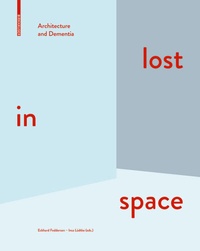
lost in space
Description

Dementia presents immense challenges - both for individuals as well as for society as a whole. More than 35 million people all over the world currently live with dementia, a number that is expected to double by 2050. This also has implications for architecture and urban planning because dementia often affects people's sense of orientation and their ability to perceive space. How can homes, apartments, public buildings, outdoor spaces, neighbourhoods and cities, as well as environments and infrastructure, be designed to meet the needs of people with dementia as well as those of their caregivers? And can a consideration of the problems of dementia lead to a better understanding of space that can improve architecture and the built environment for us all?
This book addresses these and other questions in a series of professional essays that examine the specific requirements for different disciplines. In addition, international case study projects illustrate the breadth of current actual solutions. The book is intended as a guide for all those involved in the design and planning process - architects, interior designers, engineers, town planners, local authorities and clients - and as a reader for the users themselves: for people with dementia, their family and friends, and all those in their social environment.
More details
Other editions
Additional editions
Persons
Content
2 - Lost in Space [Seite 7]
2.1 - Prologue [Seite 9]
2.2 - Rediscovering Space
3 - Architecture and Space [Seite 13]
3.1 - Learning, Remembering and Feeling Space [Seite 15]
3.2 - Architecture Should Be Self-Evident and Comprehensible
3.3 - Change of Scenery: One Space â?" Different Impressions
3.4 - Sonnweid House
3.5 - Haaptmannâ?Ts schlass
3.6 - house of life
3.7 - Fischer, Ralphlost
4 - individual and society [Seite 53]
4.1 - dementia as a cultural challenge [Seite 55]
4.2 - dementia â?" forms, research and prognoses [Seite 62]
4.3 - dementia â?" an illness with many repercussions
4.4 - alzheimerâ?Ts â?" fate or challenge? [Seite 70]
4.5 - music in the therapy of alzheimerâ?Ts
4.6 - dance and cognition
4.7 - Heylighen, Ann#Van Steenwinkel, Iris#Van Audenhove, Chantalmidmost â?" living with dementia [Seite 86]
5 - house and courtyard [Seite 91]
5.1 - layers of living
5.2 - typological grids
5.3 - light
5.4 - architectural space, acoustics and dementia [Seite 110]
5.5 - norra vram nursing home [Seite 114]
5.6 - hanna reemtsma house [Seite 118]
5.7 - gairola house [Seite 122]
5.8 - house of sense memory [Seite 126]
6 - block and quarter [Seite 135]
6.1 - a neighbourhood for a lifetime
6.2 - meaningful outdoor spaces for people with dementia [Seite 146]
6.3 - kahla housing for the elderly [Seite 154]
6.4 - zollikofen nursing and care centre for the elderly [Seite 158]
6.5 - home for the elderly and library [Seite 164]
6.6 - vialonga elderly day care centre [Seite 170]
6.7 - de hogeweyk
6.8 - urban game-board
7 - town and country [Seite 185]
7.1 - mapping dementia
7.2 - towards a dementia-friendly hospital [Seite 194]
7.3 - finding home in central station [Seite 200]
7.4 - land custom station [Seite 204]
7.5 - lingang new city [Seite 208]
7.6 - dementia, local municipalities and public space
8 - About the authors [Seite 218]
9 - Reference literature [Seite 220]
10 - Acknowledgements [Seite 221]
11 - Illustration credits [Seite 224]
