

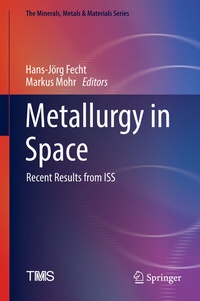
Metallurgy in Space
Description

This book presents experimental work conducted on the International Space Station (ISS) in order to characterize metals and alloys in the liquid state. The internationally recognized authors present and discuss experiments performed in microgravity that enabled the study of the relevant volume and surface related properties free of the restrictions of a gravity-based environment. The collection serves also as a handbook of space experiments using electromagnetic levitation techniques. A summary of recent results provides an overview of the wealth of space experiment data, which will ignite further research activities and inspire academics and industrial research departments for their continuous development.
More details
Other editions
Additional editions
Persons
Hans Fecht is Chaired Professor and Director of the Institute of Functional Nanosystems at Ulm University, Germany. He received his PhD at the University of Saarbrücken, Germany, in 1984. As a fellow of the Max-Kade Foundation, New York, he was appointed post-doctoral associate at the University of Wisconsin-Madison and in 1987 as senior research associate at the California Institute of Technology, Pasadena, USA. In 1990 he became Professor at the University of Augsburg, Germany, in 1993 he was appointed Full Professor at Technical University Berlin and in 1997 at Ulm University, while between 2001 and 2012 he additionally was appointed as senior researcher at the Institute of Nanotechnology, KIT. In addition, he holds guest professor positions in China, India and Japan. He has published more than 500 scientific papers and six books. He coordinated numerous national, European and international research projects in the field of materials science and nanotechnology. Among several other awards Prof. Fecht received the prestigious G.W. Leibniz Prize of the German Research Foundation (DFG) and is member of the European Academy of Sciences and Arts (Salzburg) and EURASC in Brussels. Over the last 30 years he performs experiments in space under microgravity conditions using parabolic flight and sounding rocket platforms. More recently, he directs a containerless processing program in Thermophysics on the International Space Station ISS involving about 30 research groups and industrial partners worldwide.
Markus Mohr is a Senior Research Associate at the Institute of Functional Nanosystems at Ulm University, Germany. He received his Diplom in Electrical Engineering (Dipl.-Ing.) from Ulm University in 2011, and completed his Ph.D. degree (Dr.-Ing.) at Ulm University in 2017. His current research activities include the measurement of thermophysical properties of metallic alloys on microgravity platforms (in parabolic flightsand on the international space station).
