

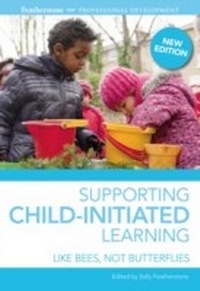
Supporting Child-initiated Learning
Like Bees, Not Butterflies
1st Edition
Published on 20. June 2013
144 pages
978-1-4081-9504-8 (ISBN)
Description

Why is it that, when children play, some behave like butterflies, flitting around among the flowers of the activities on offer, landing for a moment before moving on to the next attractive flower (activity) while others behave with the single minded concentration of bees?
As children grow and learn, they acquire skills through play and practical activities. This recently acquired learning is tenuous and is secured through practice, repeating the skills in different contexts, with different people. Only then will learning be 'hard wired' for life. It is now evident that where children are able to select resources, play companions and activities for themselves, they can practise emerging skills and concepts by selecting the resources they need and using them in ways which are unique to them.
This book, written by a group of experts in early years practice, explores the place and purpose of child-intitiated learning in high quality early years practice. Child-initiated learning is a key feature of the Early Years Foundation Stage.
As children grow and learn, they acquire skills through play and practical activities. This recently acquired learning is tenuous and is secured through practice, repeating the skills in different contexts, with different people. Only then will learning be 'hard wired' for life. It is now evident that where children are able to select resources, play companions and activities for themselves, they can practise emerging skills and concepts by selecting the resources they need and using them in ways which are unique to them.
This book, written by a group of experts in early years practice, explores the place and purpose of child-intitiated learning in high quality early years practice. Child-initiated learning is a key feature of the Early Years Foundation Stage.
More details
Edition
1. Auflage
Language
English
Place of publication
London
United Kingdom
Publishing group
Bloomsbury Publishing PLC
Target group
Professional and scholarly
ISBN-13
978-1-4081-9504-8 (9781408195048)
Copyright in bibliographic data and cover images is held by Nielsen Book Services Limited or by the publishers or by their respective licensors: all rights reserved.
Schweitzer Classification
Other editions
Additional editions
Book
03/2013
Featherstone
€25.00
No shipping information available
Person
Sally Featherstone has a wealth of experience as a teacher, head teacher and a local authority adviser and inspector. In recent years, alongside her activities in publishing, Sally has continued to build a national reputation as a trainer and consultant in the Primary and Early Years field.
Content
- FC
- Title
- Copyright
- Contents
- Preface
- Introduction
- Part 1 Starting points and definitions
- 1 Jennie Lindon: What does child-initiated learning mean, where does it fit and why is it important for young children?
- 2 Linda Pound: Playing what you know
- 3 Janet Moyles: Empowering children and adults: play and child-initiated learning
- Part 2 Curriculum and environment
- 4 Ros Bayley and Lynn Broadbent: Child-initiated learning and developing children's talk
- 5 Wendy Scott: Child-initiated writing
- 6 Judith Dancer: Count us in! - the importance of child-initiated learning in mathematical development
- 7 Helen Bilton: Setting the scene for child-initiated learning out of doors
- Part 3 Special issues
- 8 Sue Palmer: An inconvenient truth: early childcare has to be upfront, personal and real
- 9 Jan Dubiel: Tiaras may be optional - the truth isn't: the Early Years Foundation Stage and accurate assessment
- 10 Jane Cole: Our role as adults in enabling independent learning
- 11 Pam Lafferty: Child-initiated learning - a view from HighScope
- 12 Theodora Papatheodorou: Bilingual learners
- 13 Sally Featherstone: Practice makes perfect: how the growing brain makes sense of experiences
