

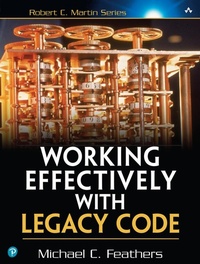
Working Effectively with Legacy Code
1st Edition
Published on 22. September 2004
464 pages
978-0-13-293175-5 (ISBN)
Description

Get more out of your legacy systems: more performance, functionality, reliability, and manageability
Is your code easy to change? Can you get nearly instantaneous feedback when you do change it? Do you understand it? If the answer to any of these questions is no, you have legacy code, and it is draining time and money away from your development efforts.
In this book, Michael Feathers offers start-to-finish strategies for working more effectively with large, untested legacy code bases. This book draws on material Michael created for his renowned Object Mentor seminars: techniques Michael has used in mentoring to help hundreds of developers, technical managers, and testers bring their legacy systems under control.
The topics covered include
Understanding the mechanics of software change: adding features, fixing bugs, improving design, optimizing performance
Getting legacy code into a test harness
Writing tests that protect you against introducing new problems
Techniques that can be used with any language or platform-with examples in Java, C++, C, and C#
Accurately identifying where code changes need to be made
Coping with legacy systems that aren't object-oriented
Handling applications that don't seem to have any structure
This book also includes a catalog of twenty-four dependency-breaking techniques that help you work with program elements in isolation and make safer changes.
Is your code easy to change? Can you get nearly instantaneous feedback when you do change it? Do you understand it? If the answer to any of these questions is no, you have legacy code, and it is draining time and money away from your development efforts.
In this book, Michael Feathers offers start-to-finish strategies for working more effectively with large, untested legacy code bases. This book draws on material Michael created for his renowned Object Mentor seminars: techniques Michael has used in mentoring to help hundreds of developers, technical managers, and testers bring their legacy systems under control.
The topics covered include
Understanding the mechanics of software change: adding features, fixing bugs, improving design, optimizing performance
Getting legacy code into a test harness
Writing tests that protect you against introducing new problems
Techniques that can be used with any language or platform-with examples in Java, C++, C, and C#
Accurately identifying where code changes need to be made
Coping with legacy systems that aren't object-oriented
Handling applications that don't seem to have any structure
This book also includes a catalog of twenty-four dependency-breaking techniques that help you work with program elements in isolation and make safer changes.
More details
Series
Edition
1. Auflage
Language
English
Place of publication
Hoboken
United States
Publishing group
Pearson Education (US)
Target group
College/higher education
File size
4,34 MB
ISBN-13
978-0-13-293175-5 (9780132931755)
Copyright in bibliographic data and cover images is held by Nielsen Book Services Limited or by the publishers or by their respective licensors: all rights reserved.
Schweitzer Classification
Other editions
Additional editions
Michael Feathers
Working Effectively with Legacy Code
Book
10/2004
1st Edition
Pearson
€60.94
Shipment within 15-20 days
Person
MICHAEL C. FEATHERS works for Object Mentor, Inc., one of the world's top providers of mentoring, skill development, knowledge transfer, and leadership services in software development. He currently provides worldwide training and mentoring in Test-Driven Development (TDD), Refactoring, OO Design, Java, C#, C++, and Extreme Programming (XP). Michael is the original author of CppUnit, a C++ port of the JUnit testing framework, and FitCpp, a C++ port of the FIT integrated-testing framework. A member of ACM and IEEE, he has chaired CodeFest at three OOPSLA conferences.
(c) Copyright Pearson Education. All rights reserved.
(c) Copyright Pearson Education. All rights reserved.
Content
Preface.
Introduction.
I. THE MECHANICS OF CHANGE.
1. Changing Software.
2. Working with Feedback.
3. Sensing and Separation.
4. The Seam Model.
5. Tools.
II. CHANGING SOFTWARE.
6. I Don't Have Much Time and I Have To Change It.
7. It Takes Forever To Make a Change.
8. How Do I Add a Feature?
9. I Can't Get This Class into a Test Harness.
10. I Can't Run This Method into a Test Harness.
11. I Need to Make a Change. What Methods Should I Test?
12. I Need to Make Many Changes In One Area Do I Have To Break.
13. I Need To Make a Change but I Don't Know What Tests To Write.
14. Dependencies on Libraries Are Killing Me.
15. My Application Is All API Calls.
16. I Don't Understand the Code Well Enough To Change It.
17. My Application Has No Structure.
18. My Test Code Is in the Way.
19. My Project Is Not Object-Oriented. How Do I Make Safe Changes?
20. This Class Is Too Big and I Don't Want It to Get Any Bigger.
21. I'm Changing The Same Code All Over the Place.
22. I Need To Change a Monster Method and I Can't Write Tests for It.
23. How Do I Know That I'm Not Breaking Anything?
24. We Feel Overwhelmed. It Isn't Going To Get Any Better.
III. DEPENDENCY BREAKING TECHNIQUES.
25. Dependency Breaking Techniques.
Appendix: Refactoring.
Glossary.
Introduction.
I. THE MECHANICS OF CHANGE.
1. Changing Software.
2. Working with Feedback.
3. Sensing and Separation.
4. The Seam Model.
5. Tools.
II. CHANGING SOFTWARE.
6. I Don't Have Much Time and I Have To Change It.
7. It Takes Forever To Make a Change.
8. How Do I Add a Feature?
9. I Can't Get This Class into a Test Harness.
10. I Can't Run This Method into a Test Harness.
11. I Need to Make a Change. What Methods Should I Test?
12. I Need to Make Many Changes In One Area Do I Have To Break.
13. I Need To Make a Change but I Don't Know What Tests To Write.
14. Dependencies on Libraries Are Killing Me.
15. My Application Is All API Calls.
16. I Don't Understand the Code Well Enough To Change It.
17. My Application Has No Structure.
18. My Test Code Is in the Way.
19. My Project Is Not Object-Oriented. How Do I Make Safe Changes?
20. This Class Is Too Big and I Don't Want It to Get Any Bigger.
21. I'm Changing The Same Code All Over the Place.
22. I Need To Change a Monster Method and I Can't Write Tests for It.
23. How Do I Know That I'm Not Breaking Anything?
24. We Feel Overwhelmed. It Isn't Going To Get Any Better.
III. DEPENDENCY BREAKING TECHNIQUES.
25. Dependency Breaking Techniques.
Appendix: Refactoring.
Glossary.
