

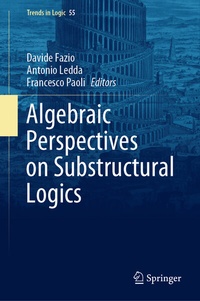
Algebraic Perspectives on Substructural Logics
Description

This volume presents the state of the art in the algebraic investigation into substructural logics. It features papers from the workshop AsubL (Algebra & Substructural Logics - Take 6). Held at the University of Cagliari, Italy, this event is part of the framework of the Horizon 2020 Project SYSMICS: SYntax meets Semantics: Methods, Interactions, and Connections in Substructural logics.
Substructural logics are usually formulated as Gentzen systems that lack one or more structural rules. They have been intensively studied over the past two decades by logicians of various persuasions. These researchers include mathematicians, philosophers, linguists, and computer scientists. Substructural logics are applicable to the mathematical investigation of such processes as resource-conscious reasoning, approximate reasoning, type-theoretical grammar, and other focal notions in computer science. They also apply to epistemology, economics, and linguistics. The recourse to algebraic methods-- or, better, the fecund interplay of algebra and proof theory -- has proved useful in providing a unifying framework for these investigations. The AsubL series of conferences, in particular, has played an important role in these developments. This collection will appeal to students and researchers with an interest in substructural logics, abstract algebraic logic, residuated lattices, proof theory, universal algebra, and logical semantics.More details
Other editions
Additional editions
Persons
Davide Fazio
is a Post-Doctoral Research Fellow at the University of Cagliari
Antonio Ledda is Full Professor of Logic at the University of Cagliari. His interests include algebraic logic, universal algebra, and the foundations of physics.
Francesco Paoli is a Full Professor of Logic at the University of Cagliari. He published, among other things, the book Substructural Logics: A Primer (Kluwer, 2002) and over 50 papers in international peer-reviewed journals. His research interests include nonclassical (substructural, quantum, many-valued) logics, universal algebra, and the foundations of physics.
Content
Chapter 1. Introduction.- Chapter 2. Distributivity and Varlet Distributivity (Paolo Aglianò).- Chapter 3. On Distributive Join Semilattices (Rodolfo C. Ertola-Biraben, Francesc Esteva, and Lluìs Godo).- Chapter 4. Implication in Weakly and Dually Weakly Orthomodular Lattices (Ivan Chajda, Helmut Länger).- Chapter 5. Residuated Operators And Dedekind-Macneille Completion (Ivan Chajda, Helmut Länger, Jan Paseka).- Chapter 6. Pbz* -Lattices: Ordinal And Horizontal Sums (Roberto Giuntini, Claudia Muresan, Francesco Paoli).- Chapter 7. Emv-Algebras - Extended MV-Algebras (Anatolij Dvurecenskij, Omid Zahiri).- Chapter 8. Quasi-Nelson; or, Non-Involutive Nelson Algebras (Umberto Rivieccio, Matthew Spinks).- Chapter 9. Hyperdoctrines and the Ontology of Stratified Semantics (Shay Allen Logan).
