

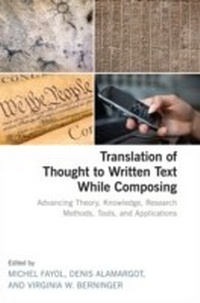
Translation of Thought to Written Text While Composing
Advancing Theory, Knowledge, Research Methods, Tools, and Applications
1st Edition
Published on 4. May 2012
408 pages
978-1-136-49671-4 (ISBN)
Description

Translation of cognitive representations into written language is one of the most important processes in writing. This volume provides a long-awaited updated overview of the field.
The contributors discuss each of the commonly used research methods for studying translation; theorize about the nature of the cognitive and language representations and cognitive/linguistic transformation mechanisms involved in translation during writing; and make the case that translation is a higher-order executive function that is fundamental to the writing process.
The book also reviews the application of research to practice -- that is, the translation of the research findings in education and the work-world for individuals who interact with others using written language to communicate ideas.
This volume provides a rich resource for student, theorists, and empirical researchers in cognitive psychology, linguistics, and education; and teachers and clinicians who can use the research in their work.
The contributors discuss each of the commonly used research methods for studying translation; theorize about the nature of the cognitive and language representations and cognitive/linguistic transformation mechanisms involved in translation during writing; and make the case that translation is a higher-order executive function that is fundamental to the writing process.
The book also reviews the application of research to practice -- that is, the translation of the research findings in education and the work-world for individuals who interact with others using written language to communicate ideas.
This volume provides a rich resource for student, theorists, and empirical researchers in cognitive psychology, linguistics, and education; and teachers and clinicians who can use the research in their work.
Reviews / Votes
"Panoramic in scope, theoretically dense, and finely detailed, this book is must reading for every writing researcher. It is a state-of-the-art resource that will support for many years to come professionals interested in advancing the knowledge of writing processes and improving instructional practices at all levels." - Paul M. Rogers, Ph.D., George Mason University, USA"This book represents a major leap forward in our understanding of the Translation processes involved in writing. The international and interdisciplinary set of authors present a critical outlook on research about translation that encompasses recent advances in both theory and methods. This allows the reader to gain a detailed and very up to date appreciation of the importance of translation to the development of writing." - Vince Connelly, Ph.D., Oxford Brookes University, UK
"This fascinating new book brings together disparate lines of research on translation processes in writing to create new insights. Translation -- the empty box in the original Hayes and Flower model of writing -- is where cognitive representations and language merge to create text and, thus, is central to understanding writing. This book should be required reading for every serious student of writing." - Charles MacArthur, Ph.D., University of Delaware, USA
More details
Language
English
Place of publication
London
United Kingdom
Publishing group
Taylor & Francis Ltd
Target group
College/higher education
File size
7,57 MB
ISBN-13
978-1-136-49671-4 (9781136496714)
Copyright in bibliographic data and cover images is held by Nielsen Book Services Limited or by the publishers or by their respective licensors: all rights reserved.
Schweitzer Classification
Other editions
Additional editions
Michel Fayol | M. Denis Alamargot | Virginia Berninger
Translation of Thought to Written Text While Composing
Advancing Theory, Knowledge, Research Methods, Tools, and Applications
Book
05/2017
1st Edition
Psychology Press Ltd
€76.94
Shipment within 10-20 days
Michel Fayol | M. Denis Alamargot | Virginia Berninger
Translation of Thought to Written Text While Composing
Advancing Theory, Knowledge, Research Methods, Tools, and Applications
Book
02/2012
1st Edition
Psychology Press Ltd
€207.50
Shipment within 3-4 weeks
Persons
Michel Fayol, M. Denis Alamargot, Virginia Berninger
Content
Part 1. Reexamining What Translation is and Its Role in Writing. Fayol, Alamargot, Berninger, Introduction to the Volume: From Cave Writers to Elite Scribes to Professional Writers to Universal Writers: Translation is Fundamental to Writing. Hayes, Translation and its Relation to Other Writing Processes: Evidence from Language Bursts, Revision, and Transcription. Berninger, Rijlaarsdam, Fayol, Mapping Research Questions about Translation to Methods, Measures, and Models. Part 2. Individual Differences and Developmental Research Methods for Generating and Applying Theory of Translation at Different Levels of Language to Writing. Berninger, Fayol, Alamargot, Contribution of the Pattern Analyzer, Oracle, Cross-Code Talker, Cross-Code Scribe, and Silent Orthographer in Learning to Transcribe and Translate at the Word-Level. Berninger, Hayes, Twenty Children on Writing Treks: Intra-Individual and Inter-Individual Variation in Their Developing, Self-Regulated Translation and Related Processes Grades 1 to 5. Verheyden, Van den Branden, Rijlaarsdam, Van den Bergh, De Maeijer, Translation Skills and Trade-Off in Young L2-Learners' Written Narrations. Part 3. Instructional Research with Improving Translation in Mind. Jones, Christensen, Impact of Teacher Professional Development on Understanding the Role of Handwriting during Translation of Beginning Writers: Improved Handwriting and Story Composing. Costa, Kitson, Knuth, Miller, Yerby, Anderson, Hooper, Beginning Writer's Translational Processes during Composing: Insights from Selected Neuropsychological Findings, Self-Talk Strategies, and Evidence-Based Interventions. Puranik, Wagner, Kim, Lopez, Assessing Elementary Students' Transcription and Text Generation during Written Translation: A Multivariate Approach. Dunn, Facilitating Children's Translation of Ideas into Written Language through Combining Art Activities and Self-Regulated Strategy Instruction for Writing. Part 4. Experimental Methods for Studying Translation in Real Time in Adults and Children. Fayol, Lete, From Ideas to Written Text: The Contribution of On-Line Studies to Understanding Written Composition. Alamargot, Chesnut, Caporossi, Using Eye and Pen Movements to Study the Writing Process. Lambert, Alamargot, Fayol, Why Use a Copy Task to Study Spelling in Handwriting? Part 5. Reflections on Past, Present, and Future of Translation Research. Neef, Braunschweig, Translation in the Context of Theoretical Writing System Research. Torrance, Final Comments on Translation. Glossary.
