

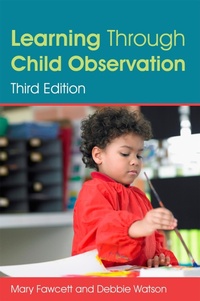
Learning Through Child Observation, Third Edition
3rd Edition
Published on 21. April 2016
224 pages
978-1-78450-141-9 (ISBN)
Description

This fully updated third edition of Learning Through Child Observation is a handbook for professionals working in, or students preparing to work in, children's services.
This accessible text examines the value of observation, its use in assessment and the practical aspects and methods of observational study. The authors focus on the importance of fully recognising the child's developmental and emotional state when intervening, and the need to see children 'holistically' and as unique individuals within the wider context of the family and community. This new edition reflects updates to policy and practice and further develops the critical perspective on contemporary thinking about childhood and observational methods. This edition has also expanded its focus to include observation of primary-aged children.
A popular text, it will appeal to students and professionals in all children's services, whether in pre-school, schools, social care, mental health or health settings.
This accessible text examines the value of observation, its use in assessment and the practical aspects and methods of observational study. The authors focus on the importance of fully recognising the child's developmental and emotional state when intervening, and the need to see children 'holistically' and as unique individuals within the wider context of the family and community. This new edition reflects updates to policy and practice and further develops the critical perspective on contemporary thinking about childhood and observational methods. This edition has also expanded its focus to include observation of primary-aged children.
A popular text, it will appeal to students and professionals in all children's services, whether in pre-school, schools, social care, mental health or health settings.
Reviews / Votes
Child observation has a long history and this new edition of Mary Fawcett's popular title intriguingly reflects changing concerns for work with children over the past 20 years when the book first appeared. The embedded historicity in the most recent edition strengthens the book's main message, that we should attend carefully both the context of observation and to what we ourselves bring to that context through our own experiences. The book is aimed at a broad range of students who need to develop skills in using observation as they prepare for their particular place in the children's workforce, starting with a simple introduction to major theorists in the field of childhood studies, the different reasons to observe - to learn, to assess, to research, to safeguard and to be professionally alert - and different methods of observation from unstructured diaries to more structured approaches. The practicalities of observation are given due prominence alongside the importance of ethical considerations. Students will certainly value the chapter on what to do with the information they have gathered, how to manage the sometimes controversial links between observation and assessment and the importance of clarifying terminology when sharing observations in interprofessional contexts. -- Jan Georgeson, Research Fellow, Plymouth Institute of Education, UKMore details
Edition
3rd Revised edition
Language
English
Place of publication
London
United Kingdom
Target group
Primary & secondary/elementary & high school
College/higher education
Professional and scholarly
Edition type
Revised edition
File size
3,25 MB
ISBN-13
978-1-78450-141-9 (9781784501419)
Copyright in bibliographic data and cover images is held by Nielsen Book Services Limited or by the publishers or by their respective licensors: all rights reserved.
Schweitzer Classification
Other editions
Additional editions
Mary Fawcett | Debbie Watson
Learning Through Child Observation, Third Edition
Book
04/2016
3rd Edition
Jessica Kingsley Publishers
€29.00
Shipment within 15-20 days
Persons
Mary Fawcett is an early years consultant and also an evaluator for 5x5x5=creativity, an arts-based research organisation focusing on the creative values, environments and relationships that support the expression of children's feelings, thoughts and ideas. She was formerly a social work lecturer and Director of Early Childhood Studies at the University of Bristol.
Debbie Watson is Reader in Childhood Studies at the University of Bristol and the Director of the PhD programmes. Debbie is an experienced teacher in schools and in Higher Education. In particular, her interests are in the sociology of childhood, diversities in childhood, research with children and in the wellbeing of children and young people.
Debbie Watson is Reader in Childhood Studies at the University of Bristol and the Director of the PhD programmes. Debbie is an experienced teacher in schools and in Higher Education. In particular, her interests are in the sociology of childhood, diversities in childhood, research with children and in the wellbeing of children and young people.
Content
- Intro
- Learning Through Child Observation (Third Edition) by Mary Fawcett and Debbie Watson
- Acknowledgements
- Introduction
- 1. Why Observation Matters
- Introduction
- The nature of observation
- UK national context
- Professional development
- 2. Views on Children and Childhood
- Introduction
- What then is a child? What might be considered 'child-like' behaviour?
- Historical perspectives
- The observer's view of children and childhood
- Topics to consider
- Professional bias
- 3. Changing Views of Child Observation
- Historical perspectives
- Contemporary views of child development
- Sociology of childhood/childhood studies
- 4. Observational Methods and Practice
- Introduction
- Underlying issues
- Selecting a method
- Making a start on child observation studies
- Setting up an observation: contacting a preschool group and selecting a child
- Carrying out an observation
- Evaluation of observational visits
- 5. Child Observations: Themes and Lines of Enquiry
- Introduction
- Key issues in development
- Reflection on themes
- A final note
- 6. Observation and Assessment
- Introduction
- The concept of assessment
- Assessment issues in integrated services
- 7. Supporting Child Observation
- Introduction
- Background
- Learning objectives and key issues in observation
- Teaching observation skills
- Conclusion
- 8. Observation, Reflection and Documentation: The Reggio Emilia Approach
- Introduction
- The Reggio Emilia approach
- The 'hundred languages of children': variety in communicating meaning
- Conclusion
- 9. Observation, Reflection and Documentation in Action: Co-producing Research Tools with Room 13
- Introduction
- Room 13 Hareclive
- Children as co-researchers
- The project
- Children as observers
- Conclusion
- Conclusion
- Appendix: The Task Code Categories from the Oxford Preschool Project
- References
- Subject Index
- Author index
- Blank Page
