

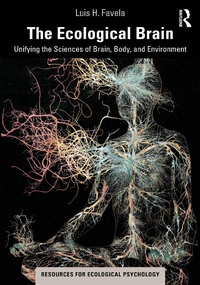
The Ecological Brain
Unifying the Sciences of Brain, Body, and Environment
1st Edition
Published on 22. December 2023
212 pages
978-1-003-83035-1 (ISBN)
Description

The Ecological Brain is the first book of its kind, using complexity science to integrate the seemingly disparate fields of ecological psychology and neuroscience. The book develops a unique framework for unifying investigations and explanations of mind that span brain, body, and environment: the NeuroEcological Nexus Theory (NExT).
Beginning with an introduction to the history of the fields, the author provides an assessment of why ecological psychology and neuroscience are commonly viewed as irreconcilable methods for investigating and explaining cognition, intelligent behavior, and the systems that realize them. The book then progresses to its central aim: presenting a unified investigative and explanatory framework offering concepts, methods, and theories applicable across neural and ecological scales of investigation. By combining the core principles of ecological psychology, neural population dynamics, and synergetics under a unified complexity science approach, NExT offers a compressive investigative framework to explain and understand neural, bodily, and environmental contributions to perception-action and other forms of intelligent behavior and thought.
The book progresses the conversation around the role of brains in ecological psychology, as well as bodies and environments in neuroscience. It is essential reading for all students of ecological psychology, perception, cognitive sciences, and neuroscience, as well as anyone interested in the history and philosophy of the brain/mind sciences and their state-of-the-art methods and theories.
Beginning with an introduction to the history of the fields, the author provides an assessment of why ecological psychology and neuroscience are commonly viewed as irreconcilable methods for investigating and explaining cognition, intelligent behavior, and the systems that realize them. The book then progresses to its central aim: presenting a unified investigative and explanatory framework offering concepts, methods, and theories applicable across neural and ecological scales of investigation. By combining the core principles of ecological psychology, neural population dynamics, and synergetics under a unified complexity science approach, NExT offers a compressive investigative framework to explain and understand neural, bodily, and environmental contributions to perception-action and other forms of intelligent behavior and thought.
The book progresses the conversation around the role of brains in ecological psychology, as well as bodies and environments in neuroscience. It is essential reading for all students of ecological psychology, perception, cognitive sciences, and neuroscience, as well as anyone interested in the history and philosophy of the brain/mind sciences and their state-of-the-art methods and theories.
Reviews / Votes
"The brain is just a brain. It has no function without the body and the environmental niche it occupies. The Ecological Brain is an attempt to explain this trivial yet often neglected embeddedness, integrating recent knowledge from psychology and neuroscience research." Gyoergy Buzsaki, M.D., Ph.D., Biggs Professor of Neural Sciences, NYU Neuroscience Institute, New York University, USA"After decades of asking what your head's inside of, ecological psychologists are beginning to ask, "what's inside your head?" In The Ecological Brain, Luis Favela takes seriously the claim that mind is low-dimensional dynamics in a brain-body-environment system. By synthesizing complexity theory, nonlinear dynamics, and recent work on neural manifolds, he points a way forward for understanding perception and action at neural, organism, and ecological scales." William H. Warren, Chancellor's Professor of Cognitive Science, Brown University, USA
More details
Series
Edition
1. Auflage
Language
English
Place of publication
London
United Kingdom
Publishing group
Taylor & Francis Ebooks
Target group
College/higher education
Illustrations
2 Tables, black and white; 19 Line drawings, black and white; 8 Halftones, black and white; 27 Illustrations, black and white
ISBN-13
978-1-003-83035-1 (9781003830351)
Copyright in bibliographic data and cover images is held by Nielsen Book Services Limited or by the publishers or by their respective licensors: all rights reserved.
Schweitzer Classification
Other editions
Additional editions
Book
12/2023
1st Edition
Routledge
€204.20
Shipment within 15-20 days
Book
12/2023
1st Edition
Routledge
€71.50
Shipment within 15-20 days
Person
Luis H. Favela is Associate Professor of Philosophy and Cognitive Sciences at the University of Central Florida, USA, and is a fellow with the Research Corporation for Science Advancement. His research is interdisciplinary, situated at the intersections of the cognitive sciences, experimental psychology, and the philosophies of mind and science.
Content
1. Making everybody upset 2. Why "ecological" psychology? 3. The sins of cognitivism visited upon neuroscience 4. The varieties of ecological neuroscience 5. Foundations of complexity science for the mind sciences 6. What is NExT? NeuroEcological Nexus Theory 7. Putting the NeuroEcological Nexus Theory to work 8. Conclusion
