

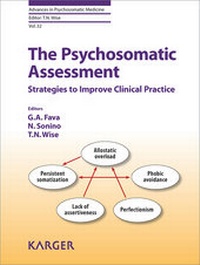
The Psychosomatic Assessment
Strategies to Improve Clinical Practice.
1st Edition
Published on 20. October 2011
246 pages
978-3-8055-9854-5 (ISBN)
Available for download
Description

Patient reported outcomes have become more and more important in clinical practice and research. Evaluating subjective perceptions of patients has become mandatory for a full assessment of treatment responses. In this context, clinimetrics, the science of clinical measurements, provides unprecedented opportunities for psychosomatic assessment. This volume illustrates how this approach can be translated into everyday practice complementing and improving the medical interview. The most sensitive and reliable clinical methods are presented for evaluating specific psychosocial aspects of disease, i.e. childhood adversities, life events and chronic stress, lifestyle, sexual function, subclinical and affective disturbances, personality, illness behavior, well-being and family dynamics. Each chapter provides practical illustrations as to how crucial information can be obtained with specific methods individualized according to the patients' needs. A hyperlink is provided to a website that contains many of the instruments assessed in the volume. This book enables the reader to understand the value of patient reported outcomes in clinical practice. It is intended to expand and refine the skills of clinicians who work in general and specialized medicine and psychiatry, whether physicians, psychologists or other health professionals.
More details
Other editions
Additional editions
Book
10/2011
1st Edition
S. Karger
€61.00
Article exhausted; check different version
Persons
Content
- Cover
- Contents
- Preface
- Principles of Psychosomatic Assessment
- Abstract
- Assessment of Psychosocial Factors Affecting Individual Vulnerability
- The Clinimetric Approach
- Pathophysiological Implications
- Clinical Implications
- Current Issues
- References
- The Psychosomatic Interview
- Abstract
- The Interview Process
- The Interview Itself
- Breaking Bad News
- Motivational Interviewing
- Putting It Together
- Conclusion
- References
- Evaluating Childhood Adversity
- Abstract
- Discussion of Adverse Childhood Events
- Review of Instruments to Evaluate Childhood Adverse Experiences
- Some Good Quality Instruments
- Conclusions and Future Recommendations
- References
- Evaluating Life Events and Chronic Stressors in Relation to Health: Stressors and Health in Clinical Work
- Abstract
- Stressors
- Critical Life Events
- Standardized Methods for Recording Typical Critical Life Events That People May Experience
- Triggers and Habitual Levels of Critical Life Changes
- Positive and Negative Life Changes
- Detailed Interviews Regarding Critical Life Events - A Sociological Perspective
- Work and Unemployment as Stressors
- How to Measure the Psychosocial Work Environment?
- Unemployment
- Combinations of Social Background/Childhood Adversity and Adult Life Stressors
- Physiological Correlates
- Conclusion
- References
- Assessment of Lifestyle in Relation to Health
- Abstract
- Assessing Behaviors: Behavioral and Quantitative Approaches
- Habitual Diet Intake and Health
- Physical Activity and Health
- Alcohol, Smoking and Drug Consumption: A General Overview
- Alcohol Consumption and Health
- Smoking and Health
- Illicit Drug Consumption and Health
- Conclusion
- References
- Assessment of Sexual Function in the Medically Ill: Psychosomatic Approach to Sexual Functioning
- Abstract
- General Issues
- Psychosomatic Assessment of Sexual Functioning
- Conclusion
- References
- Psychological Factors in Medical Disorders Assessed with the Diagnostic Criteria for Psychosomatic Research
- Abstract
- The Diagnostic Criteria for Psychosomatic Research-Structured Interview
- Abnormal Illness Behavior
- Somatization
- Irritability
- Demoralization
- Alexithymia
- Conclusion
- References
- Mood and Anxiety in the Medically Ill
- Abstract
- Reliability
- Rating Scales for Depression
- Rating Scales for Anxiety
- Discussion and Conclusion
- References
- Assessment of Personality in Psychosomatic Medicine: Current Concepts
- Abstract
- Alexithymia
- Type A Personality
- Type D Personality
- Temperament and Character
- The Five-Factor Model
- Conclusions
- References
- Illness Behavior
- Abstract
- Sick Role and Illness Behavior
- Abnormal Illness Behavior
- Assessment of Somatization
- Assessment of the Hypochondriacal Spectrum
- Assessment of Illness Denial
- Illness Perception
- Conclusions
- References
- Assessment of Psychological Well-Being in Psychosomatic Medicine
- Abstract
- Relationship between Well-Being and Symptomatology: Kellner's Symptom Questionnaire
- Salutogenesis and Its Influence on Health: The Sense of Coherence Scale
- Psychological Well-Being and Health
- Conclusions
- References
- Family Assessment in the Medical Setting
- Abstract
- Family Assessment
- Individual Life Cycle Tasks
- Family Life Cycle Tasks
- Including the Family in the Evaluation of a Patient
- Assessment of the Family
- Additional Investigations
- Problem Description
- Problem Clarification
- Tools for Family Assessment
- Subjective Family Rating Scales
- Externally Rated Instruments of Family Functioning
- General Assessment Issues
- Conclusion
- References
- Relational Ethics and Psychosomatic Assessment
- Abstract
- Ethical Foundations
- Relational Ethics
- Process of Deliberation
- Major Ethical Problems in Psychosomatic Medicine
- Conclusions
- References
- Author Index
- Subject Index
- Cover

