

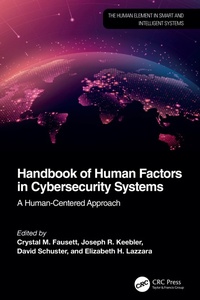
Handbook of Human Factors in Cybersecurity Systems
A Human-Centered Approach
1st Edition
Published on 28. January 2026
288 pages
978-1-040-49932-0 (ISBN)
Description

Data and security breaches can cost organizations millions and result in bad publicity and lost income, with humans often being regarded as the "weakest link" in cybersecurity incidents. This book is a cross-disciplinary primer on the latest research on human aspects of cybersecurity, reimagining the role of humans in cybersecurity systems. It aims to increase participation in research on the emerging, critical, and impactful area of human factors of cybersecurity by orienting human factors researchers, professionals, and students to cybersecurity issues while providing them with comprehensive, cross-cutting knowledge from human factors that applies to this emerging area.
Across nine chapters, the Handbook of Human Factors in Cybersecurity Systems covers the essential topics for understanding humans to optimize cybersecurity system performance. Topics included cover system safety, cybersecurity teams, safety culture, cyberattacks, defence approaches, phishing, emerging cybersecurity threats and many more. The book investigates cybersecurity across numerous industries, including aviation and healthcare, and is backed up by interesting, real-life case studies. The reader will develop a full and thorough understanding of how to integrate human factors principles with cybersecurity practices.
With chapters from a team of global experts, this book is an essential read for any student, academic or professional in the disciplines of computer engineering, systems engineering, safety engineering, human factors and ergonomics and cybersecurity engineering.
Across nine chapters, the Handbook of Human Factors in Cybersecurity Systems covers the essential topics for understanding humans to optimize cybersecurity system performance. Topics included cover system safety, cybersecurity teams, safety culture, cyberattacks, defence approaches, phishing, emerging cybersecurity threats and many more. The book investigates cybersecurity across numerous industries, including aviation and healthcare, and is backed up by interesting, real-life case studies. The reader will develop a full and thorough understanding of how to integrate human factors principles with cybersecurity practices.
With chapters from a team of global experts, this book is an essential read for any student, academic or professional in the disciplines of computer engineering, systems engineering, safety engineering, human factors and ergonomics and cybersecurity engineering.
Reviews / Votes
Covers why humans are referred to as the "weakest link" in cybersecurity, making the scientific discipline of human factors especially relevantCombines author expertise from both human factors and cybersecurity domains
Delivers a first of its kind title since cybersecurity is a relatively understudied domain within human factors science
Provides a timely publication since the cybersecurity workforce is at an all time high Includes case studies from major companies that show examples of good and bad practice
More details
Series
Edition
1. Auflage
Language
English
Place of publication
London
United Kingdom
Publishing group
Taylor & Francis Ltd
Target group
College/higher education
Professional and scholarly
Illustrations
14 Line drawings, black and white; 6 Halftones, black and white; 20 Illustrations, black and white
File size
7,91 MB
ISBN-13
978-1-040-49932-0 (9781040499320)
Copyright in bibliographic data and cover images is held by Nielsen Book Services Limited or by the publishers or by their respective licensors: all rights reserved.
Schweitzer Classification
Other editions
Additional editions
Crystal Fausett | Joseph R. Keebler | David Schuster
Handbook of Human Factors in Cybersecurity Systems
A Human-Centered Approach
Book
approx. 01/2026
1st Edition
CRC Press
€135.50
Not yet published
Persons
Dr. Crystal Fausett is an Assistant Professor in the School of Information at San Jose State University, USA, specializing in human-technology interaction and systems design. With expertise spanning healthcare, cybersecurity, and military operations, her research examines how diverse user groups interact with complex systems and process critical information under varying conditions. As an advocate for human-centered approaches to technology, she is dedicated to developing systems that accommodate human capabilities while mitigating limitations; transforming users from "the weakest link" into essential partners. Dr. Fausett holds a PhD in Human Factors from Embry-Riddle Aeronautical University, USA.
Dr. Joseph R. Keebler is a Professor of Human Factors at Embry-Riddle Aeronautical University, USA, and has over 20 years of experience conducting experimental and applied Human Factors science, with a specific focus on training and teamwork in medical, military, and consumer domains. He has partnered with multiple agencies leading projects aimed at the implementation of HF/E in complex, high-risk systems to increase safety and human performance. He directs the Small Teams Analog Research (STAR) laboratory, and co-directs the Research Engineering and Applied Collaborations in Healthcare (REACH) Laboratory. These laboratories include a team of faculty and students who work to solve real-world teamwork and training issues, with STAR focusing on training and teamwork in aerospace, cybersecurity, robotics, and artificial intelligence, and REACH focusing on patient safety, training, and teamwork issues in healthcare settings. He holds a PhD in Psychology from the University of Central Florida, USA.
Dr. David Schuster is a Professor in the Department of Psychology at San Jose State University, USA, and Principal Investigator at the Virtual Environments, Cognition, and Training Research (VECTR) Lab. Dr. Schuster's research centers on understanding individual and shared cognition in complex environments. He has conducted research in domains such as aviation, transportation security training, and human-robot interaction. He is interested in how complex sociotechnical systems support or hinder people, with a focus on decision-making among cybersecurity professionals. He holds a Ph.D. in Psychology from the University of Central Florida, USA, specializing in Applied Experimental and Human Factors Psychology.
Dr. Elizabeth H. Lazzara is an Associate Professor at Embry-Riddle Aeronautical University, USA. She currently co-leads the Research, Engineering, and Applied Collaboration in Healthcare (REACH). Although she has extensive experiences in military, academic, and commercial settings, her primary interests lie within improving the quality of patient care within the healthcare domain. Dr. Lazzara strives to make a long-lasting and significant impact by examining and advancing the science and practice of clinical care and patient safety issues pertaining to human performance, teamwork, team training, simulation-based training, and performance measurement. She holds a PhD in Human Factors Psychology from the University of Central Florida.
Dr. Joseph R. Keebler is a Professor of Human Factors at Embry-Riddle Aeronautical University, USA, and has over 20 years of experience conducting experimental and applied Human Factors science, with a specific focus on training and teamwork in medical, military, and consumer domains. He has partnered with multiple agencies leading projects aimed at the implementation of HF/E in complex, high-risk systems to increase safety and human performance. He directs the Small Teams Analog Research (STAR) laboratory, and co-directs the Research Engineering and Applied Collaborations in Healthcare (REACH) Laboratory. These laboratories include a team of faculty and students who work to solve real-world teamwork and training issues, with STAR focusing on training and teamwork in aerospace, cybersecurity, robotics, and artificial intelligence, and REACH focusing on patient safety, training, and teamwork issues in healthcare settings. He holds a PhD in Psychology from the University of Central Florida, USA.
Dr. David Schuster is a Professor in the Department of Psychology at San Jose State University, USA, and Principal Investigator at the Virtual Environments, Cognition, and Training Research (VECTR) Lab. Dr. Schuster's research centers on understanding individual and shared cognition in complex environments. He has conducted research in domains such as aviation, transportation security training, and human-robot interaction. He is interested in how complex sociotechnical systems support or hinder people, with a focus on decision-making among cybersecurity professionals. He holds a Ph.D. in Psychology from the University of Central Florida, USA, specializing in Applied Experimental and Human Factors Psychology.
Dr. Elizabeth H. Lazzara is an Associate Professor at Embry-Riddle Aeronautical University, USA. She currently co-leads the Research, Engineering, and Applied Collaboration in Healthcare (REACH). Although she has extensive experiences in military, academic, and commercial settings, her primary interests lie within improving the quality of patient care within the healthcare domain. Dr. Lazzara strives to make a long-lasting and significant impact by examining and advancing the science and practice of clinical care and patient safety issues pertaining to human performance, teamwork, team training, simulation-based training, and performance measurement. She holds a PhD in Human Factors Psychology from the University of Central Florida.
Content
0. You Can't Take the Human Out of Cybersecurity: Reimagining People as Partners, Not Problems. 1. Applying Sociotechnical Systems Safety to Cybersecurity. 2. Human Factors within the Cybersecurity Domain. 3. Cybersecurity Incident Response Teams and Multiteam Systems: An Input-Process-Output Framework. 4. Enhancing Cybersecurity Through Teamwork: Developing Effective Security Operation Center Teams. 5. Insights and Recommendations for Improving Handoff Processes in Cybersecurity Operations Centers. 6. Oppositional Human Factors. 7. Complex Healthcare Systems in the Modern Social Engineering Landscape: The Human Factors of System Survivability. 8. Machine Learning for Device Identification with Application in Aviation Cybersecurity. 9. Cybersecurity and Ground Transportation.
