

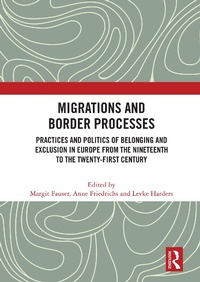
Migrations and Border Processes
Practices and Politics of Belonging and Exclusion in Europe from the Nineteenth to the Twenty-First Century
1st Edition
Published on 13. May 2021
162 pages
978-1-000-34393-9 (ISBN)
Description

Migrations and Border Processes: Practices and Politics of Belonging and Exclusion in Europe from the Nineteenth to the Twenty-First Century brings together scholars from history, sociology and anthropology to explore cross-boundary mobility and migration during the formation, development, and transformation of the modern (nation-)state explicating the conflictive and fluctuating character of borders.
Current media images of a "fortress Europe" suggest that migrations and borders are closely connected. The historical perspective demonstrates that such bordering processes are not new. However, they have developed new dynamics in different historical phases, from the formation of the modern (nation-)state in the nineteenth century to the creation of the European Union during the second half of the twentieth century. This book explains the dynamic relationships between borders and migratory movements in Europe from the nineteenth century to the present by approaching them from four different, overlapping angles: (1) the multiple actors involved, (2) scales and places of borders and their crossings, (3) the instruments and techniques employed and (4) the significance of social categories. Focusing on the historical, local specificity of the complex relations between migrations and boundaries will help denaturalize the concept of the border as well as further reflection on the shifting definitions of migration and belonging.
The chapters in this book were originally published as a special issue of the Journal of Borderlands Studies.
Current media images of a "fortress Europe" suggest that migrations and borders are closely connected. The historical perspective demonstrates that such bordering processes are not new. However, they have developed new dynamics in different historical phases, from the formation of the modern (nation-)state in the nineteenth century to the creation of the European Union during the second half of the twentieth century. This book explains the dynamic relationships between borders and migratory movements in Europe from the nineteenth century to the present by approaching them from four different, overlapping angles: (1) the multiple actors involved, (2) scales and places of borders and their crossings, (3) the instruments and techniques employed and (4) the significance of social categories. Focusing on the historical, local specificity of the complex relations between migrations and boundaries will help denaturalize the concept of the border as well as further reflection on the shifting definitions of migration and belonging.
The chapters in this book were originally published as a special issue of the Journal of Borderlands Studies.
More details
Edition
1. Auflage
Language
English
Place of publication
London
United Kingdom
Publishing group
Taylor & Francis Ltd
Target group
College/higher education
ISBN-13
978-1-000-34393-9 (9781000343939)
Copyright in bibliographic data and cover images is held by Nielsen Book Services Limited or by the publishers or by their respective licensors: all rights reserved.
Schweitzer Classification
Other editions
Additional editions
Margit Fauser | Anne Friedrichs | Levke Harders
Migrations and Border Processes
Practices and Politics of Belonging and Exclusion in Europe from the Nineteenth to the Twenty-First Century
Book
09/2023
1st Edition
Routledge
€51.98
Shipment within 15-20 days
Margit Fauser | Anne Friedrichs | Levke Harders
Migrations and Border Processes
Practices and Politics of Belonging and Exclusion in Europe from the Nineteenth to the Twenty-First Century
Book
02/2021
1st Edition
Routledge
€206.50
Shipment within 15-20 days
Persons
Margit Fauser is Professor of Migration, Transculturality and Internationalization at the Darmstadt University of Applied Sciences, Germany.
Anne Friedrichs is Postdoctoral Researcher at the Leibniz Institute of European History in Mainz, Germany.
Levke Harders is Assistant Professor at the Department of History, University of Bielefeld, Germany.
Anne Friedrichs is Postdoctoral Researcher at the Leibniz Institute of European History in Mainz, Germany.
Levke Harders is Assistant Professor at the Department of History, University of Bielefeld, Germany.
Content
Introduction
Migrations and Border Processes: Practices and Politics of Belonging and Exclusion in Europe from the Nineteenth to the Twenty-first Century
Margit Fauser, Anne Friedrichs and Levke Harders
1. The Multilayered Migration Regime in Turkey: Contested Regionalization, Deceleration and Legal Precarization
Firat Genc, Gerda Heck and Sabine Hess
2. Homogenous and Extra-territorial Border Regime? Migrations and Control Efforts Across the Eastern EU External Border
Bettina Bruns
3. The Creation of Illegal Migration in the German Confederation, 1815-1866
Michael Schubert
4. Engines of Social Change? Peasant Migration and the Transgression of Spatial, Legal and Cultural Divides in Late Imperial Russia
Lutz Karl Haefner
5. Belonging, Migration, and Profession in the German-Danish Border Region in the 1830s
Levke Harders
6. A Site of Shifting Boundaries: Fostering and Limiting Mobility in the Ruhr Valley (1860-1910)
Anne Friedrichs
7. The Emergence of Urban Border Spaces in Europe
Margit Fauser
8. Conclusion: Historical Perspectives on Borderlands, Boundaries and Migration Control
Andreas Fahrmeir
Migrations and Border Processes: Practices and Politics of Belonging and Exclusion in Europe from the Nineteenth to the Twenty-first Century
Margit Fauser, Anne Friedrichs and Levke Harders
1. The Multilayered Migration Regime in Turkey: Contested Regionalization, Deceleration and Legal Precarization
Firat Genc, Gerda Heck and Sabine Hess
2. Homogenous and Extra-territorial Border Regime? Migrations and Control Efforts Across the Eastern EU External Border
Bettina Bruns
3. The Creation of Illegal Migration in the German Confederation, 1815-1866
Michael Schubert
4. Engines of Social Change? Peasant Migration and the Transgression of Spatial, Legal and Cultural Divides in Late Imperial Russia
Lutz Karl Haefner
5. Belonging, Migration, and Profession in the German-Danish Border Region in the 1830s
Levke Harders
6. A Site of Shifting Boundaries: Fostering and Limiting Mobility in the Ruhr Valley (1860-1910)
Anne Friedrichs
7. The Emergence of Urban Border Spaces in Europe
Margit Fauser
8. Conclusion: Historical Perspectives on Borderlands, Boundaries and Migration Control
Andreas Fahrmeir
