

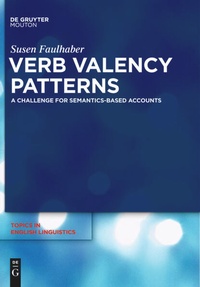
Verb Valency Patterns
Description

Taking as its point of departure the general assumption that meaning is crucial in accounting for verb complementation, this volume presents the results of an empirical study of verb complementation patterns of semantically similar English verbs. The semantic parallels of the verbs selected are based on their coverage in dictionaries - first and foremost the Valency Dictionary of English (Herbst, Heath, Roe and Götz 2004) - as well as corpus research and native speaker assessments. It is demonstrated that despite obvious similarities in complementation between such verbs, there are still a significant number of syntactic discrepancies which cannot be accounted for on the basis of meaning alone and that semantic factors - such as selection restrictions and aspectual properties - do not sufficiently correlate with the verbs' syntactic properties and consequently do not have sufficient explanatory power.
Thus the results rigorously challenge so-called projectionist approaches which assume the position that complementation is determined by semantic properties and thus ought to be predictable on this basis. In the light of a general trend towards placing greater emphasis on semantic aspects, in the fields of construction grammar and cognitive grammar too, the number of idiosyncratic phenomena on the level of single complements as well as whole patterns clearly underlines the importance of storage phenomena as opposed to rule-based generation. As such it stresses the necessity of finding ways to systematically account for item-specific properties of verbs in any grammatical theory of the English language.
The book is targeted at all linguists interested in the relationship between semantics and syntax, which is one of the prevalent questions in modern linguistics, also in the field of construction grammar and cognitive grammar. Since the data is presented in a way which is compatible with various theories of complementation, the target group is clearly not restricted to any specific linguistic school. Because of the large amount of item-specific information presented, this book is also a valuable source for grammarians and lexicographers.
More details
Other editions
Additional editions
Person
Content
2 - Contents [Seite 8]
3 - Figures [Seite 11]
4 - Tables [Seite 13]
5 - Abbreviations [Seite 16]
6 - 1 Introduction [Seite 18]
6.1 - 1.1 Major questions [Seite 18]
6.2 - 1.2 The model of analysis - overview and important concepts [Seite 20]
6.2.1 - 1.2.1 Valency models - a brief overview [Seite 20]
6.2.2 - 1.2.2 Valency carriers, complements and adjuncts, and different types of valency [Seite 21]
6.2.3 - 1.2.3 Valency patterns [Seite 23]
6.2.4 - 1.2.4 Optionality of complements [Seite 25]
6.2.5 - 1.2.5 Subject complement unit (SCU) and predicate complement units (PCUs) [Seite 27]
6.2.6 - 1.2.6 Levels of valency and the use of semantic roles [Seite 28]
6.2.7 - 1.2.7 Valency constructions [Seite 32]
6.2.8 - 1.2.8 Complement types [Seite 33]
6.2.9 - 1.2.9 Participant roles [Seite 34]
6.3 - 1.3 Design of the study [Seite 37]
7 - 2 The meaning of complements [Seite 40]
7.1 - 2.1 Complement types as part of a verb's valency structure [Seite 40]
7.1.1 - 2.1.1 Overview [Seite 40]
7.1.2 - 2.1.2 Complement types [Seite 40]
7.1.3 - 2.1.3 Valency structures - introducing the model used [Seite 46]
7.2 - 2.2 Alternative realizations of participants [Seite 49]
7.2.1 - 2.2.1 Semantic specialization vs. synonymy of complement types [Seite 49]
7.2.1.1 - 2.2.1.1 AGENT + talk + TOPIC [Seite 49]
7.2.1.2 - 2.2.1.2 AGENT + agree + TOPIC/REFERENCE [Seite 53]
7.2.1.3 - 2.2.1.3 AGENT + forget + ÆFFECTED [Seite 64]
7.2.2 - 2.2.2 Polysemous complement types [Seite 66]
7.2.2.1 - 2.2.2.1 AGENT + cheat + REFERENCE [Seite 66]
7.2.2.2 - 2.2.2.2 AGENT + argue + TOPIC/REFERENCE [Seite 72]
7.2.2.3 - 2.2.2.3 AGENT + inform + TOPIC [Seite 77]
7.2.3 - 2.2.3 Blocked patterns [Seite 81]
7.3 - 2.3 Conclusion [Seite 84]
7.3.1 - 2.3.1 No stable semantic properties [Seite 85]
7.3.2 - 2.3.2 Synonymous and polysemous complement types [Seite 95]
8 - 3 Pattern choice and verb meaning [Seite 99]
8.1 - 3.1 Assessing the role of verb meaning - theoretical assumptions [Seite 99]
8.2 - 3.2 A comparison of semantically similar verbs [Seite 103]
8.2.1 - 3.2.1 The database - introduction and description of methodology [Seite 103]
8.2.2 - 3.2.2 Semantically similar verbs and their pattern inventories [Seite 109]
8.2.3 - 3.2.3 Results of the analysis - quantitative evaluation [Seite 131]
8.3 - 3.3 Phenomena identified in the analysis [Seite 141]
8.3.1 - 3.3.1 Complementation options in a valency framework - an overview [Seite 141]
8.3.2 - 3.3.2 Same valency pattern but different participant pattern [Seite 145]
8.3.3 - 3.3.3 Same pattern restricted to a very specific context [Seite 151]
8.3.4 - 3.3.4 Different formal realizations of the same participant [Seite 158]
8.3.4.1 - 3.3.4.1 Differences in optionality [Seite 158]
8.3.4.2 - 3.3.4.2 Different formal realizations of the same participant - an overview [Seite 162]
8.3.4.3 - 3.3.4.3 Different formal realizations of BENREC [Seite 172]
8.3.4.4 - 3.3.4.4 Different formal realizations of PREDICATIVE [Seite 176]
8.3.4.5 - 3.3.4.5 Different formal realizations of TOPIC [Seite 182]
8.3.4.6 - 3.3.4.6 Different formal realizations of ÆFFECTED [Seite 187]
8.3.4.7 - 3.3.4.7 Different formal realizations of PREFERENCE and AIM [Seite 206]
8.3.4.8 - 3.3.4.8 Conclusion [Seite 208]
8.3.5 - 3.3.5 Different flexibility in the combination of participants [Seite 210]
8.3.6 - 3.3.6 Frequency-based differences in the choice of complements [Seite 213]
8.3.7 - 3.3.7 Formal similarity between verbs of opposite meaning [Seite 224]
8.4 - 3.4 Different aspects of verb meaning and pattern choice [Seite 225]
8.4.1 - 3.4.1 The participant inventory [Seite 226]
8.4.2 - 3.4.2 Selection restrictions [Seite 229]
8.4.3 - 3.4.3 The situation type of the verb [Seite 240]
8.5 - 3.5 Implications [Seite 252]
9 - 4 The meaning of patterns [Seite 266]
9.1 - 4.1 The pattern as an additional entity [Seite 266]
9.1.1 - 4.1.1 Complement type-independent pattern restrictions [Seite 266]
9.1.2 - 4.1.2 Participant mergers [Seite 271]
9.1.3 - 4.1.3 Instability of complement-participant correlation [Seite 273]
9.1.4 - 4.1.4 Realization of participants dependent on the overall pattern [Seite 278]
9.1.5 - 4.1.5 Conclusion [Seite 280]
9.2 - 4.2 The relationship between pattern and meaning [Seite 281]
9.2.1 - 4.2.1 Same valency pattern - same participant pattern? [Seite 281]
9.2.1.1 - 4.2.1.1 Theoretical background: assumptions of construction grammar [Seite 281]
9.2.1.2 - 4.2.1.2 The pattern [NP + verb + NP + NP] [Seite 284]
9.2.1.3 - 4.2.1.3 The pattern [NP + verb + for_NP] [Seite 289]
9.2.2 - 4.2.2 Same valency pattern - similar verb meaning? [Seite 295]
9.2.2.1 - 4.2.2.1 Verb class studies - a brief review [Seite 296]
9.2.2.2 - 4.2.2.2 Semantic verb groups based on pattern groups [Seite 301]
10 - 5 Conclusion [Seite 309]
10.1 - 5.1 Different approaches towards the syntax-semantics interface - an assessment in the light of empirical findings [Seite 309]
10.2 - 5.2 Summary of the results [Seite 316]
10.2.1 - 5.2.1 Lexical aspect, selection restrictions, and participant inventories [Seite 316]
10.2.2 - 5.2.2 Competition with other lexical units of the same lexeme [Seite 319]
10.2.3 - 5.2.3 No stable complement type or pattern meaning [Seite 321]
10.2.4 - 5.2.4 Verb meaning not predictable from pattern choice [Seite 325]
10.2.5 - 5.2.5 Accounting for alternative valency constructions [Seite 326]
10.2.6 - 5.2.6 Idiomaticity in complementation [Seite 330]
10.3 - 5.3 Implications for a theory of complementation [Seite 334]
11 - Appendix 1 [Seite 344]
12 - References [Seite 346]
13 - Index [Seite 368]
