

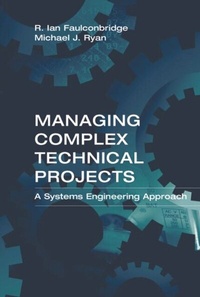
Managing Complex Technical Projects
A Systems Engineering Approach
1st Edition
Published on 1. January 2002
274 pages
978-1-58053-764-3 (ISBN)
Description

This unique resource delivers complete, easy-to-understand coverage of the management of complex technical projects through systems engineering. Written for a wide spectrum of readers, from novices to experienced practitioners, the book holds the solution to delivering projects on time and within budget, avoiding the failures and inefficiencies of past efforts. It provides you with a framework that encapsulates all areas of systems engineering, clearly showing you where the multitude of systems engineering activities fit within the overall effort. You get a top-down approach that introduces you to the philosophical aspects of this discipline, and offers you a cohesive understanding of a plethora of important terms, standards and practices that have been developed independently. Moreover, the authors present key systems engineering issues in a manner that promotes individual thinking and unique approaches to the varied projects you encounter in the field.
More details
Other editions
Additional editions
Book
11/2002
Artech House Publishers
€106.50
Shipment within 10-20 days
Content
- Managing Complex Technical Projects: A Systems Engineering Approach
- Contents v
- Preface xiii
- 1 Introduction to Systems Engineering 1
- 1.1 What Is a System? 2
- 1.2 System Life Cycle 5
- 1.3 What Is Systems Engineering? 9
- 1.4 Systems Engineering Relevance 15
- 1.5 Systems Engineering Benifits 16
- 1.6 Analysis, Synthesis, and Evaluation 18
- 1.7 A Systems Engineering Framework 21
- Endnotes 24
- 2 Conceptual Design 29
- 2.1 Introduction 29
- 2.2 Identify Stakeholder Requirements 30
- 2.3 Systems-Feasibility Analysis 41
- 2.4 System-Requirements Analysis 43
- 2.5 System-Level Synthesis 60
- 2.6 System-Design Review 63
- Endnotes 65
- 3 Preliminary Design 67
- 3.1 Introduction 67
- 3.2 Subsystem-Requirements Analysis 68
- 3.3 Requirements Allocation 72
- 3.4 RBS Versus WBS 80
- 3.5 Interface Identification and Design 82
- 3.6 Subsystem-Level Synthesis and Evaluation 85
- 3.7 Preliminary Design Review 94
- Endnotes 96
- 4 Detailed Design and Development 97
- 4.1 Introduction 97
- 4.2 Detailed Design Requirements 98
- 4.3 Designing and Intergrating System Elements 98
- 4.4 System Prototype Development 104
- 4.5 Detailed Design Reviews 105
- 4.6 Construction and Production 108
- 4.7 Operational Use and System Support 112
- 4.8 Phaseout and Disposal 117
- Endnotes 119
- 5 Systems Engineering Management 121
- 5.1 Introduction 121
- 5.2 Technical Reviews and Audits 121
- 5.3 System Test and Evaluation 127
- 5.4 Technical Risk Management 139
- 5.5 Configuration Management 144
- 5.6 Specifications and Standards 152
- 5.7 Integration Management 157
- 5.8 Systems Engineering Management Planning 159
- Endnotes 160
- 6 Systems Engineering Management Tools 163
- 6.1 Standards 163
- 6.2 MIL-STD-499B Systems Engineering (Draft) 164
- 6.3 EIA/IS-632 Systems Engineering 171
- 6.4 IEEE 1220 (Trial Use) and IEEE 1220-IEEE Standard for Application and Management of the Systems Engineering Process 173
- 6.5 ANSI/EIA-632-Processes for Engineering a System 179
- 6.6 Other Useful Documents 187
- 6.7 Capability Maturity Models 189
- 6.8 SEI--System Engineering Capability Maturity Model 191
- 6.9 CMM Intergration 194
- Endnotes 196
- 7 Systems Engineering Process Tools 199
- 7.1 Analysis Tools--Requirements Engineering 199
- 7.2 Synthesis--Various Tools 214
- 7.3 Evaluation--Trade-off Analysis 217
- Endnotes 222
- 8 Related Disciplines 225
- 8.1 Introduction 225
- 8.2 Project Management 225
- 8.3 Quality Assurance 230
- 8.4 Logistics Support 231
- 8.5 Operations 233
- 8.6 Design Support Network 233
- 8.7 Software Engineering 234
- 8.8 Hardware Engineering 235
- Endnotes 235
- List of Acronyms 237
- About the Authors 243
- Index 245
