

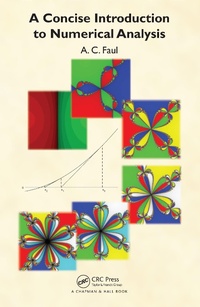
A Concise Introduction to Numerical Analysis
Published on 24. October 2018
308 pages
978-1-315-36232-8 (ISBN)
Description

This textbook provides an accessible and concise introduction to numerical analysis for upper undergraduate and beginning graduate students from various backgrounds. It was developed from the lecture notes of four successful courses on numerical analysis taught within the MPhil of Scientific Computing at the University of Cambridge. The book is easily accessible, even to those with limited knowledge of mathematics.
Students will get a concise, but thorough introduction to numerical analysis. In addition the algorithmic principles are emphasized to encourage a deeper understanding of why an algorithm is suitable, and sometimes unsuitable, for a particular problem.
A Concise Introduction to Numerical Analysis strikes a balance between being mathematically comprehensive, but not overwhelming with mathematical detail. In some places where further detail was felt to be out of scope of the book, the reader is referred to further reading.
The book uses MATLAB (R) implementations to demonstrate the workings of the method and thus MATLAB's own implementations are avoided, unless they are used as building blocks of an algorithm. In some cases the listings are printed in the book, but all are available online on the book's page at www.crcpress.com.
Most implementations are in the form of functions returning the outcome of the algorithm. Also, examples for the use of the functions are given. Exercises are included in line with the text where appropriate, and each chapter ends with a selection of revision exercises. Solutions to odd-numbered exercises are also provided on the book's page at www.crcpress.com.
This textbook is also an ideal resource for graduate students coming from other subjects who will use numerical techniques extensively in their graduate studies.
Students will get a concise, but thorough introduction to numerical analysis. In addition the algorithmic principles are emphasized to encourage a deeper understanding of why an algorithm is suitable, and sometimes unsuitable, for a particular problem.
A Concise Introduction to Numerical Analysis strikes a balance between being mathematically comprehensive, but not overwhelming with mathematical detail. In some places where further detail was felt to be out of scope of the book, the reader is referred to further reading.
The book uses MATLAB (R) implementations to demonstrate the workings of the method and thus MATLAB's own implementations are avoided, unless they are used as building blocks of an algorithm. In some cases the listings are printed in the book, but all are available online on the book's page at www.crcpress.com.
Most implementations are in the form of functions returning the outcome of the algorithm. Also, examples for the use of the functions are given. Exercises are included in line with the text where appropriate, and each chapter ends with a selection of revision exercises. Solutions to odd-numbered exercises are also provided on the book's page at www.crcpress.com.
This textbook is also an ideal resource for graduate students coming from other subjects who will use numerical techniques extensively in their graduate studies.
Reviews / Votes
"This is a thorough and detailed introduction to the important topic of numerical analysis. It is based upon an existing successful postgraduate course and assumes a significant level of mathematical sophistication. The material is very clearly presented, with lots of end-of-topic questions and examples in MATLAB that really illustrate the key issues involved, such as error propagation. The range of topics is conventional, but the level of detail is not. This is definitely a textbook that should be on the shelf of anyone working in the field who wants a deep understanding of the methods, limitations, and practical issues."-Dr. Matt Probert, Department of Physics, University of York, UK
More details
Language
English
Place of publication
London
United Kingdom
Publishing group
Taylor & Francis Ltd
Target group
College/higher education
Illustrations
49 Illustrations, black and white
File size
9,81 MB
ISBN-13
978-1-315-36232-8 (9781315362328)
Copyright in bibliographic data and cover images is held by Nielsen Book Services Limited or by the publishers or by their respective licensors: all rights reserved.
Schweitzer Classification
Other editions
Additional editions
A. C. Faul
A Concise Introduction to Numerical Analysis
Book
09/2020
1st Edition
Chapman & Hall/CRC
€74.90
Shipment within 15-20 days
A. C. Faul
A Concise Introduction to Numerical Analysis
Book
03/2016
1st Edition
Chapman & Hall/CRC
€132.90
Shipment within 15-20 days
Person
Content
Fundamentals. Linear Systems. Interpolation and Approximation Theory. Non-Linear Systems. Numerical Integration. ODEs. Numerical Differentiation. PDEs.
