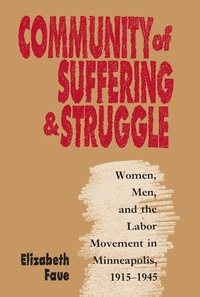
Community of Suffering and Struggle
Description

Elizabeth Faue traces the transformation of the American labor movement from community forms of solidarity to bureaucratic unionism. Arguing that gender is central to understanding this shift, Faue explores women’s involvement in labor and political organizations and the role of gender and family ideology in shaping unionism in the twentieth century. Her study of Minneapolis, the site of the important 1934 trucking strike, has broad implications for labor history as a whole. Initially the labor movement rooted itself in community organizations and networks in which women were active, both as members and as leaders. This community orientation reclaimed family, relief, and education as political ground for a labor movement seeking to re-establish itself after the losses of the 1920s. But as the depression deepened, women — perceived as threats to men seeking work — lost their places in union leadership, in working-class culture, and on labor’s political agenda. When unions exchanged a community orientation for a focus on the workplace and on national politics, they lost the power to recruit and involve women members, even after World War II prompted large numbers of women to enter the work force. In a pathbreaking analysis, Faue explores how the iconography and language of labor reflected ideas about gender. The depiction of work and the worker as male; the reliance on sport, military, and familial metaphors for solidarity; and the ideas of women’s place — these all reinforced the representation of labor solidarity as masculine during a time of increasing female participation in the labor force. Although the language of labor as male was not new in the depression, the crisis of wage-earning — as a crisis of masculinity — helped to give psychological power to male dominance in the labor culture. By the end of the war, women no longer occupied a central position in organized labor but a peripheral one.
More details
Other editions
Additional editions