

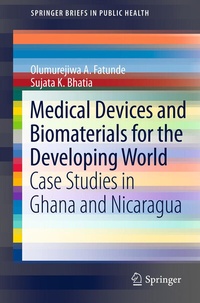
Medical Devices and Biomaterials for the Developing World
Case Studies in Ghana and Nicaragua
1st Edition
Published on 31. August 2012
XVIII, 112 pages
978-1-4614-4759-7 (ISBN)
Description

This book focuses on the adoption of medical technology in the developing world, and the role that can be played by new biomaterials. These authors urge that advanced technology be aligned with the needs of developing and emerging markets, and an alternative definition of technology be embraced. This "new technology" considers natural sources of materials and tools for treatment and is not restricted to the usual traditional computerized or electronic technology.
This book explores the difficulties that accompany successful transfer of technologies between disparate settings. The book then leaves the world of traditional technology and focuses on biomaterials, which represent an enormous opportunity for developing societies to become active participants in the development of new technologies. Biomaterials can be used in the treatment of disease throughout the developing world and beyond. Biomaterials encompass a range of naturally derived substances; of particular interest here are naturally derived and synthetically manufactured materials with potential applications in different body systems. Because many of these materials can be grown, the agricultural output of developing nations is an obvious potential source of these biomaterials. The book considers the cases of Ghana and Nicaragua as examples of the broader situation in West Africa and Central/South America. These two regions are uniquely positioned with regard to both health care and technological capabilities, and both stand to grow significantly in the coming years. While the agricultural sectors of the two nations are quite different, both are major producers of corn and other materials that should be investigated further. Of course, the difficulty in using a foodstuff for medical purposes is fully explored.
This book explores the difficulties that accompany successful transfer of technologies between disparate settings. The book then leaves the world of traditional technology and focuses on biomaterials, which represent an enormous opportunity for developing societies to become active participants in the development of new technologies. Biomaterials can be used in the treatment of disease throughout the developing world and beyond. Biomaterials encompass a range of naturally derived substances; of particular interest here are naturally derived and synthetically manufactured materials with potential applications in different body systems. Because many of these materials can be grown, the agricultural output of developing nations is an obvious potential source of these biomaterials. The book considers the cases of Ghana and Nicaragua as examples of the broader situation in West Africa and Central/South America. These two regions are uniquely positioned with regard to both health care and technological capabilities, and both stand to grow significantly in the coming years. While the agricultural sectors of the two nations are quite different, both are major producers of corn and other materials that should be investigated further. Of course, the difficulty in using a foodstuff for medical purposes is fully explored.
More details
Series
Language
English
Place of publication
New York
United States
Publishing group
Springer US
Target group
Professional and scholarly
Product notice
Reflowable
Illustrations
XVIII, 112 p. 41 illus., 11 illus. in color.
File size
2,82 MB
ISBN-13
978-1-4614-4759-7 (9781461447597)
DOI
10.1007/978-1-4614-4759-7
Schweitzer Classification
Other editions
Additional editions
Olumurejiwa A. Fatunde | Sujata K. Bhatia
Medical Devices and Biomaterials for the Developing World
Case Studies in Ghana and Nicaragua
Book
08/2012
Springer
€53.49
Shipment within 15-20 days
Persons
Prof. Sujata Bhatia is Assistant Director for Undergraduate Studies in Biomedical Engineering at Harvard University.
Olumurejiwa Fatunde is a graduate student in International Health Policy at the London School of Economics. She graduated from Harvard University with an AB in biomedical engineering.
Content
Introduction.- Case study of Ghana.- Case study of Nicaragua.- Corn and soy-derived materials: Properties and potential clinical applications.- Feasibility study of corn- and soy-derived materials.- Discussion, recommendations, and conclusion.
