

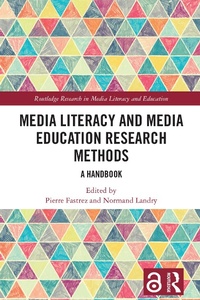
Media Literacy and Media Education Research Methods
A Handbook
1st Edition
Published on 27. November 2023
342 pages
978-1-000-98253-4 (ISBN)
Description

This handbook interrogates the foundations of media literacy and media education research from a methodological standpoint. It provides a detailed, illustrated overview of key methods used in the study of media literacy and media education. Further, it reveals the diversity of this research field and organizes this diversity by using three categories of investigation: media practices, educational initiatives, and prescriptive discourses.
The book offers valuable reference points and tools for exploring the range of research methods used to study media literacy and media education and how these methods connect to epistemological stances, theoretical frameworks, and research questions. It serves as a guide for researchers who wish to position themselves, reflect on the methods they use or are considering using, and compare and contrast them against alternative or complementary approaches. After reading this book, readers will be better able to identify and define the objects of study in media literacy and media education research, the preferred ways of conducting investigations, the phenomena, issues, and dimensions that these are likely to bring to light, and the knowledge that they generate.
This comprehensive and up-to-date overview of the field of media literacy education research methods will be of great interest to scholars and students of education studies, media studies, media literacy, cognitive science, and communication studies.
Chapter 2 of this book is freely available as a downloadable Open Access PDF at http://www.taylorfrancis.com under a Creative Commons Attribution (CC-BY) 4.0 International license.
The book offers valuable reference points and tools for exploring the range of research methods used to study media literacy and media education and how these methods connect to epistemological stances, theoretical frameworks, and research questions. It serves as a guide for researchers who wish to position themselves, reflect on the methods they use or are considering using, and compare and contrast them against alternative or complementary approaches. After reading this book, readers will be better able to identify and define the objects of study in media literacy and media education research, the preferred ways of conducting investigations, the phenomena, issues, and dimensions that these are likely to bring to light, and the knowledge that they generate.
This comprehensive and up-to-date overview of the field of media literacy education research methods will be of great interest to scholars and students of education studies, media studies, media literacy, cognitive science, and communication studies.
Chapter 2 of this book is freely available as a downloadable Open Access PDF at http://www.taylorfrancis.com under a Creative Commons Attribution (CC-BY) 4.0 International license.
More details
Series
Edition
1. Auflage
Language
English
Place of publication
London
United Kingdom
Publishing group
Taylor & Francis Ltd
Target group
College/higher education
Illustrations
16 Tables, black and white; 2 Line drawings, black and white; 2 Halftones, black and white; 4 Illustrations, black and white
ISBN-13
978-1-000-98253-4 (9781000982534)
Copyright in bibliographic data and cover images is held by Nielsen Book Services Limited or by the publishers or by their respective licensors: all rights reserved.
Schweitzer Classification
Other editions
Additional editions
Book
05/2025
1st Edition
Routledge
€68.00
Shipment within 15-20 days
Book
11/2023
1st Edition
Routledge
€206.30
Shipment within 15-20 days

Book
10/2023
Taylor & Francis
Unfortunately, price unknown
Available (delivery time upon request)
Persons
Pierre Fastrez is Senior Research Associate at the Belgian National Fund for Scientific Research and Professor of Information and Communication at the Universite catholique de Louvain (Belgium). His main research interests concern the definition of media literacy competence and media literacy assessment methods.
Normand Landry is Professor at TELUQ University and Canada Research Chair in Media Education and Human Rights. His work focuses on communication rights, media education, social movement theory, law, and democratic communications.
Normand Landry is Professor at TELUQ University and Canada Research Chair in Media Education and Human Rights. His work focuses on communication rights, media education, social movement theory, law, and democratic communications.
Content
Introduction: Navigating the Field of Media Education and Media Literacy through its Research Methods: Media Practices, Educational Initiatives, and Prescriptive Discourses
Part 1: Media Practices
Chapter One: Documenting Media Practices to Define Media Literacy Competence: A Qualitative Approach
Chapter Two: Studying the Media Education Practices of Young Children at Home: Methodological Lessons from a Cross-national Qualitative Study on Digital Activities at Home
Chapter Three: Participatory Action Research and Media Literacy: Towards Engaged, Accountable, and Collaborative Knowledge Production with Marginalized Communities
Chapter Four: Observing Literacy Practices in the "Third Space": Research Methods
Chapter Five: Researching Media Literacy Practices Using Both Critical and Posthuman Inquiry
Part 2: Educational Initiatives
Chapter Six: Methodological Considerations in Researching Teachers' Views and Practices of Media Literacy
Chapter Seven: A Research Methodology Aimed at Analyzing Teaching Practices in Relation to the Development of Digital Skills in a University Setting
Chapter Eight: Design-based Research into the Co-creation of Teaching Activities for the Theoretical Refinement of a Multimodal Media Literacy Competency Model
Chapter Nine: Quantitative Methods for Assessing Media Literacy in Evaluations of Health Promotion Intervention Programs Using Media Literacy Education
Chapter Ten: Issues of Pedagogy, Alignment, and Context in Assessing Measures of Media Literacy
Part 3: Prescriptive Discourses
Chapter Eleven: Analyzing Public Policies on Media Education: From Modalization to Modeling of Official Discourses
Chapter Twelve: Analyzing School Curricula, Training Programs, and Learning Material: A Method in Media Education
Chapter Thirteen: Quick-Scan Analysis as a Method to Analyze and Compare Media Literacy Frameworks
Chapter Fourteen: Critical Discourse Studies for Research on Media and Information Literacy Projects: An Illustrated Discussion of Seven Methodological Considerations
Chapter Fifteen: Rethinking Media Education Policy Research and Advocacy: A Deliberative Approach
Part 1: Media Practices
Chapter One: Documenting Media Practices to Define Media Literacy Competence: A Qualitative Approach
Chapter Two: Studying the Media Education Practices of Young Children at Home: Methodological Lessons from a Cross-national Qualitative Study on Digital Activities at Home
Chapter Three: Participatory Action Research and Media Literacy: Towards Engaged, Accountable, and Collaborative Knowledge Production with Marginalized Communities
Chapter Four: Observing Literacy Practices in the "Third Space": Research Methods
Chapter Five: Researching Media Literacy Practices Using Both Critical and Posthuman Inquiry
Part 2: Educational Initiatives
Chapter Six: Methodological Considerations in Researching Teachers' Views and Practices of Media Literacy
Chapter Seven: A Research Methodology Aimed at Analyzing Teaching Practices in Relation to the Development of Digital Skills in a University Setting
Chapter Eight: Design-based Research into the Co-creation of Teaching Activities for the Theoretical Refinement of a Multimodal Media Literacy Competency Model
Chapter Nine: Quantitative Methods for Assessing Media Literacy in Evaluations of Health Promotion Intervention Programs Using Media Literacy Education
Chapter Ten: Issues of Pedagogy, Alignment, and Context in Assessing Measures of Media Literacy
Part 3: Prescriptive Discourses
Chapter Eleven: Analyzing Public Policies on Media Education: From Modalization to Modeling of Official Discourses
Chapter Twelve: Analyzing School Curricula, Training Programs, and Learning Material: A Method in Media Education
Chapter Thirteen: Quick-Scan Analysis as a Method to Analyze and Compare Media Literacy Frameworks
Chapter Fourteen: Critical Discourse Studies for Research on Media and Information Literacy Projects: An Illustrated Discussion of Seven Methodological Considerations
Chapter Fifteen: Rethinking Media Education Policy Research and Advocacy: A Deliberative Approach
