

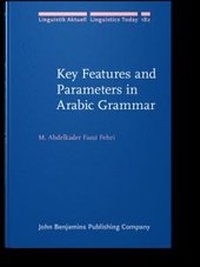
Key Features and Parameters in Arabic Grammar
1st Edition
Published on 1. February 2012
XX, 358 pages
978-90-272-7496-0 (ISBN)
Description

In light of recent generative minimalism, and comparative parametric theory of language variation, the book investigates key features and parameters of Arabic grammar. Part I addresses morpho-syntactic and semantic interfaces in temporality, aspectuality, and actionality, including the Past/Perfect/Perfective ambiguity akin to the very synthetic temporal morphology, collocating time adverb construal, and interpretability of verbal Number as pluractional. Part II is dedicated to nominal architecture, the behaviour of bare nouns as true indefinites, the count/mass dichotomy (re-examined in light of general, collective, and singulative DP properties), the mirror image ordering of serialized adjectives, and N-to-D Move in synthetic possession, proper names, and individuated vocatives. Part III examines the role of CP in time and space anchoring, double access reading (in a DAR language such as Arabic), sequence of tense (SOT), silent pronominal categories in consistent null subject languages (including referential and generic pro), and the interpretability of inflection. Semantic and formal parameters are set out, within a mixed macro/micro-parametric model of language variation. The book is of particular interest to students, researchers, and teachers of Arabic, Semitic, comparative, typological, or general linguistics.
More details
Other editions
Additional editions
Abdelkader Fassi Fehri
Key Features and Parameters in Arabic Grammar
Book
02/2012
John Benjamins Publishing Co
€104.94
Shipment within 10-15 days
Person
Content
- Key Features and Parameters in Arabic Grammar
- Editorial page
- Title page
- Copyright page
- Dedication page
- Table of contents
- Foreword
- Provenance of Chapters
- Part I Temporality, aspect, voice, and event structure
- Tense/Aspect interaction and variation
- 1. Past, Perfect, Perfective
- 1.1 The Past/Perfect ambiguity
- 1.2 Temporal and modal qad
- 1.3 One or two projections of T
- 1.4 Perfective
- 2. Present, Imperfect, Imperfective
- 3. Imperfect and SOT
- 4. Perfectivity
- 4.1 ST as Perfective
- 4.2 PT as Imperfective?
- 4.3 From Tense to Aspect
- 4.4 The Tense/Aspect language typology revisited
- 5. Conclusion
- Transitivity, causativity, and verbal plurality
- 1. Issues
- 1.1 Problem 1: Semitic morpho-syntax
- 1.2 Problem 2: Transitivity theory
- 2. Number Theory
- 2.1 Ingredients of Num T
- 2.2 Verbal plurality and distributed Num
- 2.3 Distributed plurality
- 2.4 Causative complexity, verbalization, and distributivity
- 2.5 Two sources of transitivity
- 2.6 Parallel plural morphology
- 2.7 Summary
- 3. Cross-linguistic evidence
- 3.1 Causatives, transitives, and event quantification
- 3.1.1 Causativization and transitivization
- 3.1.2 Multiple behaviour
- 3.1.3 Event quantification
- 3.2 Moravcsik's resistant cases
- 4. Conceptual motivations and competing analyses
- 4.1 Little v: Verbalizer or transitivizer?
- 4.2 Aspect
- 4.3 Voice
- 4.3.1 Anti-transitive reflexives
- 4.3.2 Reflexive causatives
- 4.3.3 Agentive and expositive causatives
- 4.3.4 Requestive causatives
- 4.3.5 Ergative Num and intensive forms
- 4.4 Further empirical motivations
- 4.4.1 Ergative and unergative Num in event plurality and transitivity
- 4.4.2 Adicity, (in)transitive alternations, and multiple uses
- 5. Num theory and Num heights
- 5.1 Sg and Pl Merge
- 5.2 Language variation
- 6. Summary and conclusion
- Synthetic/analytic asymmetries in voice and temporal patterns
- 1. Analysis, voice, and temporality
- 1.1 The problem
- 1.2 Nominal auxiliaries
- 1.3 S/O Agr split and auxiliary selection
- 1.4 Temp auxiliaries
- 1.5 Voice
- 1.5.1 Arabic and anaphoric Agr
- 1.5.2 Latin and split Agr
- 1.5.3 Modern Greek
- 1.5.4 Albanian
- 1.5.5 Moroccan Arabic
- 2. Formal complexity and categorization
- 2.1 Further analytic and synthetic questions
- 2.1.1 Pass and additional complexity
- 2.1.2 Two finite Agrs
- 2.1.3 Ancient Greek as fully synthetic
- 2.2 Reanalysis as the source of analytic pass or perfect
- 2.3 A splitting analysis (of Temp and Agr categories)
- 3. Peculiarities and structural heights
- 3.1 Imperfective passive
- 3.2 Verbal and adjectival voices
- 3.3 Multiple functions across heights
- 4. Summary and conclusion
- Arabic Perfect and temporal adverbs
- 1. Salient properties of the Arabic TR system
- 1.1 Polyfunctionality of T/Asp forms
- 1.2 The PresPerf split: Synthesis and analysis
- 1.3 The Past split: Simple Past Pfv and complex Past Impfv
- 2. The Perfect/Past ambiguity
- 2.1 Aspects and Tenses
- 2.2 Positional "deictic" adverbs
- 2.3 Perf and modal qad
- 2.4 Adverbs and simple vs. complex tenses
- 2.5 Durational adverbs
- 3. Temporal adverbs and kinds of Perfect
- 3.1 Positional mundu
- 3.1.1 Imperfective tenses
- 3.1.2 Perfective tenses
- 3.1.3 PresPerf tense
- 3.2 Durational mundu
- 3.3 Perf of Res and Post-state
- 4. Summary and conclusion
- 4.1 T/Asp morphology
- 4.2 T/Asp adverbs or particles
- 4.3 Conclusion
- Part II DP, np, bareness, and count/mass structures
- The grammar of count and mass
- 1. Toward a wider count grammar
- 1.1 Ways of 'numeralizing'
- 1.1.1 Partitive numeral
- 1.1.2 Predicative numeral
- 1.1.3 Numeral verbs
- 1.1.4 Numeral adverbs
- 1.2 Ways of count quantifying
- 1.2.1 Count quantifier bid? in a construct state
- 1.2.2 Predicative count quantifier
- 1.2.3 The count/measure ambiguity of kam
- 1.2.4 More partitives
- 1.3 Events selecting count nouns
- 2. General nouns
- 2.1 General atomicity
- 2.2 Singulative atomicity
- 2.3 General nouns and general Number
- 2.4 Counting and numeralizing
- 2.5 The general noun is not plural
- 2.6 The general noun is not mass
- 2.7 The general noun is not a group
- 3. Collective varieties
- 3.1 What 'counts' in the grammar of collectives
- 3.2 Syntactic groups
- 4. Masses
- 4.1 Mass as atomless
- 4.2 Mass is cumulative, and non-divisive
- 4.3 Mass as distinct from plural
- 4.4 Plural of mass is productive
- 5. Count/mass architecture, features, and functional categories
- 5.1 Count and mass syntax
- 5.2 Interpreting plural and singular inflections
- 6. Summary and conclusion
- Synthesis in Arabic DPs
- 1. Setting the stage for synthesis
- 1.1 Synthetic ingredients
- 1.2 Synthetic 'articles'
- 1.3 Quantifiers
- 1.4 Numerals
- 1.5 Demonstratives
- 1.6 Indefinites in Arabic dialects
- 2. DP architecture
- 2.1 Adjective modification
- 2.1.1 The NA Order
- 2.1.2 MIO
- 2.1.3 Adjectival classes and non-intersectives
- 2.1.4 DA extensions
- 2.2 Mirror image alternations
- 2.3 Synthetic indefinites
- 3. Core properties and types of synthetic possession
- 3.1 How real is Definiteness spreading?
- 3.2 Possessor placement
- 3.3 Two classes of synthetic possessives
- 4. Characterizing the variation
- Bare, generic, mass, and referential DPs
- 1. Overt D contrasts and genericity
- 1.1 Definite, generic, and mass
- 1.2 Predicates and anaphors
- 1.2.1 Kind Level Predicates
- 1.2.2 Stage Level Predicates
- 1.2.3 Individual Level Predicates
- 1.2.4 Kind anaphora
- 1.3 Plural as 'plural of the singular'
- 1.3.1 Scope
- 1.3.2 Opacity
- 1.3.3 Telicity
- 2. Arabic BNs are indefinites
- 2.1 Arabic BNs as indefinites?
- 2.2 GenP and N-to-Gen
- 2.3 Arabic/Romance distinctions and the Numeral Parameter
- 2.3.1 Varieties of bareness
- 2.3.2 The Numeral Parameter
- 3. Further discussion
- 3.1 Gen contexts
- 3.2 Modification and D-binding
- 3.3 Modalized contexts
- 3.4 Definite and indefinite generics
- 4. BNs and PNs
- 5. Mass specification
- 6. Conclusion
- Determination parameters in the Arabic and Semitic diglossia
- 1. Indefinites
- 1.1 N moves over indefinite quantifier
- 1.2 N movement to indefinite D
- 1.3 Adjective movement and movement over adjectives
- 1.4 Semitic overt indetermination
- 2. Definites
- 3. Double (in)determination in Semitic
- 3.1 Definites and indefinites are not complementary
- 3.2 Searching for minimal (in)definite pairs
- 3.3 PNs are not indefinite
- 4. Bare determination
- 4.1 Individuating and non-individuating vocatives
- 4.2 Unique' superlatives
- 5. Account and summary
- 5.1 The computational history of determination
- 5.2 Two features in computation
- Part III Clausal structure, silent pronouns, and Agree
- Arabic silent pronouns, person, and voice
- 1. The referential/non-referential correlation
- 2. Impersonals/indefinites
- 2.1 Arabic
- 2.2 Comparison with French, Finnish, Irish, and Italian
- 2.3 The human feature
- 3. Referential pro
- 3.1 A topic approach
- 3.2 A Probe-Goal implementation
- 4. Passive', 'impersonal', 'indefinite'
- 5. Expletives and EPP
- 5.1 Arabic expletives
- 5.2 Pronouns and EPP
- 5.3 Finnish
- 6. Some consequences
- 6.1 Variation around Person
- 6.2 Topicality and Person
- 6.3 A new approach to Voice
- Plural verbs and Agree
- 1. Introduction
- 2. Nominal Number
- 2.1 Where is number?
- 2.2 Non-human plurality
- 2.3 Lexical collectives
- 2.4 Syntactic collectives
- 2.5 Plurals of plurals and similar matters
- 3. Verb plurality
- 3.1 Pluractional morphology
- 3.2 Collective and distributive plural
- 3.3 Semantic Pl in SVO
- 3.4 Kinds of plural agreement: Collective and non-collective
- 4. Reciprocity
- 4.1 Lexical reciprocals and symmetric events
- 4.2 Morphological reciprocals
- 4.3 Syntactic reciprocals
- 5. Summary and conclusion
- Time/space anchors, logophors, finiteness, and (un)interpretability of inflection
- 1. CP anchoring, double access tenses, and logophors
- 1.1 Person double access
- 1.2 Time double access
- 1.3 Arabic as a DAR language
- 1.4 Double access and Mood
- 1.5 Root and logophoric Cs
- 2. Finiteness
- 2.1 Subject properties
- 2.1.1 Cases of subjects
- 2.1.2 Positions of subjects
- 2.1.3 Subject agreement
- 2.1.4 Expletive subjects
- 2.2 Truncated structures
- 2.2.1 Raising
- 2.2.2 Auxiliary (complex tense) structures
- 2.2.3 ECM
- 2.2.4 Control
- 3. The structure of Tense
- 3.1 Tense on T and Person
- 3.2 Synthetic and analytic temporality
- 3.3 V movement
- 4. Summary and conclusion
- References
- Index
