

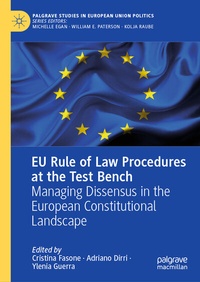
EU Rule of Law Procedures at the Test Bench
Description

This book analyses the EU rule of law instruments from the perspective of the academic, inter- and intra-institutional dissensus at the EU level. The angle of analysis proposed by this book allows to detect the sources of dissensus inherent in the design of the EU rule of law toolbox and in their enforcement. The proliferation of the instruments, without any major efforts of systematization, seems to be part of the problem, with a series of overlaps. At the same time, especially in the post-pandemic context, the procedures implementing the various EU rule of law tools have become more and more intertwined, so that it becomes difficult to disentangle one from the other in terms of effects. The book thus feed the debate on the strengths and deficiencies of the EU rule of law toolbox ten years after the first ad hoc measures were adopted, also offering some recommendations on how to turn dissensus into constructive mechanisms to improve the management of the rule of law in the EU.
More details
Other editions
Additional editions
Persons
Cristina Fasone is Associate Professor of Comparative Public Law at Luiss University, Rome, Italy.
Adriano Dirri is Post-Doctoral Fellow in Comparative Public Law at Luiss University, Rome, Italy.
Ylenia Guerra is Post-Doctoral Fellow in Constitutional Law at Luiss University, Rome, Italy.
Content
Chapter 1: Introduction: Dissensus as a Trigger and as a Consequence of the Rule of Law Crisis in the EU Adriano.- Part I :The Instruments Provided by EU Primary Law.- Chapter 2. Key political an d legal debates on Article 7 TEU in times of dissensus over the rule of law.- Chapter 3. Ordinary weapons for exceptional threats? The infringement procedure and the rule of law crisis.- Chapter 4. The Rising Value of the Preliminary Reference Procedure in the Rule of Law Protection.- Chapter 5. Granting Rights, preserving the Rule of Law? The Effectiveness of the Charter of Fundamental Rights.- Chapter 6: The Cooperation and Verification Mechanism: The end of the Exceptionalism?.-Part II-. The Tools Offered by EU Legislation.- Chapter 7: Strengthening the Rule of Law Through Macroeconomic Support: The Technical Support Instrument and Its Precedents.- Chapter 8: The Role of OLAF and EPPO in the Protection of the Rule of Law.- Part III -. The Effectiveness of Soft Law Tools.- Chapter 9. The Shortcomings ofthe Rule of Law Framework and Dialogue.- Chapter 10. Measuring Justice? The EU Justice Scoreboard in the Light of the performance-based approach.- Chapter 11. The Prospective Impact of the Rule of Law Reports: A tool to be fine-tuned.- Part IV - The Economic and Fiscal Leverage.- Chapter 12. Enforcing the European Union's Rule of Law through Economic Governance Mechanisms: The Role of the European Semester.- Chapter 13. Recent trends and ambiguities of conditionality as an instrument of EU internal governance.- Chapter 14. Contesting the Rule of Law in the European Union: The Creation and Implementation of the Rule of Law Conditionality Regulation.- Chapter 15. The Recovery and Resilience Facility and its effects on the Rule of Law Conditionality: A (potentially) well-functioning connection.-
Chapter 16. The role of competition law in defending rule of law values in the EU.
