

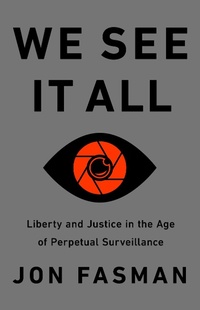
We See It All
Liberty and Justice in an Age of Perpetual Surveillance
Published on 26. January 2021
288 pages
978-1-5417-3068-7 (ISBN)
Description

An investigation into the legal, political, and moral issues surrounding how the police and justice system use surveillance technology, asking the question: what are citizens of a free country willing to tolerate in the name of public safety?
As we rethink the scope of police power, Jon Fasman's chilling examination of how the police and the justice system use the unparalleled power of surveillance technology-how it affects privacy, liberty, and civil rights-becomes more urgent by the day. Embedding himself within police departments on both coasts, Fasman explores the moral, legal, and political questions posed by these techniques and tools.
By zeroing in on how facial recognition, automatic license-plate readers, drones, predictive algorithms, and encryption affect us personally, Fasman vividly illustrates what is at stake and explains how to think through issues of privacy rights, civil liberties, and public safety. How do these technologies impact how police operate in our society? How should archaic privacy laws written for an obsolete era-that of the landline and postbox-be updated?
Fasman looks closely at what can happen when surveillance technologies are combined and put in the hands of governments with scant regard for citizens' civil liberties, pushing us to ask: Is our democratic culture strong enough to stop us from turning into China, with its architecture of control?
As we rethink the scope of police power, Jon Fasman's chilling examination of how the police and the justice system use the unparalleled power of surveillance technology-how it affects privacy, liberty, and civil rights-becomes more urgent by the day. Embedding himself within police departments on both coasts, Fasman explores the moral, legal, and political questions posed by these techniques and tools.
By zeroing in on how facial recognition, automatic license-plate readers, drones, predictive algorithms, and encryption affect us personally, Fasman vividly illustrates what is at stake and explains how to think through issues of privacy rights, civil liberties, and public safety. How do these technologies impact how police operate in our society? How should archaic privacy laws written for an obsolete era-that of the landline and postbox-be updated?
Fasman looks closely at what can happen when surveillance technologies are combined and put in the hands of governments with scant regard for citizens' civil liberties, pushing us to ask: Is our democratic culture strong enough to stop us from turning into China, with its architecture of control?
More details
Other editions
Additional editions
Book
01/2021
PublicAffairs,U.S.
€26.50
Shipment within 15-20 days
Person
Jon Fasman is the Washington correspondent of the Economist, having previously been South-East Asia bureau chief and Atlanta correspondent. In addition to his work for the Economist, he is also the author of two novels, both published by The Penguin Press: The Geographer's Library, was a New York Times bestseller in 2005 and has been translated into more than a dozen languages; and The Unpossessed City, which was published in autumn of 2018, was a finalist for the New York Public Library's Young Lions Fiction Award. Fasman resides in Westchester County, N.Y.
Content
- Intro
- TITLE PAGE
- COPYRIGHT
- TABLE OF CONTENTS
- DEDICATION
- EPIGRAPH
- PREFACE
- PROLOGUE: "A perfect architecture of control"
- 1 TECHNOLOGY AND DEMOCRACY: How much state surveillance and control are you willing to tolerate in the name of public safety?
- 2 EXPANDING THE PLATFORM: "Facebook and WhatsApp are spying on us anyway," he said, holding up his phone. "Privacy is dead."
- 3 WATCHING EACH OTHER: "It is the Interest, and ought to be the Ambition, of all honest Magistrates, to have their Deeds openly examined, and publicly scann'd."
- 4 MISSION CREEP: "You can tell me who you are. But give me fifteen minutes with your phone and I'll tell you who you really are."
- 5 THE END OF ANONYMITY: "The history of surveillance is the history of powerful surveillance systems being abused."
- 6 EYES IN THE SKY: "Where law enforcement leaders see a wonderful new tool for controlling crime and increasing public safety, a portion of the public sees the potential for a massive invasion of privacy."
- 7 WIDENING THE NET: "The public doesn't look at people with ankle monitors and say, 'There's an innocent person.' They say, 'What did that person do?'"
- 8 THE BLACK BOX OF JUSTICE: "In a racially stratified world, any method of prediction will project the inequalities of the past into the future."
- 9 THE CHINA PROBLEM: "We can now have a perfect architecture of control. What democratic practices do we need to not become China?"
- 10 THE OAKLAND SOLUTION: "We just started showing up."
- CONCLUSION: The case for optimism
- ACKNOWLEDGMENTS
- DISCOVER MORE
- NOTES
- ABOUT THE AUTHOR
