

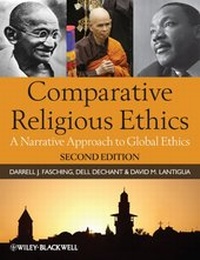
Comparative Religious Ethics
Description

Reviews / Votes
"It is indeed a very rare thing to have the opportunity andprivilege to work with a book that engages, challenges and provokesthe student to wrestle with the fundamental ethical questions ofour time. Comparative Religious Ethics is such a book.Intellectually rigorous, profoundly insightful and beautifullywritten, it is an invaluable resource for the instructor andstudent alike." --Louise M. Doire, College of Charleston "Comparative Religious Ethics invites the reader tocomprehend the ethical teachings of the world's religions by meansof narratives drawn from those traditions and from human historicalexperience. The stories range from Gilgamesh to Gandhi and fromHiroshima to globalization. Beneath the engaging narratives lies anapproach rich in theoretical insights from the study of comparativereligion and ethical theory." --Ronald M. Green, Dartmouth CollegeMore details
Other editions
Additional editions
Persons
Content
Chapter 1
Religion, Ethics, and Storytelling
Human religiousness is defined by two opposing deep structures of human experience and imagination that shape the way stories are told, heard and interpreted. Moreover, our understanding of good and evil is defined by the kind of story we think we are in and the role we see ourselves playing in that story. The terms “sacred” and “holy,” which have typically been used interchangeably, are proposed here as names for these opposing deep structures. The sacred defines the experience of those who share a common identity as “human” and see all others as profane and less (or less than) human. The sacred generates a morality expressed in narratives of mistrust and hostility toward the stranger. The experience of the holy, by contrast, generates an ethic which calls into question every sacred morality in order to transform it in the name of justice and compassion. An ethical story is one that questions sacred morality in the name of hospitality to the stranger and audacity on behalf of the stranger. The task of an ethic of the holy is not to replace the sacred morality of a society but to transform it by breaking down the divisions between the sacred and profane through narratives of hospitality to the stranger which affirm the human dignity of precisely those who do not share “my identity” and “my story.”
Storytelling: from Comparative Ethics to Global Ethics
In April of 1968, Martin Luther King, Jr., often referred to as “the American Gandhi,” went to Memphis to help black workers settle a garbage strike. At the time, this Baptist minister from the black church tradition was looking forward to spending the approaching Passover with Rabbi Abraham Joshua Heschel. Heschel, who had marched with him in a civil rights protest at Selma, Alabama, three years earlier, had become a close friend and supporter. Unfortunately, King was not able to keep that engagement. Like Gandhi before him, on April 4, 1968, Martin Luther King, Jr., a man of non-violence, was violently assassinated. Another of King's friends, the Buddhist monk and anti-Vietnam war activist, Thich Nhat Hanh, whom King had nominated for a Nobel Peace Prize, received the news of his death while at an interreligious conference in New York City. Only the previous spring, King had officially come out against the Vietnam War, partly at the urging of Thich Nhat Hanh and Abraham Joshua Heschel. This occurred under the auspices of Clergy and Laymen Concerned about Vietnam, founded by Heschel, John Bennett, and Richard Neuhaus. Now, he who had called for an end to hatred, violence and war was dead. But the spiritual and ethical vision he shared with his friends, across religions and cultures, is not. It is alive and well.
Our task in this book is to understand how a Christian minister, a Jewish rabbi, and a Buddhist monk, all inspired by a Hindu “Mahatma” (Great Soul), Mohandas K. Gandhi, were able to share a common ethical vision of non-violence while maintaining their respective religious identities. We shall do so while taking into account important questions concerning this ethic raised by the Muslim Malcolm X and the feminist voices of Rosemary Ruether (Christian) and Joanna Macy (Buddhist). Out of the dialogue among them we believe an important spiritual and ethical path for a global ethic is emerging. It is what John Dunne calls “the way of all the earth” – a biblical phrase that could also be translated “the way of all flesh” or the way of all mortal beings.
We live in a developing global civilization made up of many religions and cultures interconnected by mass media, international transportation, international corporations, and the internet. No longer can any person, country, or religion be an island: we are more and more interdependent. The twentieth century began with great hopes that science and technology would usher in a secular age of rationality, peace, and progress. Instead, it ushered in an age of apocalyptic nightmares – an age of nationalism, racism and global conflict leading to two world wars and an estimated 100 000 000 deaths. Science and technology, it seems, were better at creating instruments of mass destruction, like the gas chambers of Auschwitz and the atomic bombs dropped on Hiroshima and Nagasaki, than the instruments of peace. The question that hangs over our heads is whether the next century (indeed the next millennium) will bring more of the same, or whether diverse religions and cultures will find ways to build bridges to an era of peace. It remains an open question whether the religions of the world will be part of the problem or part of the solution.
In addressing this question we are, moreover, faced with the serious challenge of cultural and ethical relativism. Are religions and cultures so different from one another that all their interactions inevitably result in conflict and misunderstanding? Are they so different from each other that no ethical consensus can be reached? The study of ethics must be more than an “objective” survey of abstract theories taught in a noncommittal fashion. It ought to convey the wisdom one generation has to pass on to the next. To leave the next generation with no wisdom in an age as dangerous as ours is to create a cynical generation that believes there are no standards and so one view of life is thought to be as good as another. The wisdom that has come to birth in our time, we are convinced, is that which has emerged in response to the atrocities of World War II, the indignities of racism, sexism and colonialism everywhere, and the violation of our environment by modern scientific/technological civilization. What the dangers of our time call for is an interreligious and international strategy for turning around our science and technology, protecting the human dignity of all peoples, and restoring the ecology of our mother earth. The study of comparative religious ethics has an important role to play in addressing these issues through forging a global ethic.
The answers we seek, however, lie not so much in theories as in the life stories of extraordinary persons who have wrestled with questions of justice, non-violence, and ecological well-being in an age of racism, sexism, religious prejudice, nationalism, colonialism, terrorism, and nuclear war. Our story picks out a thread of cross-cultural or global conversation from the human drama of history that begins with the Russian novelist Tolstoy (1828–1910) who in turn influenced Gandhi (1869–1948) who in turn influenced a generation that includes Martin Luther King, Jr. (1929–1968), Abraham Joshua Heschel (1907–1972), Thich Nhat Hanh (1926–), and Malcolm X (1925–1965). King, a Baptist minister, drew on Gandhi's Hinduism to launch the civil rights movement and protest the Vietnam War. Heschel, a Hasidic Jew, marched with King and was himself a leader in the protest against the Vietnam War. King nominated the Buddhist Thich Nhat Hanh for the Nobel Peace Prize for his non-violent struggles against the Vietnam War. And of course, Malcolm X argued with King about the merits of non-violence even as he moved closer to King after his conversion to traditional Islam.
Out of these lives (and the lives of others we cannot explore here), we believe, has emerged an interreligious global ethic of human dignity, human rights and human liberation. Their individual lives of tireless struggle for human dignity and human rights, their common involvement in issues of justice, war, and peace, and their involvement in each other's lives and religions, we contend, demonstrates that not only can a shared ethic emerge, it is emerging among people of different religions and cultures. There is a Jewish tradition that says that God always sees to it that there are 36 righteous persons hidden in the world for whose sake God spares the world, despite rampant evil. This book is not so much about ethical theories as it is about such persons – individuals whose holiness has changed, and continues to change, the world. It is about them and about the religious stories and spiritual practices that sustain them.
There are many ways to study religious ethics comparatively. One approach would be to study moralities empirically through comparative ethnography – an anthropological, purely descriptive, study of moral practices in different communities, which would contrast similarities and differences. A related approach would require doing an historical study of the changes in moral practices that have evolved in different religions and cultures. Or we could take a philosophical approach. This could be descriptive, comparing ethical theories across cultures, or else prescriptive, attempting to formulate theoretically a universal ethic of what we ought to do, and advocating that it be shared by all religions and cultures. All of these are important to do, and we will, in some modest degree, draw on most of them. However, our main approach will take us in a different direction.
Our approach will be through comparative storytelling and comparative spirituality in response to some of the defining events of the twentieth century – the struggle against colonialism, racism, sexism, terrorism, and the human capacity to inflict mass death revealed at Auschwitz and Hiroshima. We will not be looking to the philosophers and legal experts for guidance, but to the stories of heroes and saints, both ancient and postmodern; those whose heroism and holiness have shaped and continue to shape each tradition. So we will look to stories of ancient figures...
