

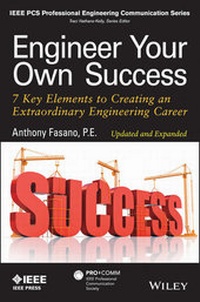
Engineer Your Own Success
Description

More details
Other editions
Additional editions
Person
Content
A Note From The Series Editor xiii
Acknowledgments xv
Foreword xvii
Preface xix
Introduction: Use This Book Strategically 1
PART I YOUR GUIDE TO ENGINEERING A SUCCESSFUL JOB SEARCH 3
1 Building a Winning Résumé 5
1.1 Building a Winning Résumé (Online and Offline) 5
1.2 There Is One Key Factor to a Great Résumé 6
1.3 The Importance of Customizing Your Résumé 6
1.4 There Is a Formula to Building a Winning Résumé 7
1.5 Determining the Proper Length of a Résumé 8
1.6 Effectively Show Non-engineering Experience on Your Résumé 12
1.7 The Importance of Honesty During the Interview Process 13
1.8 Seven Steps to Creating a LinkedIn Profile That Can Land a Job 14
1.9 Your LinkedIn Profile and Your Résumé Should Be Perfect Professional Snapshots 16
1.10 Key Points to Remember 18
2 Landing and Acing an Engineering Job Interview 19
2.1 Leverage LinkedIn Groups to Land a Job Interview 19
2.2 Understanding Prospective Employers and Their Needs 20
2.3 Interview Research and Preparation 22
2.4 Interview Etiquette and Attire 23
2.5 Performing During the Actual Interview 24
2.6 The Follow-Up to the Interview 25
2.7 Jobs Can Affect Your PE License 26
2.8 Key Points to Remember 26
Part II THE 7 KEY ELEMENTS TO AN EXTRAORDINARY ENGINEERING CAREER 29
3 Career Goals Act as Your Destination 31
3.1 Career Goals Act as Your Destination 31
3.2 Start by Defining "Success" 32
3.3 Define Your Values 33
3.4 Ask Yourself Where Why What How and Who 34
3.5 More on Why 35
3.6 Think Big and Then Think BIGGER! 36
3.7 Formulate and Prioritize Your Goals 37
3.8 Be SMART and Use Small Steps for Big Results 37
3.9 Let Your Definition of Success Guide You 40
3.10 Motivate Yourself to Pursue Your Goals 41
3.11 Time to Celebrate! 42
3.12 Key Points to Remember 42
4 Obtain Credentials That Will Help You to Reach Your Goals 45
4.1 Credentials Bring You Credibility 45
4.2 Set Yourself Apart from Others 46
4.3 Recognizing the Difference between Patience and Procrastination 47
4.4 Exam Preparation: Start With the End in Mind 48
4.5 Tips for Approaching the PE Exam 49
4.5.1 Take the Fundamentals of Engineering Exam as Soon as Possible 49
4.5.2 Start the PE Exam Application Process as Early as Possible 50
4.5.3 Submit the Application as Soon as Possible 51
4.5.4 Don't Take the Exam Just to See What It Contains 51
4.5.5 Take a Review Course Whether You Want to or Not 52
4.5.6 Ask Others What Worked for Them 52
4.5.7 Bring the Right Materials to the Exam 53
4.5.8 The Day of the Exam 54
4.5.9 The Day After the Exam 55
4.5.10 Credentialing Processes around the World 55
4.6 If You Fall Off the Horse Get Right Back On 55
4.7 Master's in Engineering or Business Administration? 56
4.8 Awards Are Underrated 58
4.9 Take Advantage of Company Benefits 58
4.10 Key Points to Remember 59
5 Find and Become a Mentor 61
5.1 The Many Faces of a Mentor 61
5.2 Finding a Mentoring Program and Selecting the Right Mentor 62
5.2.1 Try to Select Someone from Your Specific Discipline 63
5.2.2 Consider Your Level of Comfort 64
5.2.3 Don't Settle on the First One That Comes Along 64
5.3 The Mentoring Relationship for Protégés 64
5.3.1 Establish Levels of Confidentiality 65
5.3.2 Set Expectations for Mutual Accountability 65
5.4 The Importance of Accountability 66
5.5 Getting the Most from Your Mentor 67
5.6 Become a Mentor 67
5.7 Selecting the Right Protégé 68
5.8 Being the Best Mentor You Can Be 69
5.9 How to Graciously End a Mentoring Relationship 70
5.10 Actions to Avoid for Mentors and Protégés 71
5.11 Key Points to Remember 71
6 Become a Great Communicator 73
6.1 In Today's World Communication Is a Whole Different Ball Game 73
6.2 Project/Team Communication Starts In House 74
6.3 Communicate Early and Often 75
6.4 How to (Almost) Explain Rocket Science to a Nontechnical Person 76
6.5 Honesty Really Is the Best Policy 77
6.6 How You Say Something Is Just as Important as What You Say 79
6.7 Public Speaking: The Ultimate Differentiator 80
6.8 How to Improve Your Public Speaking Skills 82
6.9 Confidence Encourages Communication 84
6.10 Sometimes Listening Is the Most Powerful Form of Communication 85
6.11 Responsiveness Impacts Reputation 86
6.12 Key Points to Remember 87
7 The Ability to Network 89
7.1 What Is Networking and Why Is It Important? 89
7.2 Secrets to Building Lasting Relationships 90
7.2.1 Their Interests Should Interest You 91
7.2.2 Listen to Others 91
7.2.3 Relationship Value Is a Two-Way Street 92
7.3 Network in Your Industry through Professional Societies and Organizations 92
7.4 Finding and Developing Project Leads Gets You Noticed 94
7.5 Opportunities Have No Limits 96
7.6 You Are Never Too Young (or Old!) to Network 97
7.7 Overcoming Low Confidence and Language Barriers 98
7.8 How to Deal with a Boss or Supervisor Who Is Holding You Back 99
7.9 Interoffice Politics and Workplace Relationships 101
7.10 Monitoring and Controlling Your Professional Image in Social Networking 102
7.10.1 Controlling Your Facebook Twitter and Google+ Messaging 102
7.10.2 Maximizing LinkedIn 103
7.11 Key Points to Remember 104
8 Stay Focused Organized Productive and Stress-Free 107
8.1 The Three Rules to Time Management and Work-Family Balance 107
8.2 Rule #1: Be Organized in All of Your Efforts 108
8.2.1 Deploy a Minimalist Mind-Set 109
8.2.2 Use the Old (and New) Trusty Notepad 110
8.2.3 Manage the Never-Ending Pile of Business Cards 112
8.2.4 Remember That Missed Appointments Equal Missed Opportunities 114
8.2.4.1 Use Your Calendar Religiously 114
8.2.4.2 Fill in All Pertinent Information 114
8.2.4.3 Confirm All Meetings 115
8.2.5 Avoid the "I Am Not Sure What Color My Desk Is" Syndrome 115
8.2.6 Prepare for Your Annual Performance Review 116
8.3 Rule #2: Stay Focused and Productive 118
8.3.1 Create Consistency through Routines 118
8.3.2 Establish Your Most Important Tasks Early Each Day 119
8.3.3 Complete or Assign Your MITs First Thing Each Day 120
8.3.4 Control Your Own Schedule by Breaking Bad E-Mail Habits 121
8.3.5 Slow Things Down through Meditation 123
8.3.6 Focus Intently on What You Are Doing 123
8.4 Rule #3: Avoid Stress and Worry at All Costs 124
8.4.1 Simplification through Elimination 125
8.4.2 Empty Your E-Mail Inbox Twice per Day 125
8.4.3 A Good To-Do List Can Work Wonders 126
8.4.4 Keep Your Body (and Mind) in Shape 128
8.4.5 Eat and Sleep Well 129
8.5 Work-Family Balance Is Achievable 130
8.5.1 Define Work-Family Balance 130
8.5.2 Build Flexibility into Your Career 131
8.5.3 Be Present in the Moment 132
8.6 Key Points to Remember 133
9 Be a Leader Every Day 135
9.1 You Are a Leader 135
9.2 The Power of Positivity 136
9.3 Great Leaders See Only Opportunity 137
9.4 Understanding Your Role 139
9.5 Delegate Delegate and Then Delegate Some More 140
9.6 Earn the Trust and Respect of Your Team 142
9.7 There Is No "I" in Team 143
9.8 Key Points to Remember 144
10 The Time Is Now: Take Action 147
10.1 The Time Is Now 147
10.2 Do Not Settle for Less 148
10.3 You Must Make Time for Your Own Development 148
10.4 Think Like an Entrepreneur in Your Career 149
10.5 Take Action 150
10.6 Key Points to Remember 150
11 Tools and Templates for Setting and Achieving Your Career Goals 153
11.1 Template for a Winning Résumé 154
11.2 Action Exercise Worksheet-Define Your Values 155
11.3A Action Exercise Worksheet-Define Your End Results in One Year 155
11.3B Action Exercise Worksheet-Define Your End Results in Two Years 156
11.3C Action Exercise Worksheet-Define Your End Results in Five Years 157
11.4 Action Exercise Worksheet-Formulate and Prioritize Goals 158
11.5 Action Exercise Worksheet-SMART Process to Achieve Goal #1 158
11.5 Action Exercise Worksheet-SMART Process to Achieve Goal #2 159
11.5 Action Exercise Worksheet-SMART Process to Achieve Goal #3 160
11.6 Action Exercise Worksheet 161
11.7 Action Exercise Worksheet 162
11.8 Action Exercise Worksheet 163
12 Engineering Your Own Success Stories from Practicing Engineers 165
12.1 Planning to Be an Extraordinary Engineer 165
12.2 Realizing a Dream of Becoming a Structural Engineer 166
12.3 A Big Step Forward for an Aspiring World-Class Engineer 167
12.4 A Boost of Confidence to Spur Maximum Potential 168
12.5 The Push Needed to Take Action 169
12.6 I Decided to Start Planning for Me in My Career 170
13 The Best of the Blog 171
13.1 What Is Your Ultimate Career Goal? (September 10 2010) 171
13.2 From Design Engineer to Manager in 2012: You Can Do It! (January 4 2012) 172
13.3 Twelve Rules of Zen Monks That May Help You Reduce Stress and Improve Quality in Your Engineering Career (June 5 2012) 174
13.4 It's My Birthday! Who I Am Away from Work and Important Lessons That I Have Learned (August 26 2012) 176
13.5 What to Do in Your Engineering Career When You Don't Know What to Do (May 30 2013) 178
13.6 Preparation Is Key to Engineering Balance in Your Career and Life (July 25 2013) 179
13.7 Six Ways to Reinvigorate Your Engineering Career Development (July 31 2013) 181
13.8 The Only Stability You Have in Your Engineering Career Is You (September 24 2013) 182
13.9 Be Cautious Even When You Find One of the Highest-Paying Engineering Jobs (August 15 2013) 184
13.10 If You Set Lofty Goals You Will Engineer Their Reality (October 22 2013) 185
13.11 Seven Keys to Success for Engineers and Alaskan Sled Dogs (November 14 2013) 187
13.12 Do All Engineers Need to Check Things Off to Feel Productive? (December 11 2013) 188
13.13 How to Not Mess Up Your Annual Review for Engineers (December 24 2013) 189
13.14 Three Steps to Becoming a Partner in an Engineering Firm Directly from an Engineering Partner (February 5 2014) 191
Appendix: Recommended Reading 193
About the Author 199
Index 201
1
Building a Winning Résumé
When it comes to getting a job or client, congruent value is aligning the employer's need with your value add.
-Richie Norton, Resumes Are Dead and What to Do About It [1]
1.1 Building a Winning Résumé (Online and Offline)
People often talk about a "winning résumé." Is there really a difference between a typical résumé and one that "wins" over the mind of the prospective employer?
My definition of a winning résumé is very simple: it helps you land the job that you are applying for. To be more specific, a winning résumé is a document that helps to secure an interview. This step alone is a huge challenge, especially in a down economy or in a competitive market.
A winning résumé does not look a certain way, nor is it a certain length; it is a résumé that showcases your qualifications and ultimately results in an interview. No matter how it looks or how long it is, if you send it in and do not get an interview, it is a losing résumé-end of story.
In the following pages, I will give you a blueprint for building a winning résumé for any job that you apply for. While I will offer some guidelines as to the appearance and length of the résumé, your overall focus on the target person or company who is doing the hiring is the most important aspect of this résumé preparation process.
"Find out what you like doing best and get someone to pay you for doing it."
- Katherine Whitehorn[2]
1.2 There Is One Key Factor to a Great Résumé
As part of my job as an engineering career coach, I have had the opportunity to speak to many engineering hiring managers and industry recruiters, and I always ask them to explain to me exactly what they are looking for in a résumé. You may be surprised at what they have told me.
While the content of your résumé and your experience are critical to being hired by an engineering company, recruiters and hiring managers say that it is the visual presentation that will actually get you in the door for that all important first interview.
While the content of your résumé and your experience are critical to being hired by an engineering company, recruiters and hiring managers say that it is the visual presentation of your résumé that will actually get their attention.
There are hundreds of engineers applying for the same job these days. Recruiters and hiring managers don't have the time to look through hundreds of résumés, so instead, they scan them first. They spend about 10 seconds per résumé, identifying which ones look good enough for them to come back to for a more detailed review at a later date.
The résumés that typically make it to the second round of reviews are those that are neat and easy to read and contain some key points about the individual. They simply stand out from the rest.
There is no right or wrong way to create a résumé; the key is to make it presentable and give the reviewer some points that will create interest. When creating your résumé, keep in mind that someone may look at it for a mere 10 seconds and decide whether or not you will be interviewed.
1.3 The Importance of Customizing Your Résumé
Before we get into the actual résumé preparation, I want to convey the importance of customizing your résumé for a specific desired job. Here's a true story. During one of my Engineer Your Own Success seminars, an engineering executive in the audience shared some very powerful advice with the attendees. This executive worked for a large engineering company, and one of his responsibilities was to review résumés of prospective candidates and decide which ones his company should interview.
He told us that, in one instance, while looking through a pile of résumés, a candidate mentioned one of the projects that the executive's company was working on at the time. Let's say, e.g., the executive worked for XYZ Company. The applicant's résumé said, "I am currently managing the John Smith Memorial Hospital project which is very similar in nature to XYZ's Bill Taylor project in that it has a budget of $X,XXX,XXX and the clients goal is to ABC." The executive told us that as soon as he saw his company's name on the résumé, he decided to interview this candidate. Whether or not this candidate got the job is irrelevant because getting the interview can mean winning more than half the battle. The larger point is this: the applicant made a brilliant move by linking personal work projects to the current projects of the hiring company. Nothing impresses a company more than itself, so use that to your advantage.
Experienced recruiters have told me that one engineering position could have hundreds of applicants, so following this executive's advice could mean the difference between being considered for the interview or getting passed over. To stand out, you need to customize each résumé to match the requirements of the company where you are applying. I believe you will find it is well worth the extra time.
To stand out, you need to customize each résumé to match the requirements and stated goals of the prospective employer.
This should be fairly simple to do if the position you are applying for has a complete job description. Simply use the same words from the job description on your résumé; those keywords, already in the job advertisement, tell you how to word your own application documents. Look for repeated wording like "leadership" or "technical competency" or "excellent communication skills." Then, repeat those keywords or phrases, as applicable, in your own résumé and letter. If the job ad asks for someone with industry contacts, explain on your résumé or in your letter how you have a large network in the industry (if it's true).
I have always told engineers that if you apply for 10 different jobs, you should have 10 different résumés. If you don't, you are not putting yourself in the best position to land the jobs.
1.4 There Is a Formula to Building a Winning Résumé
Here are seven tips for creating a winning résumé or modifying an existing one:
- Include your contact information in the header section of the document. It should appear on all pages and should not cut into valuable résumé space. Ensure that your information is neatly listed and avoid offensive e-mail addresses (i.e., lazy@ad.com). Hint: websites like Engineering.com allow you to get a free e-mail address with their URL (@engineering.com).
- Left justify the text. Doing so ensures that the text is neatly aligned. When you are counting on someone processing the information on your résumé in a short period of time, neatness counts. It must be neat and easy to read. Invisible tables can help you align segments of text.
- Ensure that the layout of the résumé is consistent. For example, if the date range for a job is in one place, be sure that it is in the same relative location for all positions you have held over the years. Using tables to create a consistent look is a good technique, but remember to make the gridlines invisible.
- For professionals, place your most relevant work experience at the top of the listings. Students and recent graduates should place the education section near the top of your résumé with experience (i.e., internships) immediately below. Please note that it is perfectly acceptable and sometimes encouraged to place non-engineering work experience on your résumé (see Section 1.6 for recommendations on effectively showing non-engineering experience).
- Use numbers where applicable. For example, if you are currently managing a project with a $35 million budget, working on a senior design project with five other students, or you are currently managing a team of 12 project engineers, include those numbers. Numbers give reviewers tangible items that can provide them with an idea of the magnitude of projects you have worked on or managed.
- Bold important items that you want to stand out. This is important. Remember, they are looking at it for only 10 seconds, so bolding text can really help catch a reviewer's eye. Be sure not to overuse this technique or the reviewer may ignore all of the bold points.
- Lose your personal career objective or make it count. Recruiters and hiring managers have told me that everyone has the same objective (to get a job); therefore, they skip over any text about this aspect when doing their 10 second review. If you want to keep a career objective on your résumé, make sure it speaks specifically to the position you are applying for or highlights a unique skill or talent that sets you apart from others. Otherwise, eliminate it. I will discuss this in more detail in Section 1.5 as there are some situations where an objective is beneficial.
Remember, there is no right or wrong way to build a winning...
