

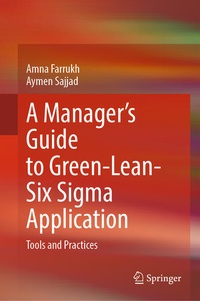
A Manager's Guide to Green-Lean-Six Sigma Application
Description

This book showcases the significance of an integrated Green Lean Six Sigma (GLSS) approach as an emerging environmentally sustainable business practice that can be applied in both manufacturing and service organizations. The GLSS approach emphasizes achieving optimal environmental benefits while maintaining operational performance. The book comprehensively covers the drivers, tools, practices, barriers, and factors required for successful implementation of this approach to address environmental sustainability issues.
Featuring practical examples of GLSS implementation from developed and developing economies, the book provides a broad perspective of the application of this approach. It is an invaluable resource for practitioners, environmental and lean six sigma consultants, senior corporate executives, decision-makers, policymakers, managers, engineering students, and research scholars seeking to adopt sustainable business practices.
In summary, this book offers a wealth of insights and knowledge that can help organizations achieve their sustainability goals while remaining competitive and profitable.
More details
Other editions
Additional editions
Persons
Amna Farrukh is currently working as an Assistant Professor in operations and supply chain management at Northumbria University, Newcastle, United Kingdom. Her areas of interest are sustainable operations and supply chain management, supply chain resilience, circular economy, lean six sigma, sustainability, supply chain transparency and traceability, and digitalization.
Aymen Sajjad is an Associate Professor of Sustainable Business Management and Discipline Lead for Management and International Business at the School of Management and Marketing, Massey Business School, Massey University. Dr Sajjad's research focuses on sustainability issues that confront organizations and societies. He has received several research awards and was recognized in 2025 among the World's Top 2% Scientists list - a prestigious list published annually by Stanford University and Elsevier. He is also the Deputy Director (Research) of the Sustainable Futures Research Hub at Massey Business School.
Dr Sajjad is an Associate Editor of Business Strategy and the Environment, Corporate Governance: The International Journal of Business in Society, FIIB Business Review Journal, and the International Journal of Sustainable Society. He is also an Editorial Advisory Board Member for the Review of International Business and Strategy, Management & Sustainability: An Arab Review, and an Editorial Review Board Member for the Journal of Global Responsibility. Dr Sajjad has published in top-tier business management and sustainability journals (e.g., International Journal of Management Reviews, Journal of Economic Behavior and Organization, Business Strategy and the Environment, International Journal of Operations and Production Management, Journal of Manufacturing Technology Management, Social Indicators Research, and Global Journal of Flexible Systems Management. In addition, he has authored several book chapters on corporate social responsibility and sustainability issues.
Content
Introduction.- Foundation of green-lean-six sigma: underpinnings and context.- Evolution and interlinkages between green, lean, and six sigma strategies.- Green-lean-six sigma - an integrated approach.- Introduction.-Green-lean-six sigma for environmental sustainability.- Introduction.- Theoretical underpinnings of the green-lean-six sigma approach.- Introduction.- Application of green-lean-six sigma - cases in manufacturing and service sectors.- Application of green-lean-six sigma in small and medium enterprises (SMEs).- Introduction.- Integrating green-lean-six sigma with emerging trends. Application of green-lean-six sigma in improving global supply chain sustainability.- Introduction.- Creating sustainable organizations through a holistic green-lean-six sigma.- Concluding comments.
