

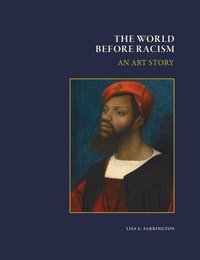
The World Before Racism
Description

Utilizing works of art as a primary source, Lisa Farrington's research in The World Before Racism conclusively answers the questions: Who invented racism? When? And why?
The term racism is understood to mean that race is the principal determinant of specific human traits and capacities and that due to racial differences, one race is inherently superior to all others. Over time, racism has commonly referenced the notion that the White race is superior to all others, fostering prejudice and discrimination. In The World Before Racism: An Art Story, author and art historian Lisa Farrington meticulously examines the intersection of art, history, and race, using original works of art as primary source materials to support her premise that racism is a construct, invented in the mid-1700s, to support the financial, political, and religious structures of European colonialism.
Using art from ancient Egypt, classical Greece, and the Roman Empire, through Medieval Europe and the colonization of the New World, to the art of the present day-sources that cannot be easily altered, edited, or selectively translated-Farrington expertly examines the intricate interplay between the Black and White races, how they saw and understood each other over the centuries. The artworks serve as powerful voices, precisely conveying the artist's intended messages. The goal of The World Before Racism is to present irrefutable evidence that the ideology of racism is unfounded, unsupported, unjustified, and destined to fade away like so many other archaic and erroneous ideas.
More details
Person
Lisa Farrington is an American art historian and author, specializing in African American, Haitian, and women's art. She is a graduate of Howard University (BFA), American University (MA), and subsequently obtained her MPh and PhD in art history and philosophy at the CUNY Graduate Center. A past Associate Dean of Fine Arts at Howard University, she is currently Distinguished Professor Emeritus and Founding Chair of the Department of Art & Music at the John Jay College of Criminal Justice at the City University of New York. Farrington is one of only six full professors of African American art history in the United States. Her 2005 book, Creating Their Own Image, was the first comprehensive history of African American female artists, from slavery to present day. Her 2015 book, African American Art: A Visual Culture and History, is an updated survey on African American art. Farrington resides in New York City.
Jack Flam is a Distinguished Professor Emeritus of Art History at Brooklyn College and The Graduate Center at the City University of New York. He is the author of numerous books, catalogues, and articles on African art and on nineteenth and twentieth-century European and American art.
Erin Thompson holds a JD from Columbia Law School and a PhD in Art History from Columbia University. As America's only professor of art crime, she studies the ethics of cultural heritage, and various other intersections between art and crime.
Content
Foreword
Erin Thompson, PhD
Introduction
Jack Flam, PhD
The World Before Racism: An Art Story
Lisa E. Farrington, PhD
Part One
Art as a Primary Source
The Ancient World
Part Two
The Middle Ages and the Moors
From Gothic to Renaissance: St. Maurice and Parzival
Part Three
European Ascendency: From Slavs to Slaves
Architects of Racism: Eighteenth and Nineteenth Centuries
Part Four: Epilogue
The Early Twentieth Century: The Harlem Renaissance
The Latter Twentieth Century: The Pan-African Black Arts Movement
The Twenty-first Century: Afrofuturism and Post-Black
Notes
Acknowledgements
Teaching Guide and Sample Syllabus
Bibliography
Index
