

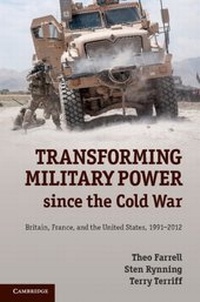
Transforming Military Power since the Cold War
Britain, France, and the United States, 1991-2012
1st Edition
Published on 20. September 2013
978-1-107-45494-1 (ISBN)
Description

This book provides an authoritative account of how the US, British, and French armies have transformed since the end of the Cold War. All three armies have sought to respond to changes in their strategic and socio-technological environments by developing more expeditionary capable and networked forces. Drawing on extensive archival research, hundreds of interviews, and unprecedented access to official documents, the authors examine both the process and the outcomes of army transformation, and ask how organizational interests, emerging ideas, and key entrepreneurial leaders interact in shaping the direction of military change. They also explore how programs of army transformation change over time, as new technologies moved from research to development, and as lessons from operations were absorbed. In framing these issues, they draw on military innovation scholarship and, in addressing them, produce findings with general relevance for the study of how militaries innovate.
Reviews / Votes
'Critically integrating and indisputably surpassing the current literature on military innovation, this is a 'must have' book for serious students of military affairs and senior leaders, particularly for those interested in, or responsible for, innovation and force development. Transforming Military Power since the Cold War is also highly relevant to policy makers facing key decisions about reposturing ground forces for joint and coalition warfare after the protracted struggles in Iraq and Afghanistan - and to any leader seeking to induce disruptive changes into large organizations.' Frank G. Hoffman, National Defense University, Washington, DC 'Since the end of the Cold War and especially in the last decade, Western armed forces have undergone radical reformation. In this important book on the United States, France, and the United Kingdom, three acknowledged experts provide a unique analysis of the central dynamics and character of this transformation focusing on three powers, widely regarded to be the most important to the future of NATO.' Anthony King, University of Exeter 'Transforming Military Power since the Cold War offers a much needed comparative perspective on contemporary military innovation. In a period of constrained resources, it will be of interest to scholars and policy makers alike.' Thomas G. Mahnken, Jerome E. Levy Chair of Economic Geography and National Security, US Naval War College 'Land forces are a crucial component of military power and have been central to the wars that the West has fought since the turn of the new millennium. Transforming Military Power since the Cold War is the most richly detailed comparative account of the adaptation of the armies of the three main war-fighting nations in the West: the United States, Britain, and France. Farrell, Rynning, and Terriff plunge into the tensions and dilemmas of army adaptations and make the case that all three armies have in a real sense transformed themselves to meet new strategic imperatives and technological challenges. This rich and nuanced account is essential reading for anyone seeking to understand the transformation of military power and how armies respond to challenges.' Pascal Vennesson, Nanyang Technological University 'This valuable book comes at a time when Western militaries face constrained budgets and the re-emergence of many of the same flawed ideas that underpinned the orthodoxy of the 'revolution in military affairs' in the 1990s. Success in military innovation depends on how civilian and military leaders manage the interaction between interests and ideas. As Western militaries develop new defence strategies, their leaders would be well advised to revisit their experiences with transformation across the first two decades of the post-Cold War period. Transforming Military Power would be a good place to start.' H. R. McMaster, SurvivalMore details
Language
English
Place of publication
Cambridge
United Kingdom
Target group
Professional and scholarly
Illustrations
13 Tables, black and white; 1 Halftones, black and white; 5 Line drawings, black and white
File size
2337,84 MB
ISBN-13
978-1-107-45494-1 (9781107454941)
Copyright in bibliographic data and cover images is held by Nielsen Book Services Limited or by the publishers or by their respective licensors: all rights reserved.
Schweitzer Classification
Other editions
Additional editions
Theo Farrell | Sten Rynning | Terry Terriff
Transforming Military Power since the Cold War
Britain, France, and the United States, 1991-2012
Book
10/2013
Cambridge University Press
€137.30
Shipment within 15-20 days
Theo Farrell | Sten Rynning | Terry Terriff
Transforming Military Power since the Cold War
Britain, France, and the United States, 1991-2012
Book
10/2013
Cambridge University Press
€39.90
Shipment within 15-20 days
Persons
Theo Farrell is Professor of War in the Modern World in the Department of War Studies at King's College London. Sten Rynning is Professor in the Department of Political Science and Head of the Center for War Studies at the University of Southern Denmark. Terry Terriff is Arthur J. Child Chair of American Security Policy and Professor in the Department of Political Science at the University of Calgary.
Content
1. Army transformation: imperatives and innovations; 2. Transformation from the top down: the United States Army, 1991-2012; 3. Transformation in contact: the British army, 1991-2012; 4. Transformation as modernization: the French Army, 1991-2012; 5. Conclusion: innovation and military power.
