

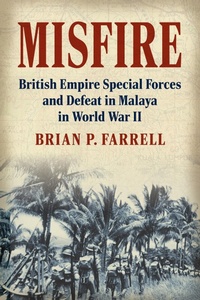
Misfire
Description

Shortlist: Templer Medal
Of all the Allied strategic defensive campaigns in the first half of World War II, the fight to defend Malaya and Singapore provided perhaps the best chance to use special forces to wider effect.
In December 1941, the issue in the East during World War II was whether or not the Japanese could drive the Western Allies out of Southeast Asia before the Allies could reinforce strongly enough to prevent it. Consequently, the British Army organized, trained, and specifically equipped special forces combat units to operate independently, for long periods of time if necessary, physically separated from the main forces in the field. British Army special forces units were usually directed to carry out two broad but often closely related missions: provide direct assistance to main force operations and harass enemy movements, lines of supply, and communications. Special forces were also frequently used to destroy specific targets, sometimes in completely independent operations with no main force in the field, and especially to act as the eyes and ears of the main force, gathering intelligence on enemy movements and/or screening those of friendly forces.
In Misfire, Brian Farrell analyzes how and why the British Army developed special forces in the early years of World War II; what uses it made of them; and the role that special and irregular forces played in defending Malaya and Singapore against Japanese invasion, from prewar preparations to capitulation in February 1942. Farrell's examination of the use of special and irregular forces helps us understand both the Malayan Campaign and wider efforts to defend Southeast Asia as well as what that campaign tells us about the evolution of such forces in the British and Empire armies.
More details
Other editions
Additional editions
Person
Content
Acknowledgments
List of Maps
List of Photos
Introduction
1. From Quebec to Norway
2. Calculating Risk
3. Aliens, Armies, and Asians
4. What's in a Name?
5. Ideas from Home
6. Command and Command Troops
7. Stopping Gaps
8. Coast Watching
9. Breakdown
10. Dead End
Conclusion: Lessons and Legacies
Appendix
Notes
Bibliography
Index
