

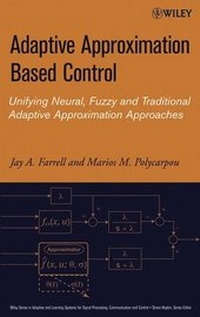
Adaptive Approximation Based Control
Description

More details
Other editions
Additional editions
Persons
Content
1. INTRODUCTION.
1.1 Systems and Control Terminology.
1.2 Nonlinear Systems.
1.3 Feedback Control Approaches.
1.3.1 Linear Design.
1.3.2 Adaptive Linear Design.
1.3.3 Nonlinear Design.
1.3.4 Adaptive Approximation Based Design.
1.3.5 Example Summary.
1.4 Components of Approximation Based Control.
1.4.1 Control Architecture.
1.4.2 Function Approximator.
1.4.3 Stable Training Algorithm.
1.5 Discussion and Philosophical Comments.
1.6 Exercises and Design Problems.
2. APPROXIMATION THEORY.
2.1 Motivating Example.
2.2 Interpolation.
2.3 Function Approximation.
2.3.1 Off-line (Batch) Function Approximation.
2.3.2 Adaptive Function Approximation.
2.4 Approximator Properties.
2.4.1 Parameter (Non)Linearity.
2.4.2 Classical Approximation Results.
2.4.3 Network Approximators.
2.4.4 Nodal Processors.
2.4.5 Universal Approximator.
2.4.6 Best Approximator Property.
2.4.7 Generalization.
2.4.8 Extent of Influence Function Support.
2.4.9 Approximator Transparency.
2.4.10 Haar Conditions.
2.4.11 Multivariable Approximation by Tensor Products.
2.5 Summary.
2.6 Exercises and Design Problems.
3. APPROXIMATION STRUCTURES.
3.1 Model Types.
3.1.1 Physically Based Models.
3.1.2 Structure (Model) Free Approximation.
3.1.3 Function Approximation Structures.
3.2 Polynomials.
3.2.1 Description.
3.2.2 Properties.
3.3 Splines.
3.3.1 Description.
3.3.2 Properties.
3.4 Radial Basis Functions.
3.4.1 Description.
3.4.2 Properties.
3.5 Cerebellar Model Articulation Controller.
3.5.1 Description.
3.5.2 Properties.
3.6 Multilayer Perceptron.
3.6.1 Description.
3.6.2 Properties.
3.7 Fuzzy Approximation.
3.7.1 Description.
3.7.2 Takagi-Sugeno Fuzzy Systems.
3.7.3 Properties.
3.8 Wavelets.
3.8.1 Multiresolution Analysis (MRA).
3.8.2 MRA Properties.
3.9 Further Reading.
3.10 Exercises and Design Problems.
4. PARAMETER ESTIMATION METHODS.
4.1 Formulation for Adaptive Approximation.
4.1.1 Illustrative Example.
4.1.2 Motivating Simulation Examples.
4.1.3 Problem Statement.
4.1.4 Discussion of Issues in Parametric Estimation.
4.2 Derivation of Parametric Models.
4.2.1 Problem Formulation for Full-State Measurement.
4.2.2 Filtering Techniques.
4.2.3 SPR Filtering.
4.2.4 Linearly Parameterized Approximators.
4.2.5 Parametric Models in State Space Form.
4.2.6 Parametric Models of Discrete-Time Systems.
4.2.7 Parametric Models of Input-Output Systems.
4.3 Design of On-Line Learning Schemes.
4.3.1 Error Filtering On-Line Learning (EFOL) Scheme.
4.3.2 Regressor Filtering On-Line Learning (RFOL) Scheme.
4.4 Continuous-Time Parameter Estimation.
4.4.1 Lyapunov Based Algorithms.
4.4.2 Optimization Methods.
4.4.3 Summary.
4.5 On-Line Learning: Analysis.
4.5.1 Analysis of LIP EFOL scheme with Lyapunov Synthesis Method.
4.5.2 Analysis of LIP RFOL scheme with the Gradient Algorithm.
4.5.3 Analysis of LIP RFOL scheme with RLS Algorithm.
4.5.4 Persistency of Excitation and Parameter Convergence.
4.6 Robust Learning Algorithms.
4.6.1 Projection modification.
4.6.2 s-modification.
4.6.3 &epsis;-modification.
4.6.4 Dead-zone modification.
4.6.5 Discussion and Comparison.
4.7 Concluding Summary.
4.8 Exercises and Design Problems.
5. NONLINEAR CONTROL ARCHITECTURES.
5.1 Small-Signal Linearization.
5.1.1 Linearizing Around an Equilibrium Point.
5.1.2 Linearizing Around a Trajectory.
5.1.3 Gain Scheduling.
5.2 Feedback Linearization.
5.2.1 Scalar Input-State Linearization.
5.2.2 Higher-Order Input-State Linearization.
5.2.3 Coordinate Transformations and Diffeomorphisms.
5.2.4 Input-Output Feedback Linearization.
5.3 Backstepping.
5.3.1 Second order system.
5.3.2 Higher Order Systems.
5.3.3 Command Filtering Formulation.
5.4 Robust Nonlinear Control Design Methods.
5.4.1 Bounding Control.
5.4.2 Sliding Mode Control.
5.4.3 Lyapunov Redesign Method.
5.4.4 Nonlinear Damping.
5.4.5 Adaptive Bounding Control.
5.5 Adaptive Nonlinear Control.
5.6 Concluding Summary.
5.7 Exercises and Design Problems.
6. ADAPTIVE APPROXIMATION: MOTIVATION AND ISSUES.
6.1 Perspective for Adaptive Approximation Based Control.
6.2 Stabilization of a Scalar System.
6.2.1 Feedback Linearization.
6.2.2 Small-Signal Linearization.
6.2.3 Unknown Nonlinearity with Known Bounds.
6.2.4 Adaptive Bounding Methods.
6.2.5 Approximating the Unknown Nonlinearity.
6.2.6 Combining Approximation with Bounding Methods.
6.2.7 Combining Approximation with Adaptive Bounding Methods.
6.2.8 Summary.
6.3 Adaptive Approximation Based Tracking.
6.3.1 Feedback Linearization.
6.3.2 Tracking via Small-Signal Linearization.
6.3.3 Unknown Nonlinearities with Known Bounds.
6.3.4 Adaptive Bounding Design.
6.3.5 Adaptive Approximation of the Unknown Nonlinearities.
6.3.6 Robust Adaptive Approximation.
6.3.7 Combining Adaptive Approximation with Adaptive Bounding.
6.3.8 Some Adaptive Approximation Issues.
6.4 Nonlinear Parameterized Adaptive Approximation.
6.5 Concluding Summary.
6.6 Exercises and Design Problems.
7. ADAPTIVE APPROXIMATION BASED CONTROL: GENERAL THEORY.
7.1 Problem Formulation.
7.1.1 Trajectory Tracking.
7.1.2 System.
7.1.3 Approximator.
7.1.4 Control Design.
7.2 Approximation Based Feedback Linearization.
7.2.1 Scalar System.
7.2.2 Input-State.
7.2.3 Input-Output.
7.2.4 Control Design Outside the Approximation Region D.
7.3 Approximation Based Backstepping.
7.3.1 Second Order Systems.
7.3.2 Higher Order Systems.
7.3.3 Command Filtering Approach.
7.3.4 Robustness Considerations.
7.4 Concluding Summary.
7.5 Exercises and Design Problems.
8. ADAPTIVE APPROXIMATION BASED CONTROL FOR FIXED-WING AIRCRAFT.
8.1 Aircraft Model Introduction.
8.1.1 Aircraft Dynamics.
8.1.2 Non-dimensional Coefficients.
8.2 Angular Rate Control for Piloted Vehicles.
8.2.1 Model Representation.
8.2.2 Baseline Controller.
8.2.3 Approximation Based Controller.
8.2.4 Simulation Results.
8.3 Full Control for Autonomous Aircraft.
8.3.1 Airspeed and Flight Path Angle Control.
8.3.2 Wind-axes Angle Control.
8.3.3 Body Axis Angular Rate Control.
8.3.4 Control Law and Stability Properties.
8.3.5 Approximator Definition.
8.3.6 Simulation Analysis.
8.4 Conclusions.
8.5 Aircraft Notation.
Appendix A: Systems and Stability Concepts.
A.1 Systems Concepts.
A.2 Stability Concepts.
A.2.1 Stability Definitions.
A.2.2 Stability Analysis Tools.
A.3 General Results.
A.4 Prefiltering.
A.5 Other Useful Results.
A.5.1 Smooth Approximation of the Signum function.
A.6 Problems.
Appendix B: Recommended Implementation and Debugging Approach.
References.
Index.
