

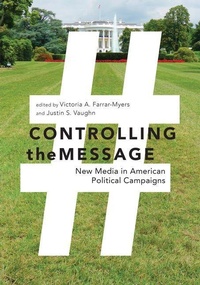
Controlling the Message
New Media in American Political Campaigns
1st Edition
Published on 27. March 2015
277 pages
978-1-4798-6550-5 (ISBN)
Description

Choice Outstanding Academic Title of 2016
From the presidential race to the battle for the office of New York City mayor, American political candidates' approach to new media strategy is increasingly what makes or breaks their campaign. Targeted outreach on Facebook and Twitter, placement of a well-timed viral ad, and the ability to roll with the memes, flame wars, and downvotes that might spring from ordinary citizens' engagement with the issues-these skills are heralded as crucial for anyone hoping to get their views heard in a chaotic election cycle. But just how effective are the kinds of media strategies that American politicians employ? And what effect, if any, do citizen-created political media have on the tide of public opinion?
In Controlling the Message, Farrar-Myers and Vaughn curate a series of case studies that use real-time original research from the 2012 election season to explore how politicians and ordinary citizens use and consume new media during political campaigns. Broken down into sections that examine new media strategy from the highest echelons of campaign management all the way down to passive citizen engagement with campaign issues in places like online comment forums, the book ultimately reveals that political messaging in today's diverse new media landscape is a fragile, unpredictable, and sometimes futile process. The result is a collection that both interprets important historical data from a watershed campaign season and also explains myriad approaches to political campaign media scholarship-an ideal volume for students, scholars, and political analysts alike.
From the presidential race to the battle for the office of New York City mayor, American political candidates' approach to new media strategy is increasingly what makes or breaks their campaign. Targeted outreach on Facebook and Twitter, placement of a well-timed viral ad, and the ability to roll with the memes, flame wars, and downvotes that might spring from ordinary citizens' engagement with the issues-these skills are heralded as crucial for anyone hoping to get their views heard in a chaotic election cycle. But just how effective are the kinds of media strategies that American politicians employ? And what effect, if any, do citizen-created political media have on the tide of public opinion?
In Controlling the Message, Farrar-Myers and Vaughn curate a series of case studies that use real-time original research from the 2012 election season to explore how politicians and ordinary citizens use and consume new media during political campaigns. Broken down into sections that examine new media strategy from the highest echelons of campaign management all the way down to passive citizen engagement with campaign issues in places like online comment forums, the book ultimately reveals that political messaging in today's diverse new media landscape is a fragile, unpredictable, and sometimes futile process. The result is a collection that both interprets important historical data from a watershed campaign season and also explains myriad approaches to political campaign media scholarship-an ideal volume for students, scholars, and political analysts alike.
Reviews / Votes
This is an indispensable book for those studying politics and social media. This is especially the case given the diversity of research strategies and subject matter examined throughout the text. Summing Up: Highly recommended. (Choice) [T]he book is a great resource book for the role of social media in political campaigns with a nuanced view and solid empirical data to back up their claims. (Communication Booknotes Quarterly) Controlling the Messagebrings valuable data and sharp analysis to bear on timely, important questions. (International Journal of Communication) Much has been made of President Barack Obama's strategy on social media...it's an interesting examination at a time when pundits are already discussing that the last time potential GOP candidate Jeb Bush ran for office (2002's Florida gubernatorial election), neither Twitter nor Facebook existed. (Library Journal) The 2012 presidential and congressional races serve as a laboratory for the scholars in this volume, who contribute 13 chapters on the impact of social media (Twitter,Facebook, YouTube, blogs, and online forums) on these elections...[P]olitical scientists specializing in this emerging field will appreciate the rigor of these studies (Library Journal) This book is well researched and is a high quality addition to the existing literature on campaign communications. The contributors do an excellent job relying on current research in the field while presenting new and important data. The timeliness of the research throughout makes it a solid contribution, particularly with the new data provided on various forms of social media use during the most recent presidential campaign. - Lori Cox Han,author of New Directions in the American Presidency The research reported in this comprehensive volume provides a snapshot of an important point in the evolution of American political campaigns. The books examination of the production and effects of social media messages will help us understand their role in contemporary campaigns. Most importantly, the research helps the discipline define the practical limits of social media influence and identify areas for future research. - David Tewksbury,co-author of News on the Internet: Information and Citizenship in the 21st CenturyMore details
Language
English
Place of publication
New York
United States
Target group
Professional and scholarly
Illustrations
69 black and white illustrations
File size
3,68 MB
ISBN-13
978-1-4798-6550-5 (9781479865505)
Copyright in bibliographic data and cover images is held by Nielsen Book Services Limited or by the publishers or by their respective licensors: all rights reserved.
Schweitzer Classification
Other editions
Additional editions
Victoria A. Farrar-Myers | Justin S. Vaughn
Controlling the Message
New Media in American Political Campaigns
Book
03/2015
New York University Press
€39.50
Shipment within 10-20 days
Victoria A. Farrar-Myers | Justin S. Vaughn
Controlling the Message
New Media in American Political Campaigns
Book
03/2015
New York University Press
€127.97
Shipment within 10-20 days
Persons
Victoria A. Farrar-Myers is an award-winning scholar and teacher, and a former Fulbright Distinguished Chair and APSA Congressional Fellow. Her publications include Scripted for Change and Legislative Labyrinth.
Justin S. Vaughn is Assistant Professor of Political Science at Boise State University. His publications include Czars in the White House and Women and the White House.
Justin S. Vaughn is Assistant Professor of Political Science at Boise State University. His publications include Czars in the White House and Women and the White House.
Content
- Cover
- Contents
- Acknowledgments
- Introduction: Controlling the Message in the Social Media Marketplace of Ideas
- PART 1: ELITE UTILIZATION
- 1. Strategic Communication in a Networked Age
- 2. Congressional Campaigns' Motivations for Social Media Adoption
- 3. Surrogates or Competitors? Social Media Use by Independent Political Actors
- 4. The Competition to Control Campaign Messages on YouTube
- PART 2: MESSAGE CONTROL IN THE NEW MEDIA ENVIRONMENT
- 5. Campaign News in the Time of Twitter
- 6. New and Traditional Media Reportage on Electoral Campaign Controversies
- 7. Traditional Media, Social Media, and Different Presidential Campaign Messages
- PART 3: SOCIAL MEDIA'S IMPACT ON CAMPAIGN POLITICS
- 8. The Influence of User-Controlled Messages on Candidate Evaluations
- 9. Terms of Engagement: Online Political Participation and the Impact on Offline Political Participation
- 10. Is Laughter the Best Medicine for Politics? Commercial versus Noncommercial YouTube Videos
- PART 4: SOCIAL MEDIA AND CIVIC RELATIONS
- 11. Comment Forum Speech as a Mirror of Mainstream Discourse
- 12. Sparking Debate: Campaigns, Social Media, and Political Incivility
- 13. Flaming and Blaming: The Political Effect of Internet News and Reader "Comments"
- Conclusion: Message Control at the Margins
- About the Contributors
- Index
- A
- B
- C
- D
- E
- F
- G
- H
- I
- J
- K
- L
- M
- N
- O
- P
- Q
- R
- S
- T
- U
- V
- W
- Y
- Z
