

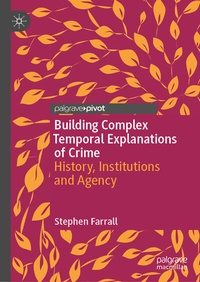
Building Complex Temporal Explanations of Crime
History, Institutions and Agency
Published on 19. May 2021
XVII, 162 pages
978-3-030-74830-2 (ISBN)
Description

This book seeks to bring understanding of both complexity and temporality into criminology. It outlines why these are important in criminological models of causation and explanation and explores them by drawing on theories and approaches in political science, comparative history, social theory and systems analyses. It discusses what is meant by complexity and introduces historical institutionalism (which is rarely used in criminology) to criminological audiences; it introduces what is known as 'why-because' analyses to the social sciences. This style of thinking is used to explore the causes of major transportation accidents (such as aeroplane or ferry disasters) and involves the integration of structural, organisational and agentic inputs in accounting for such disasters. Chapters on realistic evaluation, theories of structuration and agency, and research design and research methods are included with an example project based on the author's recent studies of Thatcherism which shows how these theories can be applied to empirical data. This book speaks to those interested in criminology, sociology, political science, research methods and the wider social sciences.
Reviews / Votes
A thoroughly engrossing invitation to criminologists to take history seriously. It is a compelling book, which casts a critical eye on complexity, continuity and change. Written with flair and imagination, it provides a bold, dynamic framework to challenge the existing parameters of criminological inquiry. Original, ambitious and thought provoking - this is an important and timely work. Eamonn Carrabine, Professor of Criminology, Department of Sociology, University of Essex A timely and refreshing read from start to finish. By offering complex answers to complex problems, Professor Farrall presents a compelling vision of criminology which is underpinned by interdisciplinarity, context, temporal processes and agency. Essential reading for anyone seeking to develop and challenge their own thinking around issues of crime. Neil Chakraborti, Professor in Criminology, University of Leicester'The tradition of all dead generations weighs like a nightmare on the brains of the living', claimed Marx in 1852. Stephen Farrall does not think of the relations between past and present in such drastic or fateful terms. Yet he is equally concerned with the laminations of past influences on our present culture and conduct. Farrall has a rare capacity to connect quantitative observations of crime and control with an historical sensibility, and with problems of social, sociological and political theory. For these reasons Farrall is able in this book to offer refreshing new perspectives on levels of explanation in thinking about crime, and to make the topic of complexity seem not only accessible but invigorating. Farrall encourages us to feel that we too can and should reach for solutions that are at once 'historical, spatial, economic, cultural and agentic'. Richard Sparks, School of Law, Univ of EdinburghMore details
Series
Edition
1st ed. 2021
Language
English
Place of publication
Cham
Switzerland
Publishing group
Springer International Publishing
Target group
Professional and scholarly
Product notice
Reflowable
Illustrations
XVII, 162 p. 10 illus., 2 illus. in color.
File size
2,62 MB
ISBN-13
978-3-030-74830-2 (9783030748302)
DOI
10.1007/978-3-030-74830-2
Schweitzer Classification
Other editions
Additional editions
Book
05/2021
Palgrave Macmillan
€74.89
Shipment within 7-9 days
Person
Stephen Farrall is Research Chair in Criminology at the University of Derby, UK.
Content
Introduction.- Chapter One: Recognising Complexity.- Chapter Two: Historical and Constructivist Institutionalisms.- Chapter Three: Why-Because Analyses.- Chapter Four: Realistic Evaluation.- Chapter Five: Where have All the People Gone? Theories of Structuration, Practice and Agency.- Chapter Six: Research Designs and Research Methods.- Chapter Seven: An Exemplar.- Chapter Eight: Concluding Observations.- Glossary.
