

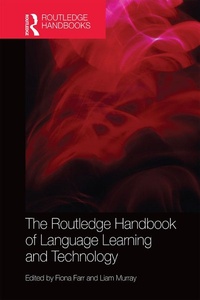
The Routledge Handbook of Language Learning and Technology
Published on 26. February 2016
596 pages
978-1-317-32942-8 (ISBN)
Description

The exponential growth and development of modern technologies in all sectors has made it increasingly difficult for students, teachers and teacher educators to know which technologies to employ and how best to take advantage of them.
The Routledge Handbook of Language Learning and Technology brings together experts in a number of key areas of development and change, and opens the field of language learning by exploring the pedagogical importance of technological innovation. The handbook is structured around six themes:
historical and conceptual contexts
core issues
interactive and collaborative technologies for language learning
corpora and data driven learning
gaming and language learning
purpose designed language learning resources.
Led by fundamental concepts, theories and frameworks from language learning and teaching research rather than by specific technologies, this handbook is the essential reference for all students, teachers and researchers of Language Learning and TESOL. Those working in the areas of Applied Linguistics, Education and Media Studies will also find this a valuable book.
The Routledge Handbook of Language Learning and Technology brings together experts in a number of key areas of development and change, and opens the field of language learning by exploring the pedagogical importance of technological innovation. The handbook is structured around six themes:
historical and conceptual contexts
core issues
interactive and collaborative technologies for language learning
corpora and data driven learning
gaming and language learning
purpose designed language learning resources.
Led by fundamental concepts, theories and frameworks from language learning and teaching research rather than by specific technologies, this handbook is the essential reference for all students, teachers and researchers of Language Learning and TESOL. Those working in the areas of Applied Linguistics, Education and Media Studies will also find this a valuable book.
Reviews / Votes
'This is a superb collection of state of the art chapters covering the full field of technology in language teaching and learning. Anyone interested in gaining an overview of the field would do well by beginning with this collection, as would more experienced readers seeking to update themselves on any given topic.' John Flowerdew, City University of Hong Kong, ChinaMore details
Series
Language
English
Place of publication
London
United Kingdom
Publishing group
Taylor & Francis Ltd
Target group
College/higher education
Illustrations
23 s/w Tabellen, 1 farbige Tabelle
1 Tables, color; 23 Tables, black and white
File size
6,40 MB
ISBN-13
978-1-317-32942-8 (9781317329428)
Copyright in bibliographic data and cover images is held by Nielsen Book Services Limited or by the publishers or by their respective licensors: all rights reserved.
Schweitzer Classification
Other editions
Additional editions
Fiona Farr | Liam Murray
The Routledge Handbook of Language Learning and Technology
Book
04/2020
1st Edition
Routledge
€74.60
Shipment within 15-20 days
Fiona Farr | Liam Murray
The Routledge Handbook of Language Learning and Technology
Book
03/2016
1st Edition
Routledge
€357.50
Shipment within 15-20 days
Persons
Fiona Farr lectures in English Language Teaching in the School of Languages, Literature, Culture and Communication at the University of Limerick, where she was also Assistant Dean for Academic Affairs in the Faculty of Arts, Humanities and Social Sciences from 2008-2011. She is a member of the Centre for Applied Language Studies (CALS), and the Inter-Varietal Applied Corpus Studies (IVACS) Research Group. She is involved in English language teacher education at undergraduate and postgraduate levels, and is currently leading the development of a PhD in TESOL to begin in September, 2013.
Liam Murray currently lectures in French language and culture, Computer-Assisted Language Learning Assessment Methods and Second Language Acquisition in the School of Languages, Literature, Culture and Communication at the University of Limerick, where he is also a member of the Centre for Applied Language Studies. At this same University, he was the Initiator and the Course Director for the successful launch in 2006 of the B.Sc. in Multimedia and Computer Games Development within the Computer Science and Information Systems Department, on which he also lectures.
Liam Murray currently lectures in French language and culture, Computer-Assisted Language Learning Assessment Methods and Second Language Acquisition in the School of Languages, Literature, Culture and Communication at the University of Limerick, where he is also a member of the Centre for Applied Language Studies. At this same University, he was the Initiator and the Course Director for the successful launch in 2006 of the B.Sc. in Multimedia and Computer Games Development within the Computer Science and Information Systems Department, on which he also lectures.
Content
List of figures
List of tables
Acknowledgements
Permissions
List of acronyms
List of contributors
Introduction
Fiona Farr and Liam Murray
Part I: Historical and conceptual contexts
Part II: Core issues
Part III: Interactive and collaborative technologies for language learning
Part IV: Corpora and data-driven learning
Part V: Gaming and language learning
Part VI: Purpose designed language learning resources
List of tables
Acknowledgements
Permissions
List of acronyms
List of contributors
Introduction
Fiona Farr and Liam Murray
Part I: Historical and conceptual contexts
Part II: Core issues
Part III: Interactive and collaborative technologies for language learning
Part IV: Corpora and data-driven learning
Part V: Gaming and language learning
Part VI: Purpose designed language learning resources
