

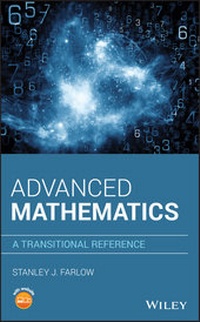
Advanced Mathematics
Description

Most universities require students majoring in mathematics to take a "transition to higher math" course that introduces mathematical proofs and more rigorous thinking. Such courses help students be prepared for higher-level mathematics course from their onset. Advanced Mathematics: A Transitional Reference provides a "crash course" in beginning pure mathematics, offering instruction on a blendof inductive and deductive reasoning. By avoiding outdated methods and countless pages of theorems and proofs, this innovative textbook prompts students to think about the ideas presented in an enjoyable, constructive setting.
Clear and concise chapters cover all the essential topics students need to transition from the "rote-orientated" courses of calculus to the more rigorous "proof-orientated" advanced mathematics courses. Topics include sentential and predicate calculus, mathematical induction, sets and counting, complex numbers, point-set topology, and symmetries, abstract groups, rings, and fields. Each section contains numerous problems for students of various interests and abilities. Ideally suited for a one-semester course, this book:
* Introduces students to mathematical proofs and rigorous thinking
* Provides thoroughly class-tested material from the authors own course in transitioning to higher math
* Strengthens the mathematical thought process of the reader
* Includes informative sidebars, historical notes, and plentiful graphics
* Offers a companion website to access a supplemental solutions manual for instructors
Advanced Mathematics: A Transitional Reference is a valuable guide for undergraduate students who have taken courses in calculus, differential equations, or linear algebra, but may not be prepared for the more advanced courses of real analysis, abstract algebra, and number theory that await them. This text is also useful for scientists, engineers, and others seeking to refresh their skills in advanced math.
More details
Other editions
Additional editions
Person
STANLEY J. FARLOW, PHD, is Professor Emeritus of Mathematics, University of Maine, USA. He was a Professor of Mathematics at the University of Maine for 47 years from 1968 to 2016, doing research in control theory, PDEs, and neural networks (GMDH algorithm) as well as teaching graduate and undergraduate courses in real and complex analysis, topology, differential equations, statistics, and a transition to higher math course.
Content
Preface vii
Possible Beneficial Audiences ix
Wow Factors of the Book x
Chapter by Chapter (the nitty-gritty) xi
Note to the Reader xiii
About the Companion Website xiv
Chapter 1 Logic and Proofs 1
1.1 Sentential Logic 3
1.2 Conditional and Biconditional Connectives 24
1.3 Predicate Logic 38
1.4 Mathematical Proofs 51
1.5 Proofs in Predicate Logic 71
1.6 Proof by Mathematical Induction 83
Chapter 2 Sets and Counting 95
2.1 Basic Operations of Sets 97
2.2 Families of Sets 115
2.3 Counting: The Art of Enumeration 125
2.4 Cardinality of Sets 143
2.5 Uncountable Sets 156
2.6 Larger Infinities and the ZFC Axioms 167
Chapter 3 Relations 179
3.1 Relations 181
3.2 Order Relations 195
3.3 Equivalence Relations 212
3.4 The Function Relation 224
3.5 Image of a Set 242
Chapter 4 The Real and Complex Number Systems 255
4.1 Construction of the Real Numbers 257
4.2 The Complete Ordered Field: The Real Numbers 269
4.3 Complex Numbers 281
Chapter 5 Topology 299
5.1 Introduction to Graph Theory 301
5.2 Directed Graphs 321
5.3 Geometric Topology 334
5.4 Point-Set Topology on the Real Line 349
Chapter 6 Algebra 367
6.1 Symmetries and Algebraic Systems 369
6.2 Introduction to the Algebraic Group 385
6.3 Permutation Groups 403
6.4 Subgroups: Groups Inside a Group 419
6.5 Rings and Fields 433
Index 443
