

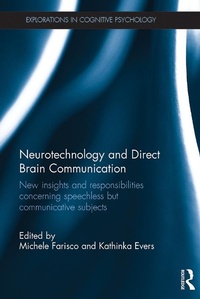
Neurotechnology and Direct Brain Communication
New insights and responsibilities concerning speechless but communicative subjects
Published on 28. April 2016
176 pages
978-1-317-52958-3 (ISBN)
Description

Neurotechnology and Direct Brain Communication focuses on recent neuroscientific investigations of infant brains and of patients with disorders of consciousness (DOC), both of which are at the forefront of contemporary neuroscience. The prospective use of neurotechnology to access mental states in these subjects, including neuroimaging, brain simulation, and brain computer interfaces, offers new opportunities for clinicians and researchers, but has also received specific attention from philosophical, scientific, ethical, and legal points of view. This book offers the first systematic assessment of these issues, investigating the tools neurotechnology offers to care for verbally non-communicative subjects and suggesting a multidisciplinary approach to the ethical and legal implications of ordinary and experimental practices.
The book is divided into three parts: the first and second focus on the scientific and clinical implications of neurological tools for DOC patient and infant care. With reference to these developments, the third and final part presents the case for re-evaluating classical ethical and legal concepts, such as authority, informed consent, and privacy.
Neurotechnology and Direct Brain Communication will appeal to researchers and postgraduate students in the fields of cognitive science, medical ethics, medical technology, and the philosophy of the mind. With implications for patient care, it will also be a useful resource for clinicians, medical centres, and health practitioners.
The book is divided into three parts: the first and second focus on the scientific and clinical implications of neurological tools for DOC patient and infant care. With reference to these developments, the third and final part presents the case for re-evaluating classical ethical and legal concepts, such as authority, informed consent, and privacy.
Neurotechnology and Direct Brain Communication will appeal to researchers and postgraduate students in the fields of cognitive science, medical ethics, medical technology, and the philosophy of the mind. With implications for patient care, it will also be a useful resource for clinicians, medical centres, and health practitioners.
More details
Series
Language
English
Place of publication
London
United Kingdom
Publishing group
Taylor & Francis Ltd
Target group
College/higher education
Professional and scholarly
Product notice
Reflowable
Illustrations
1 s/w Tabelle, 1 s/w Photographie bzw. Rasterbild, 4 s/w Zeichnungen
1 Tables, black and white; 4 Line drawings, black and white; 1 Halftones, black and white
File size
3,29 MB
ISBN-13
978-1-317-52958-3 (9781317529583)
Copyright in bibliographic data and cover images is held by Nielsen Book Services Limited or by the publishers or by their respective licensors: all rights reserved.
Schweitzer Classification
Other editions
Additional editions
Michele Farisco | Kathinka Evers
Neurotechnology and Direct Brain Communication
New insights and responsibilities concerning speechless but communicative subjects
Book
12/2017
1st Edition
Routledge
€81.89
Shipment within 15-20 days
Michele Farisco | Kathinka Evers
Neurotechnology and Direct Brain Communication
New insights and responsibilities concerning speechless but communicative subjects
Book
05/2016
1st Edition
Routledge
€227.50
Shipment within 10-20 days
Persons
Michele Farisco is part of the Neuroethics team of the Centre for Research Ethics and Bioethics, Uppsala University, Sweden, where he is completing his second PhD; member of the Ethics & Society Program in the European Human Brain Project, where he is involved in the research in philosophy and neuroethics; and head of the Science and Society Research Unit, Biogem Genetic Research Centre, Ariano Irpino, Italy. He is the author of three books and several articles in the areas of posthuman philosopy and philosophical, ethical, and legal implications of genetics and neuroscience.
Kathinka Evers is Professor of Philosophy and Senior Researcher at the Centre for Research Ethics and Bioethics, Uppsala University, Sweden, and Honorary Professor at the Central University of Chile, Chile. She is co-director of the Ethics & Society Program in the European Human Brain Project, leading the research in philosophy and neuroethics. Formerly the Executive Director for the Standing Committee on Responsibility and Ethics in Science (SCRES) of the International Council for Science (ICSU), her main research interests are in neuroethics and neurophilosophy, with special focus on analyses of consciousness and brain simulation.
Kathinka Evers is Professor of Philosophy and Senior Researcher at the Centre for Research Ethics and Bioethics, Uppsala University, Sweden, and Honorary Professor at the Central University of Chile, Chile. She is co-director of the Ethics & Society Program in the European Human Brain Project, leading the research in philosophy and neuroethics. Formerly the Executive Director for the Standing Committee on Responsibility and Ethics in Science (SCRES) of the International Council for Science (ICSU), her main research interests are in neuroethics and neurophilosophy, with special focus on analyses of consciousness and brain simulation.
Content
Introduction PART I 1. The Emergence of Consciousness: From foetal to newborn life 2. Mapping Mind-Brain Development 3. Cognitive capacities of the infant mind - a neuroimaging perspective 4. Neural Infantese. Detecting pain and suffering in preverbal infants by means of neuro-technological communication PART II 5. Does task-evoked activity entail consciousness in vegetative state? "Neuronal-phenomenal inference" versus "neuronal-phenomenal dissociation" 6. Neurotechnological communication with patients with disorders of consciousness 7. Instrumental assessment of residual consciousness in DOCs PART III 8. Ethical and deontological issues in paediatric clinical studies: an analysis of documents from national and international institutions 9. Disorders of consciousness and informed consent 10. Brain-Imaging and Privacy Concerns Conclusion
