

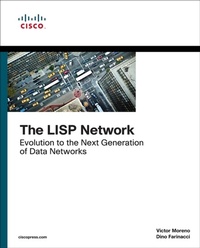
LISP Network, The
Evolution to the Next-Generation of Data Networks
1st Edition
Published on 29. January 2019
192 pages
978-0-13-454031-3 (ISBN)
Description

The complete guide to seamless anytime/anywhere networking with LISP
In an era of ubiquitous clouds, virtualization, mobility, and the Internet of Things, information and resources must be accessible anytime, from anywhere. Connectivity to devices and workloads must be seamless even when people move, and their location must be fully independent of device identity. The Locator/ID Separation Protocol (LISP) makes all this possible.
The LISP Network is the first comprehensive, in-depth guide to LISP concepts, architecture, techniques, behavior, and applications. Co-authored by LISP co-creator Dino Farinacci and Victor Moreno-co-developer of the Cisco LISP implementation-it will help you identify the opportunities and benefits of deploying LISP in any data center, campus and branch access, WAN edge, or service provider core network.
This largely implementation-agnostic guide will be valuable to architects, engineers, consultants, technical sales professionals, and senior IT professionals in any largescale network environment. The authors show how LISP overcomes key problems in large-scale networking, thoroughly introduce its key applications, guide you through designing real-world solutions, and present detailed deployment case studies based on their pioneering experience.
? Understand LISP's core principles, history, motivation, and applications
? Explore LISP's technical architecture, components, mechanisms, and workflows
? Use LISP to seamlessly deliver diverse network services and enable major advances in data center connectivity
? Improve mobility, network segmentation, and policy management
? Leverage software-defined WANs (SD-WANs) to efficiently move traffic from access to data center
? Evolve access networks to provide pervasive, mega-scale, high-density modern connectivity
? Integrate comprehensive security into the networking control and data plane, and learn how LISP infrastructure is protected against attacks
? Enforce access control policies, connection integrity, confidentiality for data in flight, and end-point anonymity
? Discover how LISP mobility mechanisms anticipate tomorrow's application use cases
In an era of ubiquitous clouds, virtualization, mobility, and the Internet of Things, information and resources must be accessible anytime, from anywhere. Connectivity to devices and workloads must be seamless even when people move, and their location must be fully independent of device identity. The Locator/ID Separation Protocol (LISP) makes all this possible.
The LISP Network is the first comprehensive, in-depth guide to LISP concepts, architecture, techniques, behavior, and applications. Co-authored by LISP co-creator Dino Farinacci and Victor Moreno-co-developer of the Cisco LISP implementation-it will help you identify the opportunities and benefits of deploying LISP in any data center, campus and branch access, WAN edge, or service provider core network.
This largely implementation-agnostic guide will be valuable to architects, engineers, consultants, technical sales professionals, and senior IT professionals in any largescale network environment. The authors show how LISP overcomes key problems in large-scale networking, thoroughly introduce its key applications, guide you through designing real-world solutions, and present detailed deployment case studies based on their pioneering experience.
? Understand LISP's core principles, history, motivation, and applications
? Explore LISP's technical architecture, components, mechanisms, and workflows
? Use LISP to seamlessly deliver diverse network services and enable major advances in data center connectivity
? Improve mobility, network segmentation, and policy management
? Leverage software-defined WANs (SD-WANs) to efficiently move traffic from access to data center
? Evolve access networks to provide pervasive, mega-scale, high-density modern connectivity
? Integrate comprehensive security into the networking control and data plane, and learn how LISP infrastructure is protected against attacks
? Enforce access control policies, connection integrity, confidentiality for data in flight, and end-point anonymity
? Discover how LISP mobility mechanisms anticipate tomorrow's application use cases
All prices
More details
Series
Edition
1. Auflage
Language
English
Place of publication
Indianapolis
United States
Publishing group
Pearson Education (US)
Target group
Professional and scholarly
File size
6,18 MB
ISBN-13
978-0-13-454031-3 (9780134540313)
Copyright in bibliographic data and cover images is held by Nielsen Book Services Limited or by the publishers or by their respective licensors: all rights reserved.
Schweitzer Classification
Other editions
Additional editions
Book
02/2019
Cisco Press
€55.00
Shipment within 3-4 weeks
Persons
Victor Moreno is a Distinguished Engineer at Cisco Systems responsible for the definition of next-generation network architectures. Victor has more than 20 years of industry experience focused on enterprise and data center network design and architecture. A recognized expert in his field, Victor holds several patents which are at the foundation of the key protocols and networking technologies that have enabled the evolution of networking to its current state. He has worked directly on the designs of global enterprises and service providers and has done extensive research on the topic of network virtualization, being a driving force within Cisco and earlier Digital Equipment Corporation for new product definition and technological direction. Victor is the co-author of the Cisco Press title Network Virtualization and has published a multitude of technical papers and articles on behalf of Cisco Systems. Victor holds a degree in electrical engineering from the Simon Bolivar University, as well as master's degrees and specializations from the Universities of York, Cambridge, and Stanford. Victor is an active contributor to the definition, implementation, and standardization of the Locator/ID Separation Protocol (LISP).
Dino Farinacci is a software engineer by trade and a technology visionary by passion, advancing the state of the art in computer networking. As one of the first Cisco Fellows, Dino holds more than 40 Internet and networking-related patents and has been a major IETF contributor for nearly 30 years with approximately 50 RFCs and Internet Drafts published. Dino is the founder of lispers.net, a nonprofit engineering organization, where he now focuses on design and deployment of LISP for IoT, cryptocurrency, and 5G mobile networks.
Dino is one of the original RFC co-authors of LISP, dating back to 2007, and has had the pleasure of writing two implementations of the protocol. He currently does consulting for large startup networking vendors and helps users deploy network designs using LISP and other architectures. If you can name an Internet protocol, there is a good chance Dino has designed and implemented it in widely deployed products. Over his career working at the NSA, CDC, 3Com, Procket, and Cisco, he has worked on dozens of operating systems, network protocols, and infrastructure systems.
Dino Farinacci is a software engineer by trade and a technology visionary by passion, advancing the state of the art in computer networking. As one of the first Cisco Fellows, Dino holds more than 40 Internet and networking-related patents and has been a major IETF contributor for nearly 30 years with approximately 50 RFCs and Internet Drafts published. Dino is the founder of lispers.net, a nonprofit engineering organization, where he now focuses on design and deployment of LISP for IoT, cryptocurrency, and 5G mobile networks.
Dino is one of the original RFC co-authors of LISP, dating back to 2007, and has had the pleasure of writing two implementations of the protocol. He currently does consulting for large startup networking vendors and helps users deploy network designs using LISP and other architectures. If you can name an Internet protocol, there is a good chance Dino has designed and implemented it in widely deployed products. Over his career working at the NSA, CDC, 3Com, Procket, and Cisco, he has worked on dozens of operating systems, network protocols, and infrastructure systems.
Content
1. LISP and the Future of Networking
2. LISP Architecture
3. LISP Unicast Handling Fundamentals
4. LISP Multicasting Fundamentals
5. Traffic Engineering and LISP
6. LISP Host Mobility
7. LISP Network Virtualization/Multi-tenancy
8. LISP and the Multi-homed Internet Edge
9. Programmability, Policy and LISP: Integration and Application
10. LISP and the Internet of Things
11. LISP Application Deployment, Configuration and Troubleshooting
2. LISP Architecture
3. LISP Unicast Handling Fundamentals
4. LISP Multicasting Fundamentals
5. Traffic Engineering and LISP
6. LISP Host Mobility
7. LISP Network Virtualization/Multi-tenancy
8. LISP and the Multi-homed Internet Edge
9. Programmability, Policy and LISP: Integration and Application
10. LISP and the Internet of Things
11. LISP Application Deployment, Configuration and Troubleshooting
