

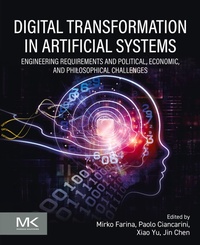
Digital Transformation in Artificial Systems
Engineering Requirements and Political, Economic, and Philosophical Challenges
Published on 16. February 2026
300 pages
978-0-443-32965-4 (ISBN)
Description

The last decade has seen exponential growth in the development of digital technologies. This has led to significant shifts in the political arena as well as in the economy, precipitating a series of revolutionary changes in the fabric of our societies, which have had far-reaching consequences and effects on the way we relate and connect to each other. Digital Transformation in Artificial Systems: Engineering Requirements and Political, Economic, and Philosophical Challenges focuses on analyzing the engineering requirements as well as the political consequences, overarching the philosophical and ethical implications of this transformation, especially in relation to its application in artificial systems. In this context, the concept of digital transformation (understood as the practice of redefining models, functions, operations, processes, and activities by leveraging technological advancements to build efficient digital environments) has become increasingly important. This book brings together key concepts, ideas, and frameworks related to this idea. It promotes an inclusive and responsible digital transformation capable of addressing the constraints on the global digital divide, deepening cooperation in digitization, industrialization, and innovation, while furthering our understanding of the ethical and moral challenges associated with such a development. The distinctive and most original element of the book is its interdisciplinarity. It will allow readers to gather crucial insights that will be instrumental to better understand the reach of the forthcoming AI revolution, its multidimensionality, and its potential impact on people and society.
- Provides a thorough exploration of digital transformation within artificial systems, covering key concepts, methodologies, and emerging trends
- Shows practical insights into implementing digital transformation strategies in artificial systems, with real-world examples and case studies illustrating successful applications
- Caters to a broad audience, including professionals, researchers, and students interested in understanding and implementing digital transformation in artificial systems
More details
Other editions
Additional editions
Mirko Farina | Paolo Ciancarini | Xiao Yu
Farina - Digital Transformation
Engineering Requirements and Political, Economic, and Philosophical Challenges
Book
approx. 02/2026
Morgan Kaufmann
€181.03
Not yet published
Content
PART A Engineering and politics1. The digital transformation of the public sector: The roles of the product owner2. Exploring new formulations for distributive fairness in intelligent decision-making3. The coevolution dilemma and the artificial intelligence paradox4. Navigating digital sovereignty within regional integration: A conceptual framework5. The reality of digital states6. Navigating the nexus of international order and artificial intelligence regulation: Divergent approaches and global governance implicationsPART B - Economy and philosophy7. Key factors for successful digital transformation in business organizations8. Unilateral sanctions in the cyber age: The impact on state sovereignty and human rights9. Digital transformation as a tool for integration in the Eurasian Economic Union10. From innovation to inaction: Why digital energy fails to empower citizens11. Balancing the scales: Understanding and addressing algorithmic gender discrimination12. Digital transformation and identity13. The critique of human-centered artificial intelligence: Why it is questionable and why it calls for a radical transformation of the human-artificial intelligence relationPART C - New frontiers14. The digitalization of the humanities: Recent trends and future prospects15. Digital transformation and propaganda in the large language models era16. Digital transformation in education: Higher education for everyone17. Criminal justice and artificial intelligence: A defense of the restricted application model for algorithmic sentencing support
