

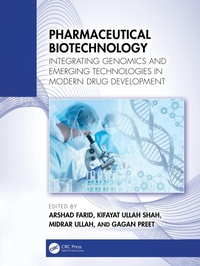
Pharmaceutical Biotechnology
Integrating Genomics and Emerging Technologies in Modern Drug Development
Published on 4. November 2025
236 pages
978-1-040-43299-0 (ISBN)
Description

This book examines the role of pharmaceutical biotechnology in modern drug development, highlighting recent advancements in genomics, biopharmaceuticals, and personalized medicine. It explores key molecular and genomic technologies that are revolutionizing drug discovery, design, and delivery. The introductory chapters describe the essential molecular biology techniques, including next-generation sequencing and CRISPR applications, gene editing, synthetic biology, and their role in drug discovery. Furthermore, the book explores pharmacogenomics as a link between genomics and drug response, while also covering the discovery, production, and commercialization of biopharmaceuticals. It provides an in-depth discussion on the role of bioinformatics in analyzing genomic data for drug development, along with genomic strategies for target identification, validation, and the discovery of biomarkers essential to modern drug development. The book also highlights advancements in personalized medicine, emphasizing the use of genomic data to tailor treatments for individual patients. It discusses the design and therapeutic applications of monoclonal antibodies and explores breakthroughs in cell and gene therapies, addressing their potential and the challenges associated with disease treatment.
Key Features:
Provides a historical and technological perspective on pharmaceutical biotechnology and genomics
Explores advanced molecular techniques, including CRISPR and next-generation sequencing, and their applications in drug discovery
Discusses pharmacogenomics and the role of biomarkers in enabling personalized medicine
Highlights emerging trends such as synthetic biology, gene editing, and biopharmaceutical development
Addresses ethical issues and challenges in genomic research and drug development
This book is intended for researchers and students of pharmaceutical sciences and biotechnology.
The Open Access version of this book, available at http://www.taylorfrancis.com, has been made available under a Creative Commons [Attribution-Non Commercial-No Derivatives (CC-BY-NC-ND)] 4.0 license.
Key Features:
Provides a historical and technological perspective on pharmaceutical biotechnology and genomics
Explores advanced molecular techniques, including CRISPR and next-generation sequencing, and their applications in drug discovery
Discusses pharmacogenomics and the role of biomarkers in enabling personalized medicine
Highlights emerging trends such as synthetic biology, gene editing, and biopharmaceutical development
Addresses ethical issues and challenges in genomic research and drug development
This book is intended for researchers and students of pharmaceutical sciences and biotechnology.
The Open Access version of this book, available at http://www.taylorfrancis.com, has been made available under a Creative Commons [Attribution-Non Commercial-No Derivatives (CC-BY-NC-ND)] 4.0 license.
More details
Language
English
Place of publication
London
United Kingdom
Publishing group
Taylor & Francis Ltd
Target group
Professional and scholarly
Illustrations
13 Tables, black and white; 25 Line drawings, color; 13 Halftones, color; 38 Illustrations, black and white
File size
8,07 MB
ISBN-13
978-1-040-43299-0 (9781040432990)
Copyright in bibliographic data and cover images is held by Nielsen Book Services Limited or by the publishers or by their respective licensors: all rights reserved.
Schweitzer Classification
Other editions
Additional editions
Arshad Farid | Kifayat Ulllah Shah | Midrar Ullah
Pharmaceutical Biotechnology
Integrating Genomics and Emerging Technologies in Modern Drug Development
Book
11/2025
1st Edition
CRC Press
€156.50
Shipment within 15-20 days
Persons
Dr. Arshad Farid, currently serving as an Assistant Professor at Gomal Center of Biochemistry and Biotechnology, Gomal University, D.I.Khan, Pakistan. He has around seventeen years of teaching and research experience. He has supervised seventeen M.Phil. research students and are mentoring several Ph.D. candidates. He has more than 100+ publications of International and National repute. The total cumulative Impact Factor of his published papers is more than 500+. His scientific activities are highly interdisciplinary, ranging from Medicinal Plants; Natural Product Chemistry; Herbal Drug Development; Ethnopharmacology to Nanotechnology, Drug delivery and Microbiology. He has served as editor for seven books that have been accepted for publication. He has also written more than 60 book chapters in Elsevier, Springer, Apple Academic Press and Wiley Publishers etc. He holds a notable count of 27 international patents (Germany, UK, Japan and South African etc.). Moreover, he has published more than 15 abstracts in national and international conference proceedings. He's contributed significantly to the scientific community by peer reviewing papers for more than 30 esteemed journals of MDPI, Elsevier, Springer and Wiley etc. Dr. Arshad was a fellow of the British Council-Charles Wallace Fellowship program at the University of Aberdeen, Scotland, UK, in 2023. Previously, he received a fellowship for "Training in the Environmental, Agricultural, and Analytical Chemistry Laboratory Techniques" from the Department of Chemistry, University of Glasgow, Scotland, UK, in 2007. He is also a Research Fellow of INTI International University, Malaysia, from 01 June 2023 to 31 December 2025.
Dr Kifayat Ullah Shah completed his PhD in Pharmaceutics from Universiti Teknologi MARA (UiTM), Malaysia in 2017. He is currently an Assistant Professor and Head of the "Particle Design and Drug Delivery Laboratory" at the Faculty of Pharmacy, Gomal University, D.I. Khan, Pakistan, with approximately sixteen years of teaching and research experience. He is active researcher in the field of particle design and drug delivery. Dr. Shah has successfully supervised 12 Master's and 4 PhD research students. He has published 40 articles in well-reputed journals and contributed several book chapters with various renowned publishers. Dr. Shah, has completed a research project titled "Novel Particulate Carrier Designs for Pulmonary Delivery of Anti-Tubercular Drugs" and has made significant contributions to the scientific community by peer-reviewing papers for many esteemed journals.
Dr. Midrarullah is an experienced academic and researcher, with over 19 years of teaching and research experience. He is currently serving as an Associate Professor in the Department of Biotechnology at Shaheed Benazir Bhutto University (SBBU), Pakistan. Dr. Midrarullah holds a PhD in Plant Biotechnology from the University of Peshawar, as well as an MPhil in the same field from Quaid-i-Azam University. Dr. Midrarullah's academic career is distinguished by his leadership in both teaching and administration. He has served in various key roles, including Chairman of the Biotechnology Department, Director of Advance Studies & Research, and Registrar of the University. He has also contributed significantly to the strategic planning and development of the university, including his leadership in committees related to admissions, curriculum development, and faculty management. In addition to his academic and administrative roles, Dr. Midrarullah has been deeply involved in research, with numerous publications in the field of Plant Biotechnology. His research has focused on topics related to sustainable agriculture, biotechnology applications in plant breeding, and environmental conservation. Dr. Midrarullah has supervised several MPhil and PhD students, contributing to the next generation of researchers and academics in biotechnology. He was honored with the Best University Teacher Award by the Higher Education Commission of Pakistan in 2015, and he has been nominated by both the British Council of Pakistan and the Ministry of Climate Change as a speaker at various international forums. His involvement in global training programs and conferences, including those in the United Kingdom, South Korea, and Iran, reflects his commitment to continuing professional development and fostering international collaboration.
Dr Gagan Preet has been serving as a Teaching Research Fellow at the Marine Biodiscovery Research Centre, University of Aberdeen, Aberdeen, Scotland, UK, since 2019. He is an expert in marine natural products research, with a strong background in chemistry and specialized expertise in computational chemistry relevant to drug design and discovery. In April 2023, Dr Preet was awarded a Postdoctoral Research Fellowship at the Marine Biodiscovery Centre, University of Aberdeen, UK. He collaborates with the National History Museum, the National Oceanography Centre, the University of South Pacific, and other institutions on the DEFRA, UK funded project DEEPEND. This project focuses on understanding the impacts of climate change and seabed mining on the ecology, microbiology, and chemistry of deep-sea biodiversity. Dr. Preet's role involves coordinating research efforts, compiling comprehensive chemical data on deep-sea biodiversity, and mapping this information. Additionally, Dr Preet's research includes the discovery of new molecules to target the Dengue Virus (a neglected tropical disease), Mucormycosis, and Type 2 Diabetes using computational and chemoinformatics approaches. He collaborates with other scientific laboratories to perform in vitro tests on the identified leads. Dr Preet's extensive laboratory research experience is invaluable in training PhD students and early-career researchers. His primary objective in academia is to actively engage in knowledge transfer and human capacity development through teaching, training, and mentoring students, fostering their development into excellent researchers, and continuously contributing to scientific knowledge with impactful and relevant outputs.
Dr Kifayat Ullah Shah completed his PhD in Pharmaceutics from Universiti Teknologi MARA (UiTM), Malaysia in 2017. He is currently an Assistant Professor and Head of the "Particle Design and Drug Delivery Laboratory" at the Faculty of Pharmacy, Gomal University, D.I. Khan, Pakistan, with approximately sixteen years of teaching and research experience. He is active researcher in the field of particle design and drug delivery. Dr. Shah has successfully supervised 12 Master's and 4 PhD research students. He has published 40 articles in well-reputed journals and contributed several book chapters with various renowned publishers. Dr. Shah, has completed a research project titled "Novel Particulate Carrier Designs for Pulmonary Delivery of Anti-Tubercular Drugs" and has made significant contributions to the scientific community by peer-reviewing papers for many esteemed journals.
Dr. Midrarullah is an experienced academic and researcher, with over 19 years of teaching and research experience. He is currently serving as an Associate Professor in the Department of Biotechnology at Shaheed Benazir Bhutto University (SBBU), Pakistan. Dr. Midrarullah holds a PhD in Plant Biotechnology from the University of Peshawar, as well as an MPhil in the same field from Quaid-i-Azam University. Dr. Midrarullah's academic career is distinguished by his leadership in both teaching and administration. He has served in various key roles, including Chairman of the Biotechnology Department, Director of Advance Studies & Research, and Registrar of the University. He has also contributed significantly to the strategic planning and development of the university, including his leadership in committees related to admissions, curriculum development, and faculty management. In addition to his academic and administrative roles, Dr. Midrarullah has been deeply involved in research, with numerous publications in the field of Plant Biotechnology. His research has focused on topics related to sustainable agriculture, biotechnology applications in plant breeding, and environmental conservation. Dr. Midrarullah has supervised several MPhil and PhD students, contributing to the next generation of researchers and academics in biotechnology. He was honored with the Best University Teacher Award by the Higher Education Commission of Pakistan in 2015, and he has been nominated by both the British Council of Pakistan and the Ministry of Climate Change as a speaker at various international forums. His involvement in global training programs and conferences, including those in the United Kingdom, South Korea, and Iran, reflects his commitment to continuing professional development and fostering international collaboration.
Dr Gagan Preet has been serving as a Teaching Research Fellow at the Marine Biodiscovery Research Centre, University of Aberdeen, Aberdeen, Scotland, UK, since 2019. He is an expert in marine natural products research, with a strong background in chemistry and specialized expertise in computational chemistry relevant to drug design and discovery. In April 2023, Dr Preet was awarded a Postdoctoral Research Fellowship at the Marine Biodiscovery Centre, University of Aberdeen, UK. He collaborates with the National History Museum, the National Oceanography Centre, the University of South Pacific, and other institutions on the DEFRA, UK funded project DEEPEND. This project focuses on understanding the impacts of climate change and seabed mining on the ecology, microbiology, and chemistry of deep-sea biodiversity. Dr. Preet's role involves coordinating research efforts, compiling comprehensive chemical data on deep-sea biodiversity, and mapping this information. Additionally, Dr Preet's research includes the discovery of new molecules to target the Dengue Virus (a neglected tropical disease), Mucormycosis, and Type 2 Diabetes using computational and chemoinformatics approaches. He collaborates with other scientific laboratories to perform in vitro tests on the identified leads. Dr Preet's extensive laboratory research experience is invaluable in training PhD students and early-career researchers. His primary objective in academia is to actively engage in knowledge transfer and human capacity development through teaching, training, and mentoring students, fostering their development into excellent researchers, and continuously contributing to scientific knowledge with impactful and relevant outputs.
Content
Chapter 1: Introduction to Pharmaceutical Biotechnology. Chapter 2: Fundamentals of Genomics. Chapter 3: The Human Genome Project: Impacts on Drug Development. Chapter 4: Molecular Biology Techniques in Drug Development. Chapter 5: Genomic Technologies: Next-Generation Sequencing and CRISPR Applications. Chapter 6: Emerging Biotechnologies: Gene Editing and Synthetic Biology. Chapter 7: Pharmacogenomics: Bridging Genomics and Drug Response. Chapter 8: Biopharmaceuticals from Discovery to Market. Chapter 9: Role of Bioinformatics in Analyzing Genomic Data for Drug Development. Chapter 10: Target Identification and Validation Through Genomic Approaches. Chapter 11: Biomarkers and Their Role in Modern Drug Development. Chapter 12: Personalized Medicine Using Genomic Data. Chapter 13: Design and Therapeutic Applications of Monoclonal Antibodies. Chapter 14: Advancements and Challenges in Cell and Gene Therapies for Disease Treatment. Chapter 15: Ethical Issues in Genomic Research and Drug Development. Chapter 16: Nanotechnology in Drug Delivery for Emerging Therapeutic Efficacy. Chapter 17: The Role of Artificial Intelligence in Pharmaceutical Biotechnology. Chapter 18: Future Direction in Pharmaceutical Biotechnology.
