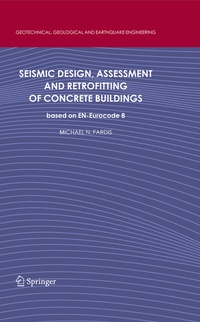
Seismic Design, Assessment and Retrofitting of Concrete Buildings
Description

Reflecting the historic first European seismic code, this professional book focuses on seismic design, assessment and retrofitting of concrete buildings, with thorough reference to, and application of, EN-Eurocode 8. Following the publication of EN-Eurocode 8 in 2004-05, 30 countries are now introducing this European standard for seismic design, for application in parallel with existing national standards (till March 2010) and exclusively after that. Eurocode 8 is also expected to influence standards in countries outside Europe, or at the least, to be applied there for important facilities. Owing to the increasing awareness of the threat posed by existing buildings substandard and deficient buildings and the lack of national or international standards for assessment and retrofitting, its impact in that field is expected to be major.
Written by the lead person in the development of the EN-Eurocode 8, the present handbook explains the principles and rationale of seismic design according to modern codes and provides thorough guidance for the conceptual seismic design of concrete buildings and their foundations. It examines the experimental behaviour of concrete members under cyclic loading and modelling for design and analysis purposes; it develops the essentials of linear or nonlinear seismic analysis for the purposes of design, assessment and retrofitting (especially using Eurocode 8); and gives detailed guidance for modelling concrete buildings at the member and at the system level. Moreover, readers gain access to overviews of provisions of Eurocode 8, plus an understanding for them on the basis of the simple models of the element behaviour presented in the book.
Also examined are the modern trends in performance- and displacement-based seismic assessment of existing buildings, comparing the relevant provisions of Eurocode 8 with those of new US prestandards, and details of the most common and popular seismic retrofitting techniques for concrete buildings and guidance for retrofitting strategies at the system level. Comprehensive walk-through examples of detailed design elucidate the application of Eurocode 8 to common situations in practical design. Examples and case studies of seismic assessment and retrofitting of a few real buildings are also presented.
From the reviews
:
"This is a massive book that has no equal in the published literature, as far as the reviewer knows. It is dense and comprehensive and leaves nothing to chance. It is certainly taxing on the reader and the potential user, but without it, use of Eurocode 8 will be that much more difficult. In short, this is a must-read book for researchers and practitioners in Europe, and of use to readers outside of Europe too. This book will remain an indispensable backup to Eurocode 8 and its existing Designers' Guide to EN 1998-1 and EN 1998-5 (published in 2005), for many years to come. Congratulations to the author for a very well planned scope and contents, and for a flawless execution of the plan".
AMR S. ELNASHAI
"The book is an impressive source of information to understand the response of reinforced concrete buildings under seismic loads with the ultimate goal of presenting and explaining the state of the art of seismic design. Underlying the contents of the book is the in-depth knowledge of the author in this field and in particular his extremely important contribution to the development of the European Design Standard EN 1998 - Eurocode 8: Design of structures for earthquake resistance. However, although Eurocode 8 is at the core of the book, many comparisons are made to other design practices, namely from the US and from Japan, thus enriching the contents and interest of the book". EDUARDO C. CARVALHO
Reviews / Votes
Endorsements:
". this is a massive book that has no equal in the published literature, as far as the reviewer knows. It is dense and comprehensive and leaves nothing to chance. It is certainly taxing on the reader and the potential user, but without it, use of Eurocode 8 will be that much more difficult. In short, this is a must-read book for researchers and practitioners in Europe, and of use to readers outside of Europe too. This book will remain an indispensable backup to Eurocode 8 and its existing Designers' Guide to EN 1998-1 and EN 1998-5 (published in 2005), for many years to come. Congratulations to the author for a very well planned scope and contents, and for a flawless execution of the plan". AMR S. ELNASHAI.
"The book is an impressive source of information to understand the response of reinforced concrete buildings under seismic loads with the ultimate goal of presenting and explaining the state of the art of seismic design. Underlying the contents of the book is the in-depth knowledge of the author in this field and in particular his extremely important contribution to the development of the European Design Standard EN1998 - Eurocode 8: Design of structures for earthquake resistance. However, although Eurocode 8 is at the core of the book, many comparisons are made to other design practices, namely from the US and from Japan, thus enriching the contents and interest of the book ...". EDUARDO C. CARVALHO.
More details
Other editions
Additional editions